
CHAPTER 1: THE FRICTION OF PERIMETERS
The wind off the flats tasted of iron filings and dry clay, the kind of heat that didn’t just sit on a man’s shoulders but dug into the small of his back like a blunt spade. Thomas “Mac” McCall adjusted the brim of his black veteran cap, the fabric thin and stiffened by twenty years of salt sweat and laundry starch. His fingers, wide-knuckled and scarred across the right thumb from an old winch snap, pressed into the rough edges of the single manila envelope tucked under his arm. The paper was crisp, too white for this valley, bearing the blue ink of an administrative order he intended to contest.
Before him, the perimeter gate of Fort Meade didn’t swing; it slid on heavy, grease-blackened tracks with a low, hydraulic groan that vibrated through the soles of his old boots. The modern world didn’t use guards with clipboards anymore. There was a gray pillar, housing an optical lens that pulsed with a dull, infrared rhythm.
“Card unreadable,” a synthetic voice flatly stated from a small grille beneath the lens. “Re-insert credential or present secondary verification.”
Mac didn’t move his hand from his side immediately. He let his gaze settle on the camera lens, seeing his own white beard reflected as a small, silver smudge in the curved glass. The young private three paces back—a kid with a chest like a fence post and a digital camouflage uniform that looked like it had never seen a grease pit—shifted his weight. The carbine slung across the boy’s chest clinked against his tactical vest, a sharp, metallic tick that Mac’s ears registered before his mind did.
“System’s picky about the old barcodes, sir,” the private said. His voice was polite but thin, the tone of someone dealing with a stalled vehicle on a busy highway. “If it doesn’t take the chip, I have to log you as a civilian visitor. That means the logistics lane. You’ll be waiting until the noon convoy clears.”
Mac didn’t turn his head. He kept his eyes on the glass eye of the gate. “The chip is good, son. It’s just the reader’s lens is coated in limestone dust from the quarry trucks down the road. It can’t see the depth of the groove.”
He reached into his pocket, his movements deliberate and slow, ensuring the private could see every inch of his arm. He drew out a small, oil-stained brass thumbnail tool—a pocket spacer from his days with the 4th Engineers. With a steady hand that belied the dull ache in his shoulder, he scraped the edge of the tool across the scanner’s glass screen, clearing a thin line through the baked-on gray grit.
He slid the card in again. The mechanism clicked, a heavy iron bolt releasing somewhere inside the housing with a sound like a hammer striking an anvil. The gate shuddered open three inches.
“Go on through,” the private murmured, his posture relaxing just enough to let the rifle swing free. “But the administrative office moved over to the old motor pool grid, sir. It’s a mile walk past the fuel bladders. Most people take the shuttle.”
“The shuttle has a hydraulic leak in the front seal,” Mac said, his voice gravel-dry and low. “I could smell the fluid from the highway. I’ll take the dirt path along the wire.”
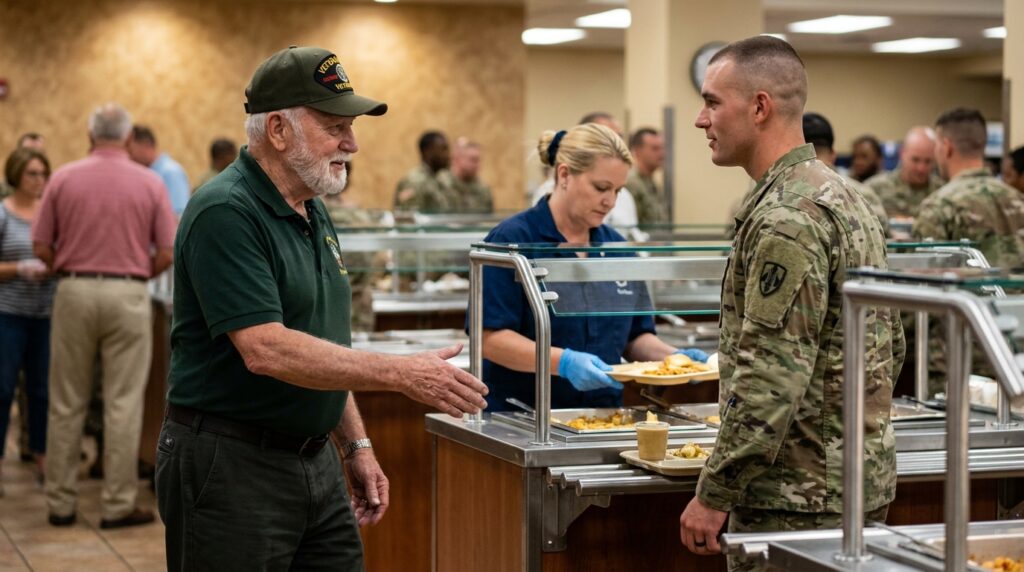
He stepped through the gap before the gate could fully cycle, his boots crunching into the crushed gravel of the interior perimeter. The air inside smelled different—more diesel, more hot copper, the scent of an engine being run past its hours. He didn’t look back at the private or the lens. He looked toward the long, low silhouette of the dining facility in the distance, where the corrugated roof shimmered under the midday sun like water on a hot skillet. His knee clicked with every third stride, a rhythmic reminder of a bridge that had come down too fast in ’72, but his grip on the envelope didn’t loosen.
The dust here was older than the buildings, but it still held the same weight.








