
CHAPTER 10: THE TRUE BEARING
The water did not retreat so much as it found its proper level, draining down the historical sluice with a long, hollow gurgle that sounded like an old machine finally settling into its housing. The six-inch wall of gray, silt-choked river water that had threatened the facility was gone, reduced to a thin, shimmering skin of dark moisture that coated the linoleum and filled the tray tracks with coarse river sand.
Mac did not shake the dampness from his boots. He remained standing at the center rail, his palms flat against the cold stainless steel, his thumbs tracing the deep longitudinal scores ground into the metal by decades of service. The yellowed blueprint from 1976 remained pinned beneath his hand, its edges dark and translucent from the flood, yet the blue surveyor lines remained sharp, mapping out the stone under-structure that had just saved the quadrant from its own efficiency.
Captain Miller stood entirely still against the gray partition wall, her clean blue uniform trousers splattered with mud up to the knee. Her black clipboard was lowered to her side, her fingers loose against the plastic edge. The small digital receipt marked SURPLUS CLEARANCE DIVESTMENT had unglued from the plastic backing in the rush, sliding down into the silt near her heel where it lay unreadable, an administrative ghost drowned by forty years of buried runoff. Her shoulder handset had stopped its three-tone pulse; the automated network had gone completely quiet, unable to log a structural recovery that had been executed without an entry code.
“The staging pad’s stabilized,” the security sergeant muttered, his boots making a heavy, leaden slosh as he stepped back from the open kitchen portal. He looked down at the hand-stamped leather insignia on his own old utility belt, then lifted his eyes to the weapons platoon specialist who was still holding the five-foot steel pinch-bar. “The regional desk just updated the grid status. The pressure indicators in bay three are dropping back to the white line. The water’s out of the grease pits.”
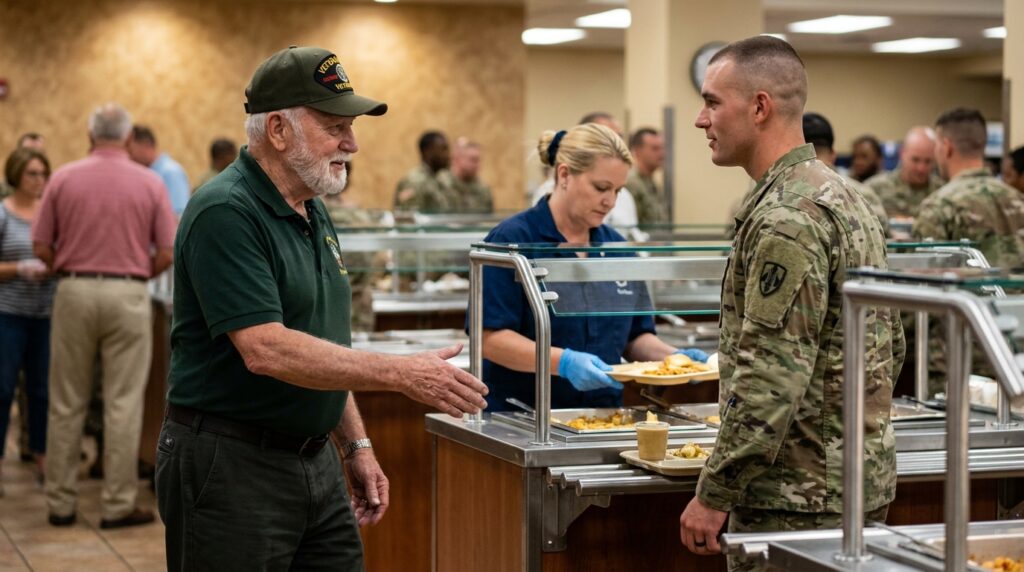
The specialist did not drop the bar. He turned toward Mac, his face still gray with the limestone dust of the outer wire, but his posture had broken from the rigid, metric-driven distance of the modern queue. He took two steps through the thin mud, his thick, grease-stained gloves coming together over the metal counter as he reached out toward the old engineer.
“Good to see you, son,” Mac said, his voice dropping into that gravelly, deeply restrained tone that carried no anger, only the timeless weight of a man who had spent his life ensuring the line didn’t break. “Looks like they’re keeping you busy.”
The young soldier didn’t respond with a formal military salute or an administrative acknowledgement. He reached across the silver food track, his thick arms closing around Mac’s slight, weather-beaten shoulders in a deep, unvarnished embrace that broke every line of garrison protocol. The rough canvas of his field jacket ground against the green cotton of Mac’s polo shirt, the small, oxidized brass castles pinned to Mac’s collar pressing into the kid’s tactical vest like an anchor finding its seat in the mud.
The entire dining hall froze. The forty junior soldiers waiting in the stalled column lowered their arms, their eyes locked onto the center counter where the old civilian and the active-duty troop held the connection. The cafeteria worker behind the glass stood mid-motion, her hand resting on the rim of the empty potato insert, the fluorescent glare above casting the reflection of the embrace across the polished silver tracks like a shadow on old iron.
Mac held the young man for three long breaths, his bare hand patting the wet fabric of the kid’s shoulder webbing, feeling the solid, human heat beneath the damp gear.
“I’m proud of you,” Mac whispered into the gray dust of the specialist’s collar, his voice holding the slow, unmistakable certainty of the old battalion lore. “Keep taking care of each other. The stone’s still there under the mud, but you’ve got to keep the ditch clear.”
The specialist pulled back slowly, his eyes bloodshot from the field but clear of the exhaustion that had slumped his shoulders ten minutes prior. His knuckles tightened on the handle of his slung carbine, his chin rising into a true, unmanaged line of respect.
“Thank you, sir,” the kid said, his voice cracking slightly against the roar of the water fading in the sub-floor channels. “That means a lot. More than the ledger.”
Miller did not raise her pen. She watched the specialist step back into the yellow tactical lane, his boots aligned perfectly with Mac’s old prints in the sand. The red LED throughput counter above her head flickered once, then died out entirely, leaving the wall blank. She looked at Mac’s faded veteran cap—the black fabric salt-stained and low on his head—and for the first time since the gate had recycled, she did not demand his digital credentials. She simply shifted her clipboard to her left arm, her fingers covering the stenciled project marker as she stepped backward into the shadow of the administrative corridor, leaving the line to find its own velocity.
Mac folded the wet blueprint with deliberate care, the linen heavy and cold against his wide knuckles. He tucked the sheet back into the damp manila envelope, smoothed the paper down against his hip, and turned toward the aluminum transition strip at the exit. The walk back past the fuel bladders would be long, and his knee would click with every third stride through the limestone dust, but as he pushed open the heavy outer door, the wind off the flats tasted less like iron filings and more like the open ridge.








