
CHAPTER 5: THE BOTTLENECK
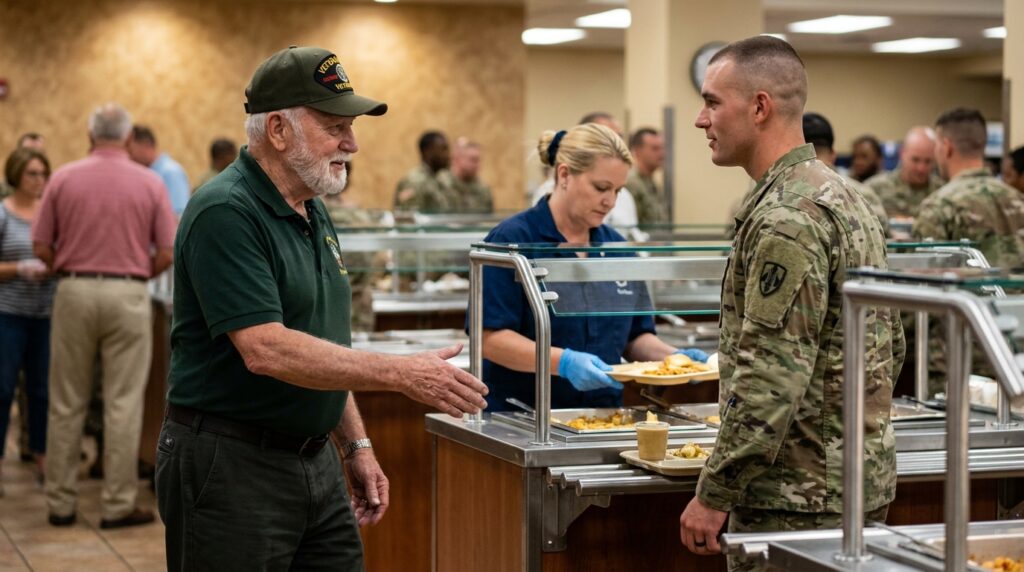
The steel rail beneath Mac’s palm vibrated with a rhythmic, high-efficiency thrum. Behind him, thirty sets of heavy, mud-caked combat boots ground to an abrupt halt against the gray non-skid flooring. The sudden silence that rippled through the weapons platoon was heavy, filled with the dull clink of tactical buckles and the coarse, uneven breathing of men who had spent twelve hours digging gun pits in the limestone flats.
“Sir, you are creating a structural delay in the primary serving lane,” Captain Miller’s voice snapped from behind his right shoulder. Her steps were rapid, a sharp, metallic sequence of heel-strikes that ended right at the lip of the stainless steel counter. She didn’t look at the soldiers waiting in the stalled queue; her eyes were locked onto the small digital overhead monitor that displayed the real-time throughput numbers. The digital counter had just dropped from forty-four to zero.
Mac didn’t lift his fingers from the metal track. He leaned his weight forward, his chest inches from the thick sneeze-guard glass that separated the active troops from the industrial ladles. “I’m getting a cup of coffee, Captain. The gate guard said the pot was always on for the regiment.”
“The regiment operates on an automated sustenance schedule, Mr. McCall. We do not maintain open-pot hospitality for unverified civilians during active company rotations,” Miller said, her black clipboard cutting through the steam rising from the sausage inserts. Her pen hovered over the top page, her fingers turning white from the force of her grip. “Look behind you. You are holding up an entire deployment element. Every thirty seconds this line remains stationary costs the transport pool four hundred gallons of idling fuel at the staging pad.”
Mac turned his head slowly, his weathered features catching the harsh reflection of the overhead fluorescent panels. The young specialist immediately behind him was six feet two, his face gray with limestone dust and his knuckles raw from cold iron. The kid’s eyes weren’t angry; they were dead-tired, staring at the old unit patch pinned to Mac’s dark green polo shirt with a faint, unreadable detachment.
“You tired, son?” Mac asked, his voice low and scraping like gravel turned over by a spade.
The specialist didn’t answer. He adjusted the nylon strap of his carbine, his jaw working a piece of flavorless gray gum. In the modern line, junior troops didn’t speak to civilians when a company officer was within four paces. The discipline was rigid, but to Mac, it smelled like exhaustion.
“He doesn’t have time to answer you,” Miller intervened, her voice rising an octave to cut through the low drone of the facility’s HVAC system. “And you don’t have the authority to interrogate my personnel. Step out of the queue into the management corridor immediately, or I will have the automated gate locks engaged. We are on a twenty-two-minute rotation.”
A faint, high-frequency tone pulsed from the small communications handset clipped to Miller’s shoulder strap. Pip… pip… pip. It was the specific alert frequency of the base’s regional development office—the same office that had issued the digital clearance notice tucked inside Mac’s crumbling manila envelope. The sound was rhythmic, consistent, and completely mechanical, vibrating against her crisp blue fabric like an insect trapped in a jar.
Mac looked at the handset, then back to the stenciled code on the rear of her clipboard: RE-EXP-GRID-44-B. The pieces didn’t fit the story she was telling about efficiency. A dining facility manager didn’t get direct telemetry updates from the engineering expansion grid unless the space beneath her feet was part of the ledger.
“You’re clearing the old redoubt because the foundations are granite,” Mac said, his words falling flat and heavy into the space between them. “The new drone tracks need six feet of solid stone to anchor the magnetic charging loops, and the creek bed is too soft. You aren’t managing a lunch line, Captain. You’re clearing the sector’s history before the contractors arrive on Monday.”
Miller’s face went entirely still. The pen in her hand stopped its nervous clicking. The junior troops in the queue didn’t move, but the air in the immediate three feet around the counter became thin, pressurized by an unstated realization. She didn’t deny it; she simply slid her thumb down the side of her clipboard, covering the stenciled lettering with her palm.
“The expansion of the base infrastructure is an open-source project approved by the regional department,” she said, her voice dropping into a transactional whisper that didn’t carry past the specialist’s ears. “But your paperwork won’t stop the machinery, Mr. McCall. The final signatures were logged into the main system at midnight. The old post is dead weight. Now, clear the lane.”
Mac’s hand remained on the rail, his skin looking like old, tanned leather against the polished silver of the counter. “The post isn’t weight, Captain. It’s the only thing keeping this hill from sliding into the flats when the October rains come. We built those retaining walls with dry-stack limestone because concrete cracks when the valley shakes. Your automation isn’t going to hold the mud.”
“That’s for the engineers to determine,” Miller said, her fingers reaching toward her handset. “Security, this is Quadrant Three Hub. I have an administrative bottleneck at the primary serving line. Requesting an extraction team to the civilian corridor.”
The cafeteria worker behind the counter, a woman with pale hair tied back under a blue net, froze mid-scoop, her industrial spoon hovering two inches above a tray of steaming potatoes. The metal track remained cold, the line remained stationary, and the low, mechanical pip from Miller’s radio continued to measure the seconds of their standstill.








