
CHAPTER 7: THE REVERBERATION LANE
The concrete beneath the serving line didn’t just thrum anymore; it groaned. A low-frequency harmonic vibration traveled up the stainless-steel tray tracks, through Mac’s palms, and anchored itself squarely in his collarbone. Far out past the secondary perimeter fence, the weight of the driverless rigs was already beginning to find the soft under-crust where the sub-grade gravel met the ancient limestone aquifer.
“Step away from the counter, Specialist,” Captain Miller said, her tone no longer detached. It had reached the sharp, dry register of a cable pulling too tight under a winch. She took a half-step toward the young soldier, her black clipboard slanting downward like a wedge meant to pry him out of the lane. “You’ve been out on the perimeter wire too long. Your telemetry has already been logged for the 1300 transport cell. If you miss your window because of an unauthorized exchange, your name goes directly to the company commander’s desk.”
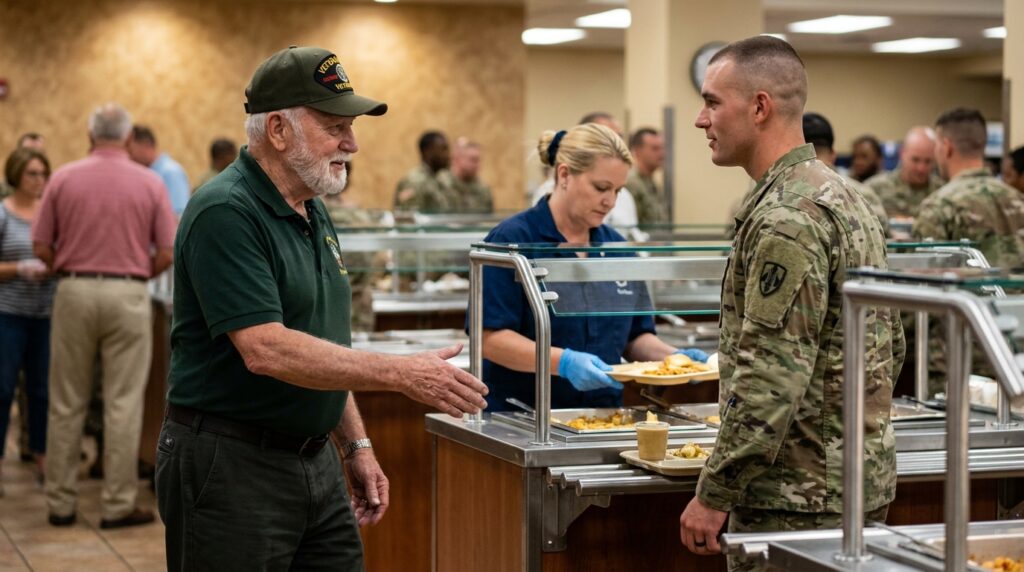
The specialist didn’t pull back his tray. The gray polymer under his hands creaked, the friction of his wet, mud-caked gloves leaving thick streaks of gray grease along the polished lip of the metal line. He looked at Mac, completely ignoring the captain’s clipboard.
“The old retention wall by the south culvert,” the kid said, his voice flat, dry, and gravel-edged from the limestone dust. “The engineers who built it left a mark on the cornerstone. A set of crossed towers with a number four stamped right into the center of the iron plate. My grandfather had that same stamp on a leather tool belt in his workshop.”
“We forged those plates out of old boiler scrap behind the depot,” Mac said, his words falling slow and heavy between the clatter of plastic cups at the far end of the hall. “We didn’t have the budget for brass, so we used what the rail yard left behind. If that foundation is shifting now, it means your automated drainage loops are backing up water into the dry-stack stone. The wall isn’t failing because it’s old, son. It’s failing because it’s being choked.”
“That’s enough,” Miller snapped. She turned her torso completely, her arm extending as she slammed the edge of her clipboard down onto the metal track right between Mac’s old knuckles and the specialist’s tray. The sharp clack of plastic against steel echoed through the immediate three tables, causing a group of junior supply clerks to look up from their ration bowls. “This is an active military installation dining facility, not a regimental reunion. Security is already clearing the corridor. Mr. McCall, you have precisely ten seconds to remove your hands from this rail before I have the MPs file a formal interference charge under section twelve.”
Mac looked down at her clipboard. In the harsh glare of the fluorescent tubes, the white paint marker notation—RE-EXP-GRID-44-B—was perfectly visible between her fingers. Just below it, a small digital receipt from the base commander’s engineering account showed a balance allocation transfer that didn’t match standard maintenance line items. It was marked SURPLUS CLEARANCE DIVESTMENT.
The decoy secret was right there, printed on thermal paper: they weren’t just clearing the old timber fort for a drone loop. They were treating the entire historic regiment’s acreage as a fiscal asset to be cleared, liquidated, and converted into modern automated infrastructure credits before the congressional audit team arrived in the fall. The administrative machinery wasn’t broken; it was working exactly as intended, using Miller’s efficiency metrics to starve out the last physical remnants of the line’s history.
“You’re running the clock to hide the ledger, Captain,” Mac said softly, his voice remaining below the noise of the room but holding a weight that made the cafeteria worker behind the glass lower her head to look through the sneeze-guard. “You need the company out of the bay and onto the trucks before the water comes through the foundation of bay three. Because if the staging area floods before the clearance order is logged, the regional department pulls the funding for the entire quadrant.”
Miller’s face lost its remaining color, the skin around her nostrils turning the same dull, desaturated gray as the linoleum floor. Her hand didn’t move toward her radio this time. It stayed flat on the clipboard, her fingers pressing into the paper until the clearance receipt began to crinkle.
Before she could speak, the double-leaf doors at the far end of the kitchen line shrieked open.
Two base security personnel—not the young gate guards, but senior non-commissioned officers wearing the heavy, black tactical vests of the garrison provost—stepped into the service alley. Their boots didn’t squeak; they had the dull, heavy thud of leather that had been oiled until it was dead to the air. The lead sergeant carried a thick nylon restraint bundle at his belt, his eyes immediately scanning the line until they indexed Mac’s faded veteran cap.
“Quadrant Three Manager,” the lead sergeant called out, his voice cutting through the hum of the steam tables like a circular saw hitting a knot in the pine. “Identify the bottleneck.”
Miller didn’t answer immediately. She looked at Mac, then flicked her eyes toward the specialist, whose boots hadn’t shifted an inch from the yellow tactical line. The entire weapons platoon behind them was silent now, a dense, dark ridge of camouflage and wet canvas that had stopped moving entirely. The high-start velocity of her forty-four-plates-per-minute line had collapsed into a complete physical standstill, the red LED counter above the counter flashing 00 like a warning light on a stalled engine.
Mac didn’t look at the guards. He reached into his dark green shirt pocket, his thick fingers drawing out the original 1976 blueprint sheet from the manila envelope, unfolding the stiff, yellowed linen right over the stainless-steel track, directly on top of her asset clearance manifestation.
“The main drainage valve is four feet beneath the kitchen floorboards, Captain,” Mac said, pointing to a small, faded blue ink circle on the old linen. “Right under that non-regulation steel drop-bolt on your security door. If you don’t drop that bolt and clear the silt by hand in the next ten minutes, you won’t need security to clear this room. The back-pressure from the creek is going to take out your whole automated serving line from the bottom up.”
The lead security sergeant stopped five paces away, his hand resting on his utility belt, his eyes dropping to the faded regimental markings on the linen map.








