
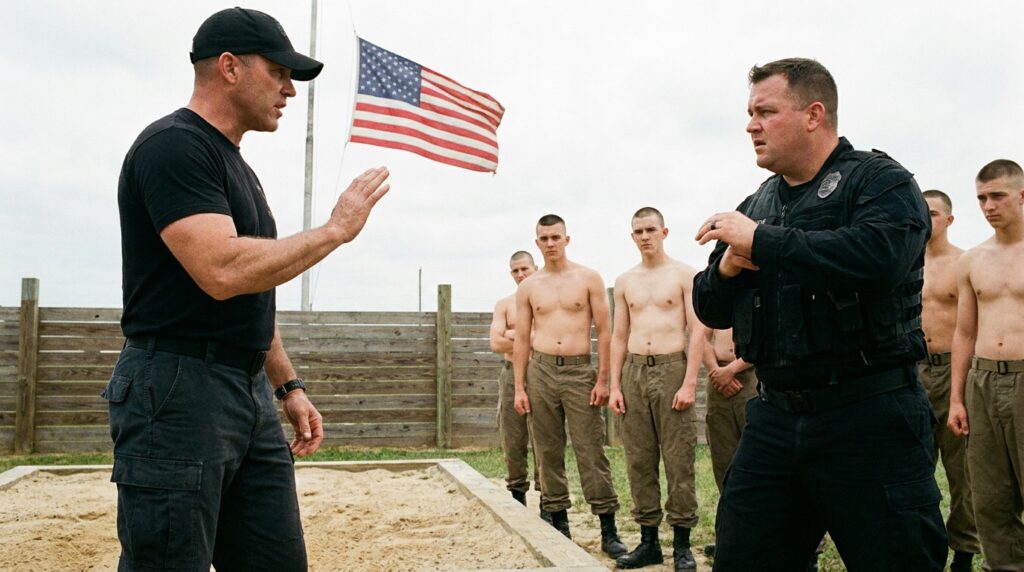
CHAPTER 8: THE HORIZON REVERSAL
The twin halogen beams of the approaching utility vehicle didn’t just illuminate the dust; they sliced it into vibrating, translucent panes of white glass. The glare struck the western face of the armory, casting the sharp, interlocking shadows of the chain-link equipment cage across the sand pit like a web of cold iron.
The black sedan stopped exactly four inches short of the sand’s northern lip. Its engine didn’t die with a vibration; it shut down into an immediate, mechanical vacuum that left only the high-pitched, metallic sizzle of its exhaust manifolds cooling in the night air.
Colonel Vance stepped out from the concrete entryway of the lower bunker’s drainage shack. His tactical vest was unbuttoned at the ribs, the heavy nylon panels flaring out like broken wings. He held his command tablet by its rubberized corner, the screen dead, its power supply drained by the manual file-deletion loop he had left churning in the dark. His face was entirely gray under the sodium lamps, his skin showing the fine, white tracking lines of sweat that had dried under the pressure of his haste.
“The terminal is locked,” Vance said, his voice carrying an empty, paper-thin resonance across the sand. He didn’t look at Shane. He looked at the rear bumper of the sedan. “The transmission code was verified by the regional server before the circuit went cold. The historical index is gone, Instructor. The registry is clean.”
The sedan door opened.
The sound of the latch was a heavy, precise click that Shane registered with the same part of his mind that timed the reset pin on his stopwatch. A single combat boot—old leather, polished until the surface reflected the blue twilight like wet coal—struck the gravel path.
The man who stepped into the light was in his late sixties. He didn’t wear a tactical vest or an administrative uniform. He wore a crisp, olive-drab utility jacket with four stars pinned to the collar points—insignia that were slightly tarnished at the edges, showing the dull, greasy patina of forty years of continuous command. His face was a map of deep, angular lines, his mouth set in a permanent, flat line that matched the stone foundation of the facility’s main gate.
General Albright didn’t look at Vance. He didn’t look at Lieutenant Harris, who had dropped his tablet into the dirt by the truck tire. His gaze moved across the twelve recruits, tracing the olive-drab utility tape wrapped around their bare ankles, measuring the stillness of their shoulders as they stood with their iron-weighted rifles held at the low-ready.
“The transport detail is holding at the outer mile marker, General,” Vance said, stepping forward, his boots dragging through the loose sand as he tried to perform a formal presentation posture. “The civilian contractor has been notified of his non-compliance under the administrative review. We are ready to begin the perimeter encasement.”
Albright stopped at the very edge of the pit, exactly where the sand met the hard clay shelf. He slowly lifted his right hand, his fingers straight, his palm striking the brim of his starched utility cap in a clean, sharp arc that cut through the lateral glare of the headlights.
He didn’t salute Vance. He didn’t address the active-duty command.
The General’s eyes were locked on the white fragmentation scar under Shane’s jaw. He held the salute for three full seconds, his body as rigid as the iron posts stacked on the flatbed behind them.
“The unit is assembled, Commander,” Albright said, his voice dropping into the sand with the heavy, unyielding mass of an operational directive from ninety-eight. “The Fort Meade audit has been moved up forty-eight hours. The manifests were retrieved from the redundant satellite array before your terminal executed the erase command, Colonel.”
Vance’s hand dropped from his belt line. His command tablet slipped from his fingers, hitting his boot before tumbling into the red earth, the glass face cracking into a dozen sharp, silver slivers that caught the light of the floodlamps. “The array… the array was decommissioned during the logistics review, sir. The index was scrubbed.”
“The index was duplicated,” Shane said. He took his hand out of his cargo pocket, his palm opening to reveal the black plastic encryption key with the SF-EX-09 serial etched into its base. The brass pins caught the halogen glare, gleaming like fresh copper against his calloused skin. “A system operator only checks the network lines, Vance. A soldier remembers where the backup wire is buried.”
Albright lowered his hand, his mouth tightening until the lines around his chin hardened into iron. “Take your lieutenant and report to the transport carrier at the gate, Colonel. Your administrative assignment is being re-binned to the regional personnel depot. In Alaska.”
Vance didn’t answer. He didn’t pick up his broken tablet. He turned on his heel, his boots churning through the sand, destroying the last remnants of the boundary line he had tried to draw. Harris followed two paces behind, his head down, his uniform smelling of cold sweat and administrative ruin as they disappeared into the blue shadow of the pine line.
Shane stood alone at the center of the pit. He looked down at the mechanical stopwatch in his palm, his thumb pressing the reset button one final time. Click. The silver hand snapped back to zero, perfectly still, perfectly quiet.
The evening wind rose from the valley, catching the heavy canvas of the garrison flag behind them. It gave one final, violent snap against the structural post—a sound like a single rifle shot echoing across an empty range—before settling into the cold, clean silence of the night.








