
CHAPTER 3: THE PIT AND THE BOUNDARY
The dust didn’t settle so much as it crystallized. By late afternoon, the heat bouncing off the red Georgia clay left a bitter, metallic tang in the back of the throat, the kind that reminded Shane of burning battery casings and damp wool blankets from ninety-eight.
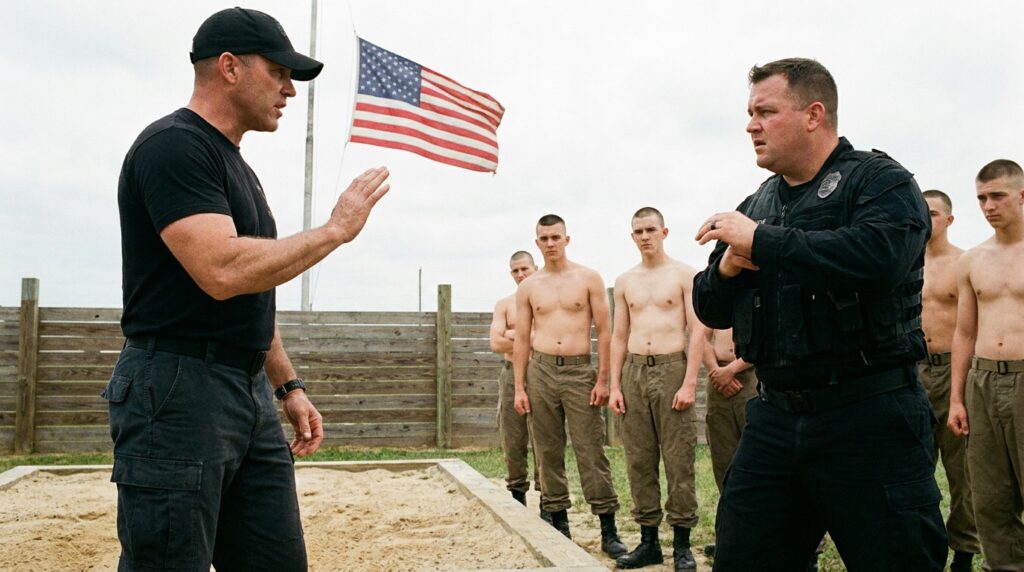
He didn’t use the desk anymore. Instead, he took his seat on an inverted wooden crate at the exact southern edge of the sand pit, his back flat against the structural post that held up the non-branded garrison flag. The heavy canvas was silent now, hanging limp like a gray shroud under the weight of the cooling, stagnant air. His thumb traced the small bevel on the back of his mechanical stopwatch—three rhythmic strokes, pause, repeat. It was a muscle memory born in dark holds, calculating seconds when light was a luxury.
“Sir,” Miller said. The recruit had his boots off, sitting on the clay embankment five yards away. His socks were gray with dried sweat, the skin around his Achilles tendons white and swollen where the damp sand had chewed through the weave. “The Lieutenant didn’t log our pull-ups. I saw him skip the entry on the tablet.”
Shane didn’t shift his gaze from the far tree line, where the pines grew too close together, blocking out the light from the state highway. “The ledger doesn’t care about your grip, Miller. Your tendons do.”
“But if it isn’t in the system,” another recruit murmured from the shadow of the water buffalo trailer—a lean kid named Cross whose ribs looked like the slats of an old fruit crate—”Colonel says we don’t get the operational credit. He told the transport detail we’re unquantified data.”
“Let him talk,” Shane said. His voice was flat, dropping down into the sand where the heat still lingered. “A man who builds a wall around a pit usually forgets to check the depth. Focus on the stance.”
The sound of an ungreased axle cut through the pine line. It was a sharp, screeching groan that made every recruit stiffen, their eyes turning instantly toward the north gate. The vehicle wasn’t the regular supply truck. It was a short-wheelbase utility carrier, its flatbed packed with stacked bundles of gray iron posts, each one wrapped in heavy steel wire that rattled against the chassis like dry bones.
Colonel Vance got out before the engine died. He didn’t close the cab door; he left it swinging, its window glass catching the late sun and casting an aggressive, shifting glare across the sand. He didn’t have Harris with him this time. He carried his own clipboard—not the standard digital screen, but a stiff aluminum folder with a heavy spring-clip that held down three thick sheets of legal-sized cream bond paper.
“Clear the pit,” Vance said, walking toward the southern boundary with a rhythmic, heavy-booted stride that ignored the loose stones. He didn’t look at the recruits. His eyes were locked on the structural post behind Shane’s shoulder. “The survey team marked the new coordinates from the highway easement. This section is being re-binned for vehicle maintenance storage.”
Shane didn’t stand up from the crate. He let his arms rest across his knees, the black cap brim dropping down until Vance’s boots were the only visible anchor in his field of vision. “The sand requires sixty days of settling after a dry spell, Colonel. If you drop steel rails into the subsoil now, the drainage will backup into the lower bunker by November.”
“There won’t be a lower bunker by November,” Vance said, stopping two inches from the edge of the pit where the sand transitioned into hard clay. He tilted the aluminum clipboard up, the cold glare of the metal surface striking Shane’s face like a flat palm. “The administrative review came through from regional command at noon. This facility is being compressed to a three-acre footprint. The remaining acreage reverts to the state logistics pool.”
Shane’s fingers stopped moving against the stopwatch. The silence that followed was different from the afternoon stillness; it was the specific, vacuum-like quiet that occurs right before a pressure bulkhead gives way. Through the thin fabric of his T-shirt, he could feel the cold wood of the post pressing against his spine, vibrating slightly as the flag above caught a sudden, freezing draft from the valley.
“The state doesn’t have the clearance for the grid coordinates under the shed, Vance,” Shane said. His voice didn’t rise, but it grew denser, the words dropping like lead weights into the soft sand between them.
“The state has whatever clearance the Department signs off on,” Vance replied, his teeth clicking together as he leaned forward, his torso casting a wide, dark shadow across the entire circle of the pit. He reached down, his fingers tapping the edge of the cream paper inside the aluminum clip. “And right now, the signature at the bottom of this eviction protocol belongs to the only authority that matters. Your name isn’t on the roster, Instructor. It isn’t even in the index.”
Miller stood up. His bare feet dug into the clay, his chest still grey with dust. He looked at Cross, then at the other four recruits who were slowly stepping out from behind the water trailer. They didn’t speak, but their shoulders squared, their bodies forming a loose, defensive wall five yards behind the instructor’s crate.
Vance noticed the movement. His eyes flicked to the young men, a thin, patronizing smile pulling the corner of his mouth toward his ear. “I’d tell your boys to keep their socks on, Shane. By tomorrow morning, this whole ring is going to be under four inches of industrial gravel.”
Shane slowly stood up. The movement was deliberate, a smooth extension of his knees that didn’t require him to lean forward or use his hands for leverage. He stood six inches taller than the Colonel, his plain black T-shirt tight against his chest, his calloused thumbs hooking into the belt loops of his cargo pants. He didn’t look at the paper. He looked at the tiny, purple hand-stamped smudge on the very edge of the aluminum frame—the same ink that had been on Harris’s receipt.
“The gravel won’t hold,” Shane said softly.
“It will hold exactly as long as I tell it to,” Vance said. He took half a step forward, his chest almost brushing Shane’s sleeve, his face darkening with the sudden, uncontrolled rush of a man who had waited three days to see a legend break. “Now get your things off my post.”








