
CHAPTER 2: THE FRICTION PARAMETER
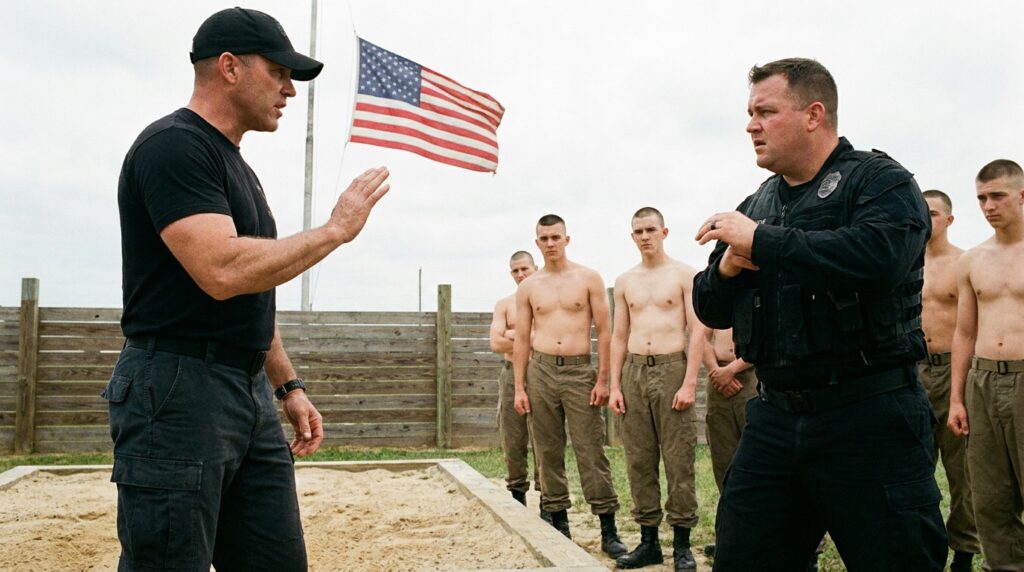
The corrugated iron roof of the armory shed didn’t just reflect the three-o’clock sun; it sharpened it into a long, silver blade that cut straight across the gravel path toward the sand pit.
Shane stood inside the shadow of the equipment cage, his fingers hooked into the chain-link diamond mesh. The metal was cold despite the ambient heat, coated in a thick, preserving film of low-grade gun oil. Outside, twenty feet away, the recruits were hauling eighty-pound sandbags from the rear of a flatbed truck. They moved in an unpunctuated rhythm, their boots crunching into the dry clay, their chests slick with grey dust that stuck to their sweat like ash.
Vance stood by the truck’s tailgate. He wasn’t checking the cargo; he was checking his wrist. Every three minutes, his eyes dropped to the dull sapphire face of his tactical watch, the digital screen casting a faint, rhythmic green pulse against the inside of his wrist. Beside him stood a junior lieutenant, a kid named Harris whose uniform still smelled of laundry starch and dry-cleaning solvent. Harris held an administrative tablet, his stylus hovering above the glass screen like a needle over a record.
“Drop them six inches closer to the log line,” Vance said. He didn’t raise his voice, but the command cut through the groaning of the truck’s suspension. “The regulatory framework for the agility course requires a standardized four-meter approach. We’re striking the old boundaries.”
One of the senior recruits, a kid named Miller who had a jagged tattoo of an anchor fading into his bicep, paused. He had a sandbag balanced on his right shoulder, the rough burlap digging into his neck. He looked toward the equipment cage, his eyes searching the dark square behind the mesh where Shane stood. He didn’t drop the bag. He waited.
Shane didn’t give him a sign. He watched the way Harris’s fingers moved across the glass interface. There was an irregularity there. On the corner of the lieutenant’s administrative folder lay a three-part carbon receipt—an old, manual logistics form used for ammunition requisition before the network went digital. It had a hand-stamped serial number in purple ink: 00-98-ALPHA. Shane’s gaze lingered on the purple ink. It was faded, the edges of the numbers slightly blurred by damp storage. The Command hadn’t used manual stamps since the year the operations in the Balkans were scrubbed from the active registers.
“Lieutenant,” Vance said, his tone dry as bone. “Did I authorize a delay?”
“No, sir,” Harris muttered, his stylus tapping the screen twice with a sharp, plastic click. “The contractor’s inventory report is still missing the serial verifications for the training dummy rifles. The old M16 concrete-fills.”
“Strike them from the log,” Vance said. “They’re non-standard. If it doesn’t have an RFID tag, it doesn’t exist on the inventory. Dump them behind the latrines for scrap collection.”
Shane stepped out of the shadow. The transition from the cool grease of the cage to the white glare of the gravel made his pupils contract into tiny black points. His boots made no sound on the stones; he walked on the balls of his feet, his weight distributed so perfectly that his shadow didn’t bounce against the corrugated iron wall behind him.
“The concrete-fills are weighted to twelve pounds, Colonel,” Shane said, stopping five feet from the truck’s rear tire. He didn’t cross into Vance’s shadow. He stayed exactly on the line where the sun hit the gravel. “The standard issue M4 with a loaded mag and an optic is eight-point-five. If they train on the baseline weight, the real thing feels like balsa wood when they’re clearing a trench under pressure.”
Vance didn’t turn around. He kept his back to Shane, his hands resting on the olive-drab tailgate. His reflection in the truck’s side mirror showed his jaw shifting—a slow, grinding movement of the molars.
“The manual says eight-point-five, Instructor,” Vance said to the mirror. “We train to the manual. If the manual changes, the simulator updates the algorithm. We aren’t building lumberjacks; we’re conditioning system operators.”
“A system operator with a broken wrist is a corpse,” Shane said. He looked at Miller, who was still holding the sandbag, his knees beginning to tremble under the static load. “Drop the bag, Miller. Take the class to the pull-up bars. Five sets of twenty, dead hang. No kips.”
Miller looked at Vance. The Colonel remained motionless, his fingers still hooked into the truck’s metal tailgate. The silence between the three men became a physical weight, heavier than the burlap sack on the recruit’s shoulder. The junior lieutenant looked down at his tablet, his thumb twitching against the plastic bezel.
“The schedule calls for the obstacle run, Instructor,” Harris whispered, his voice cracking slightly under the glare of the noon light.
“The sand is too dry for the run,” Shane said, his eyes never leaving the back of Vance’s head. “The wind shifted north. It’s pulling the moisture out of the top three inches. They’ll blow out their Achilles tendons on the turns if they don’t have the forearm strength to hold their balance when they slip.”
Vance finally turned. His movement was abrupt, the stiff nylon of his vest scraping against his shirt with a dry, papery rattle. He stepped down from the platform, his boots striking the earth six inches from Shane’s toes. The edge of his shadow swallowed Shane’s chest.
“You’re hiding behind the terrain, Shane,” Vance said, his face inches from the brim of the contractor’s cap. His breath smelled of bitter coffee and commercial mints. “You’ve been in this swamp so long you think the mud is a strategy. It isn’t. It’s just dirt. And by the end of the week, I’m paving it over.”
Shane didn’t blink. He felt the cold casing of the stopwatch in his hand, the small metal ridge of the reset button pressing into his index finger. He could see the tiny silver pins holding Vance’s rank insignia to his collar—they were slightly bent, as if they had been moved from one uniform to another in a hurry.
“The mud doesn’t need a strategy, Colonel,” Shane said softly. “It just waits.”
Vance stared at him for four seconds, his eyes searching the grey lines around Shane’s temples, looking for a flinch, a twitch, a sign of institutional panic. Finding nothing but the flat, unreadable surface of old stone, the Colonel turned to Harris.
“Log the non-compliance,” Vance commanded. “And tell the transport detail to bring the steel posts for the perimeter fence tomorrow morning at dawn. We’re boxing this section in.”
Vance walked toward the command vehicle, his boots throwing up small, angry puffs of grey dust. Harris followed a step behind, his tablet clutched against his ribs like a shield.
Shane stood alone by the truck tire. He looked down at the gravel where Vance had been standing. In the dust, left behind by the lieutenant’s hasty departure, lay a small, discarded scrap of paper—the edge of the carbon receipt Harris had been holding. The purple ink of the stamp was torn in half, but the numbers 98-ALPHA were still visible, bleeding into the dry dirt.








