
CHAPTER 4: THE ANCHOR INCIDENT
The air inside the sand pit didn’t move; it crowded.
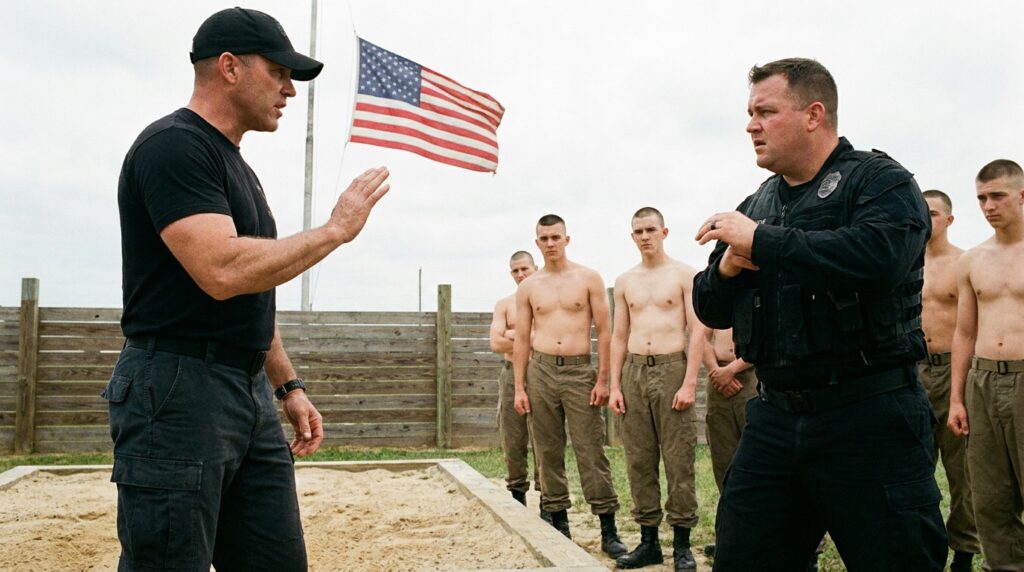
Colonel Vance’s right hand rose with an unpolished velocity. It wasn’t the clean, balanced jab of a combatives instructor, but the heavy, downward shove of a man accustomed to shifting mass by sheer administrative bulk. His fingers curved into a blunt rake, the stiff black nylon of his sleeve scraping against the edge of his armored vest with a dry, aggressive rattle that tore through the silence of the formation. His target was the center of Shane’s chest—the unbranded cotton of his black shirt, the physical threshold of the old man’s refusal.
Shane didn’t drop his center. He didn’t take the standard half-step backward that the manual prescribed for a civilian facing a physical threat from a commissioned officer. His left boot remained buried three inches deep in the coarse sand, the heel locked hard against the subsurface clay shelf he had mapped out that morning.
Before Vance’s fingers could hook into the fabric, Shane’s right forearm cleared the shadow of his hip.
The motion was minimal—an upward, mechanical sweep that tracked a forty-five-degree angle along the cold edge of Vance’s armored vest. There was no theatrical strike, no explosive crack of bone on bone. It was an interception based entirely on leverage and friction. Shane’s thumb and index finger formed an inverted clevis, striking the exact tendon junction behind Vance’s right wrist just as the Colonel’s momentum reached its apex.
Vance’s forward drive stopped.
The abruptness of the halt sent a physical shudder through the plates of his tactical vest. The aluminum folder slipped from his left arm, hitting the sand with a flat, muted thud that kicked up a tiny gray circle of grit. The sheets of legal bond paper didn’t scatter; they stayed pinned beneath the heavy metal clip, the white margins catching the harsh, lateral glare of the late afternoon sun.
Shane held him there. At arm’s length. The distance between them was precisely twenty-four inches—the exact length of a standard riot baton. His fingers were locked around Vance’s wrist bone, the calloused skin of his palm grinding into the Colonel’s sweat-slicked cuff. He could feel the rapid, high-frequency vibration of Vance’s forearm muscles trying to force the hand forward, trying to override the mechanical lock Shane had established.
“If that’s all you’ve got,” Shane said, his breath slow and even, barely disturbing the dust motes hanging between their faces, “then show me something better.”
Around the rim of the pit, the silence became total. Miller had frozen mid-stride, his bare feet gripping the clay edge, his jaw locked. Cross and the other four recruits remained stationary, their shirtless torsos slick with grey mud, their eyes fixed on the point of contact where the contractor’s hand had paralyzed an active-duty commander. The junior lieutenant, Harris, stood ten feet back by the utility carrier, his administrative tablet held at chest height like a dead weight, his screen reflecting nothing but the white sky.
Vance’s face transformed. The blood rushed to his cheekbones, turning the skin around his closely shaved head an angry, mottled purple that darkened the shadows beneath his ears. His eyes darted down to his trapped wrist, then back up to the flat, gray shade of Shane’s cap brim. He tried to rotate his radius bone to break the grip, but Shane shifted his weight an inch to the left, using the resistance of the buried clay shelf to drive the force directly back into the Colonel’s shoulder joint.
“Release the arm, Instructor,” Vance whispered. The corporate veneer was gone, replaced by a low, desperate hiss that didn’t carry to the recruits but vibrated against Shane’s shirt. “You’re touching a line you don’t survive.”
“The line is right here,” Shane said, his voice dropping into the sand. He didn’t release the pressure. He tightened his fingers another millimeter, feeling the small metal rivets of Vance’s watchband press into his own knuckle. “In the dirt. Where it’s always been.”
For two seconds, the entire facility remained suspended on that singular point of friction. The only sound was the far-off, rhythmic clanking of the utility carrier’s ungreased axle cooling in the shade. Shane kept his gaze level, watching the tiny, involuntary micro-tremors in Vance’s pupils—the realization that rank didn’t change the laws of physics, and that the sand didn’t recognize a signature.
With a slow, controlled deceleration, Shane opened his fingers. He didn’t push Vance away; he simply withdrew his hand, dropping his arm back to his side where his thumb found the familiar, warm steel casing of the stopwatch in his pocket.
Vance stumbled half a step backward, his boots churning through the top layer of sand, destroying the clean boundary line he had tried to establish. He didn’t reach for his clipboard. He stayed squared toward the instructor at arm’s length, his right hand twitching against his thigh, his chest heaving under the weight of his vest as the recruits watched him struggle to find his footing in the loose red earth.








