
CHAPTER 12: THE FRIDAY AUDIT
“The primary convoy has cleared the outer tire spikes,” Harris said. He wasn’t tracking the data line on his tablet anymore. The glass screen had fractured down its vertical axis, reflecting the cold white glare of the sodium floods across his chin like a row of small, jagged teeth. He stood by the concrete rim of the sand pit, his hand resting on the rusted frame of the equipment locker to stop his fingers from shaking. “Three administrative utility vans, Shane. They’re running with full Department placards.”
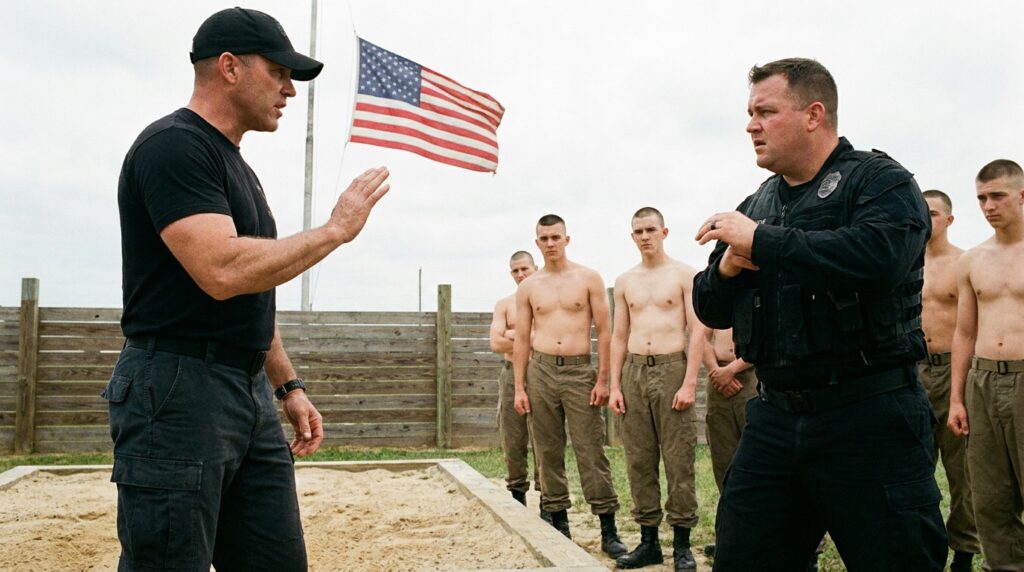
Shane didn’t adjust his cap brim. He stood at the exact geographical center of the pit, his boots buried three inches into the loose, freezing red granules where Vance had stumbled the day before. The morning air was thin, carrying the dry, alkaline smell of concrete dust and unwashed grease from the drainage ditch. His right thumb pressed against the grooved crown of the mechanical stopwatch inside his cargo pocket. One. Two. Three.
The lead vehicle didn’t slow down for the perimeter line. It drove straight onto the hard clay shelf, its heavy black tires crunching over the loose stones with a flat, rhythmic growl that died the exact second the engine cut out behind the tool room.
A single civilian investigator got out of the passenger side. He didn’t carry a clipboard or a tactical folder. He had a slim, silver-finished ledger case locked to his left wrist by a thin strand of vinyl-coated aircraft cable, the metallic weave catching the first long, gray light of the dawn. Behind him, four ununiformed security personnel stepped into the circle, their black windbreakers pulled tight against the mountain draft, their eyes instantly fixing on the twelve recruits who stood in a solid semi-circle along the flag line.
The recruits hadn’t washed the sand from their chests. The dried clay had turned into a hard, cracked gray armor that split across their sternums whenever they took a breath. They stood without their boots, their taped ankles rooted into the frozen clay, their thumbs hooked into the cast-iron sling mounts of the twelve-pound concrete-filled rifles. Miller held his piece exactly level with the investigator’s tie clip, his shoulders pinned back, his breathing completely silent.
The investigator stopped three feet from the edge of the pit. He looked down at the rusted steel padlock that lay snapped flat in the sand between Shane’s boots—the manual lock Vance had tried to use to seal the sub-bunker drainage shaft.
“The registry for this facility was archived at midnight, Instructor,” the investigator said. His voice was flat, carrying the dry, institutional precision of a man who had spent thirty years evaluating ordnance storage bins. “The land has been reclassified under section four closure rules. Every line item on this footprint is now state property for liquidation.”
“The registry is thirty pages short,” Shane said. He didn’t take his hand out of his pocket. He let his eyes move from the silver case on the man’s wrist to the white, unblemished lettering on the side of the utility van behind him. “The automated inventory script you ran from Fort Meade didn’t check the redundant satellite loop in Berlin. It only checked the files Vance’s father signed out of the warehouse.”
The investigator’s expression didn’t shift. But beneath the dark fabric of his windbreaker, his right shoulder dropped an inch—the subtle, involuntary movement of a tactical operator realizing the target had already mapped the approach.
“The Berlin relay was closed during the unification transition,” the investigator said.
“The terminal is live right now under the shed,” Shane murmured. He stepped out of the pit, his boots making a clean, unhurried scraping sound on the concrete lip. “And the duplicate ledger from the third extraction detachment isn’t in the state pool. It’s on the flatbed behind the armory, signed by the man who held the Magdeburg yard before your office scrubbed the index.”
General Albright stepped out from the shadow of the garrison flag post. He didn’t render a salute this time. He held his old leather command folder open in both hands, the faded cream sheets of the original ninety-eight manifest exposed to the grey daylight. His four stars glinted under the sodium lamp, their edges catching a sudden, sharp glare from the sedan’s cooling headlights.
“The audit is closed, Inspector,” Albright said, his voice dropping into the sand with the heavy, unyielding mass of an operational veto. “The twelve recruits in this circle have been logged as active field personnel under the historical exemption register. Their metrics are certified. Their names are on the manifest.”
The investigator stared at the old General for five long seconds, his fingers tightening against the handle of his silver case until the vinyl-coated cable groaned against his wrist. He looked back at the recruits—at Miller’s gray, porcelain-patterned chest, at the rusted iron pry-bars clutched against their thighs, at the total, unblinking stillness of the formation.
He knew what the timeline meant now. The facility hadn’t been buried to hide a financial deficit or an administrative oversight. It had been kept alive as an active, analog fault line because the system couldn’t survive the truth of the twelve names Vance had tried to cover with gravel.
With a slow, deliberate deceleration, the investigator turned toward his vehicle. He didn’t sign a liquidation order. He didn’t check the inventory. He slid back into the passenger seat, his silver case clattering against the plastic console as the driver threw the utility van into reverse, throwing up a single, angry cloud of grey clay dust that drifted across the fence line.
Shane watched the vehicle clear the gate, his thumb releasing the stopwatch button inside his pocket. Click. The mechanical hand stopped, frozen on the exact second the audit line broke.
He looked down at the sand pit. The red earth was scarred with tire tracks and boot prints, the clean boundaries completely destroyed by the friction of the week’s cold war. But beneath the top three inches, the hard clay shelf remained unyielding, holding the weight of the old grey-zone legends who had finally come back across the border to claim their standing.








