
CHAPTER 1: THE FAULT LINE
The lead-pencil tip snapped against the coarse yellow paper of the ledger. It was a clean, sharp sound, easily swallowed by the low, oily thrum of the auxiliary generators pulsing somewhere behind the supply sheds.
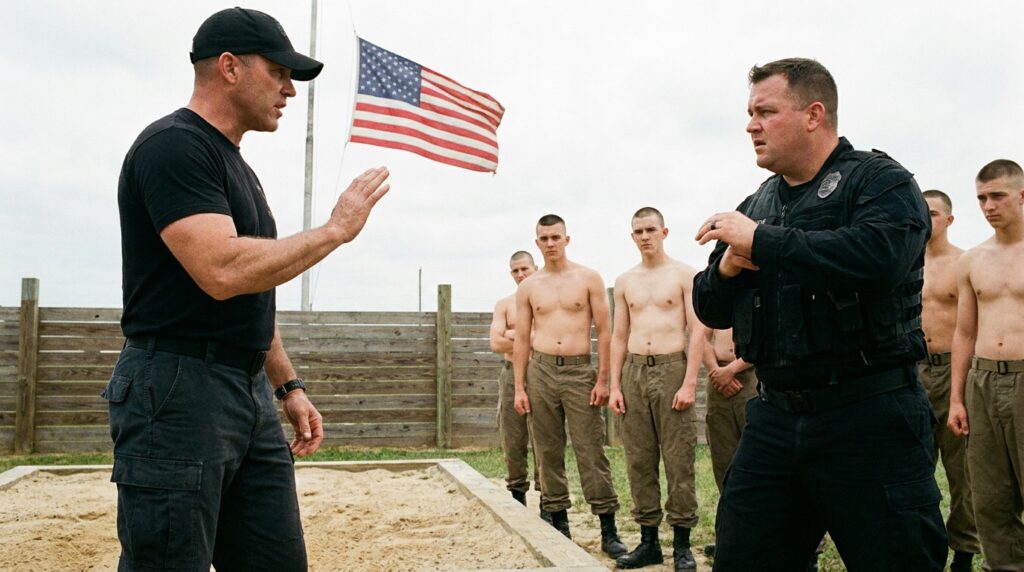
“Your contract isn’t an insurance policy,” Colonel Vance said. His voice carried the flat, metallic edge of a man who spent his mornings reviewing spreadsheets and his afternoons enforcing them. He didn’t look at the sand pit. He stood on the concrete lip of the briefing platform, his black tactical vest rigid, the crisp webbing unburdened by a single grain of red Georgia dust. “The Bureau of Land Management wants the western perimeter cleared by Friday. The Command wants a standardized metric for the tier-one recruits. What I don’t see on this sheet, Instructor, is a repeatable data point.”
Shane didn’t look up from the broken lead. He adjusted the brim of his unbranded black ballcap, the fabric faded to an industrial charcoal by three summers of standing in the open sun. His thumb rubbed the smooth, heavy steel of the mechanical stopwatch nestled in his palm. The metal was warm, exactly matching his skin temperature.
“The metric is standing,” Shane said. His voice was sparse, rhythmic, devoid of the gravel common among men who had spent their thirties shouting over helicopter rotors. “The ones who don’t understand the friction of the sand don’t stay upright when the weight shifts. You can’t chart that on a tablet, Colonel.”
Behind them, sixty yards out across the sun-baked clay, twelve recruits stood in a loose, shirtless semi-circle. They were twenty-two, twenty-three years old—dense muscle, short-cropped hair, skin turning pink under the midday heat. They had stopped breathing hard. They were watching the platform. They were measuring the distance between the crisp, unblemished black uniform of the active-duty commander and the plain, sweat-darkened cotton of the civilian contractor.
Vance took one step forward. The sound of his heavy combat boot striking the concrete was deliberate. A calculated display of mass. “The modern theater doesn’t have time for gray-zone mythology, Shane. I’ve seen your file. What’s left of it. The operations you survived were small-unit extractions using analog logistics. The new doctrine requires integrated network awareness. If a man can’t synchronize his biometric feed with the strike package, he’s a liability.”
Shane turned his head slightly. The movement revealed the deep, white line of an old fragmentation scar running beneath his jawline, disappearing into the collar of his black T-shirt. His eyes stayed in the shadow of the cap brim. “A strike package doesn’t pull a three-hundred-pound technician out of a flooded culvert when the batteries die.”
Vance’s face hardened, the skin over his closely shaved cheekbones tightening until it caught the glare of the sky. He reached out, his hand hovering inches from the wooden clipboard on Shane’s desk. It wasn’t a gesture of theft; it was an exercise in proximity. An occupation of space.
“By eighteen hundred hours,” Vance said, his voice dropping into a low, transactional hiss that barely carried past the desk, “you’ll have the digital logs transferred to my staff. Or I’ll have the gate guards reclassify your clearance to ‘visitor.’ We’re updating the system, old man. With or without your permission.”
Shane’s hand didn’t move from the stopwatch. But beneath the desk, his weight shifted three inches to the left, his boots finding the exact point of resistance in the loose gravel beneath his stool. He noticed the slight tremor in Vance’s left knuckle—the subtle, involuntary twitch of a bureaucrat who had mistaken institutional leverage for physical certainty.
“The gate has a manual override, Colonel,” Shane murmured.
Vance paused, his fingers curling slightly into a fist. Before he could answer, the heavy canvas of the garrison flag behind them gave a sharp, violent snap as a sudden thermal updraft tore through the valley, coating the ledger in a thin, pale layer of grit.








