
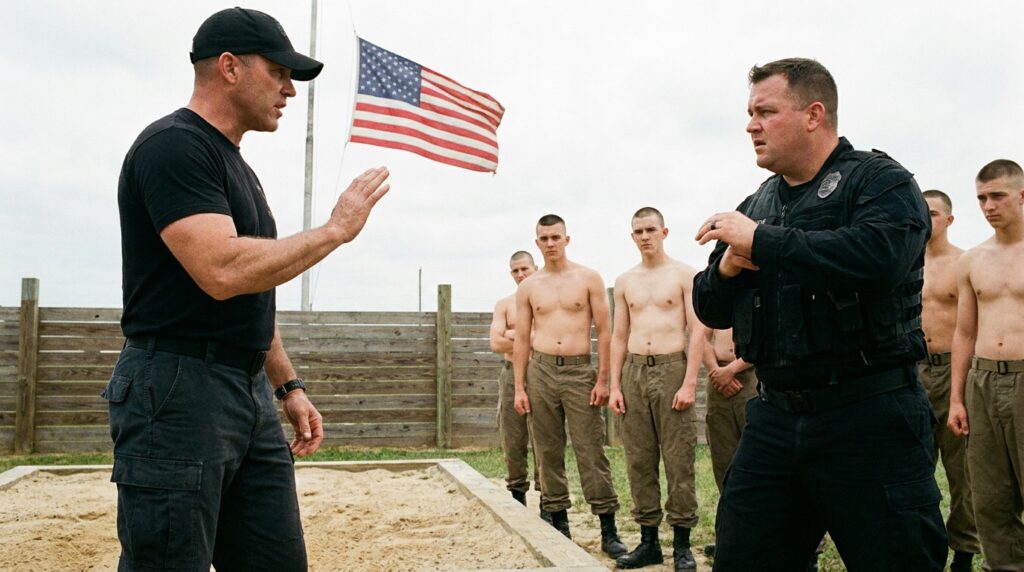
CHAPTER 5: THE STANDOFF PARADIGM
Colonel Vance’s breathing was the loudest thing inside the perimeter fence. It came in short, jagged rattles through his nostrils, each exhale whistling slightly against the high collar of his stiff tactical vest. His boots remained sunk three inches into the loose upper crust of the sand, his heels pinned by the dead weight of his armor.
He did not reach down for his fallen clipboard. The aluminum folder stayed right where it had dropped, half-buried like an unexploded shell in the red grit, its cream bond pages collecting a fine, silver skim of dust from the northern draft. His right wrist, newly released from Shane’s grip, hung near his belt line. The skin there was already turning a deep, dark gray where Shane’s thumb had locked into the tendon line, the precise shape of a crescent moon bruising beneath his watch strap.
Shane did not lower his shoulder line. He kept his boots planted into the sub-base clay shelf, his posture completely vertical under the shadow of his cap. His hands went right back into the pockets of his dark cargo trousers, his fingers closing around the cold mechanical stopwatch. He could feel the small steel cylinder of the reset pin pulsing against his knuckle like an extra vein.
“The transport detail is still at the main gate, Colonel,” Shane said. His voice was too quiet to carry past the inner line of recruits, but it had a heavy, physical edge that seemed to anchor the air between them. “They’re running the diesel engines idle. That’s eight gallons an hour from your administrative allotment. If you don’t give them a work order by sixteen hundred, the driver logs a non-compliance report.”
Vance’s left eye twitched, a tiny, vertical tremor cutting through the gray line of his lower lid. He looked at the recruits. None of them had moved. Miller stood like an iron post on the embankment, his shirtless torso grey with clay dust, his bare toes curling into the hard dirt to keep his balance. Behind him, the others formed a solid, unblinking semi-circle—six young men who had spent three weeks learning the exact weight of a twelve-pound concrete rifle, now measuring the weight of an officer who had just been frozen at arm’s length.
“Lieutenant Harris,” Vance said. He didn’t turn his head toward the utility carrier. He kept his eyes fixed on the white line of the fragmentation scar under Shane’s jaw. His voice was thin, but the transactional iron was back, sharpened by the presence of the class. “Call the perimeter guard. Tell them to clear the civilian vehicles from the northern approach line. Every vehicle without an active Department base decal is to be towed to the county impound lot.”
Harris didn’t move for three seconds. He stood by the rear wheel of the carrier, his administrative tablet clutched against his ribs so hard the hard plastic casing groaned. His screen cast a flat, pale green glow across his chin, illuminating a sudden ring of white sweat that had formed around his collar line.
“Sir,” Harris whispered, his voice cracking against the dry air. “The gate logs… the instructor’s truck is listed under the permanent historical exemption register. Section four, gray-zone contractor allocation.”
Vance’s jaw shifted, his molars grinding with a distinct, wet click that Shane noticed instantly. “The section four allocation was repealed by the logistics review three cycles ago, Lieutenant. If it isn’t in the active network index, it doesn’t exist. Update the entry. Execute the order.”
Shane let his right thumb press the stopwatch button. Click. The mechanical sound was tiny, but in the absolute silence of the sand pit, it sounded like a hammer dropping on an empty chamber. He looked over Vance’s shoulder, past the rigid nylon of the vest, straight at the purple smudge on the corner of the lieutenant’s tablet. The numbers 98-ALPHA were fading into the blue shadow of the vehicle’s cab.
“The register wasn’t repealed, Vance,” Shane said softly. He took his hand out of his pocket, his index finger pointing down at the aluminum folder between Vance’s boots. “The signature on those sheets isn’t a regional command authorization. It’s an internal transfer receipt from the logistics annex at Fort Meade. You didn’t come down here to re-bin the easement. You came down here to scrub the warehouse files.”
The blood seemed to leave Vance’s face all at once, the purple mottling around his cheeks fading into a flat, chalky grey that matched the dust on the truck’s tires. He didn’t look down at the paper. He didn’t answer. He took one step back, his heel catching on the metal edge of the clipboard, his body performing a brief, involuntary balance correction that required him to throw his arms wide to stay upright in the loose sand.
“This is an active training zone, Instructor,” Vance said, his voice dropping into a register that was too low, too hollow to be convincing. “Any interference with an administrative officer during an authorized evaluation is a federal contract violation. I suggest you remember who pays for the sand in this pit.”
“The sand doesn’t have an auditor, Colonel,” Shane said. He didn’t follow the movement. He stayed exactly where he was, his cap brim casting a long, sharp triangle of shade across his own mouth. “And the men who died putting the coordinates under that shed didn’t use an index.”
Shane turned his back on the Colonel. It was a cold, calculated movement that ignored every rule in the manual regarding a hostile presence inside the defensive circle. He looked at Miller.
“Miller,” Shane said. “The class has three minutes left on the dead-hang. Get them back to the bars. If I see a single hip swing, the whole team starts over from zero.”
Miller didn’t hesitate this time. He didn’t look at Vance’s uniform or Harris’s tablet. He struck his bare heels against the clay embankment, turned on his heel, and led the shirtless formation away from the pit with a rhythmic, silent stride that completely bypassed the utility carrier.
Vance stood alone in the center of the sand, his shadow stretching out toward the fence line like a long black wedge. His right hand was still twitching against his uniform trousers, his fingers curled into a loose, useless fist as the grey dust from the truck’s engine began to drift across his boots, covering the polished leather in a pale, uniform skin of grit.








