
CHAPTER 7: THE ARCHIVAL FAULT
“The gate sensors didn’t trip, Instructor,” Harris said. He was leaning against the heavy iron bumper of the utility truck, his uniform trousers dark with the red grease that leaked from the steering box. His fingers were locked around the edge of his tablet casing so tightly the plastic had begun to warp under the glare of the tactical floodlights. “But someone just authorized a command-level override at the eastern checkpoint. The system isn’t showing a standard registration plate.”
Shane didn’t take his hand out of his cargo pocket. His fingers remained curled around the cold, grooved rim of the mechanical stopwatch, counting the heavy mechanical beats of the facility’s master clock inside the supply shack. One. Two. Three.
“The eastern checkpoint doesn’t connect to the regional server, Harris,” Shane said. He stepped off the gravel path, his boots sinking an inch into the dry crust of the ditch line where the shadows from the pine canopy were thickest. “It’s a dead loop. It only rings if someone is using a hardwired terminal from the old ordnance bunker.”
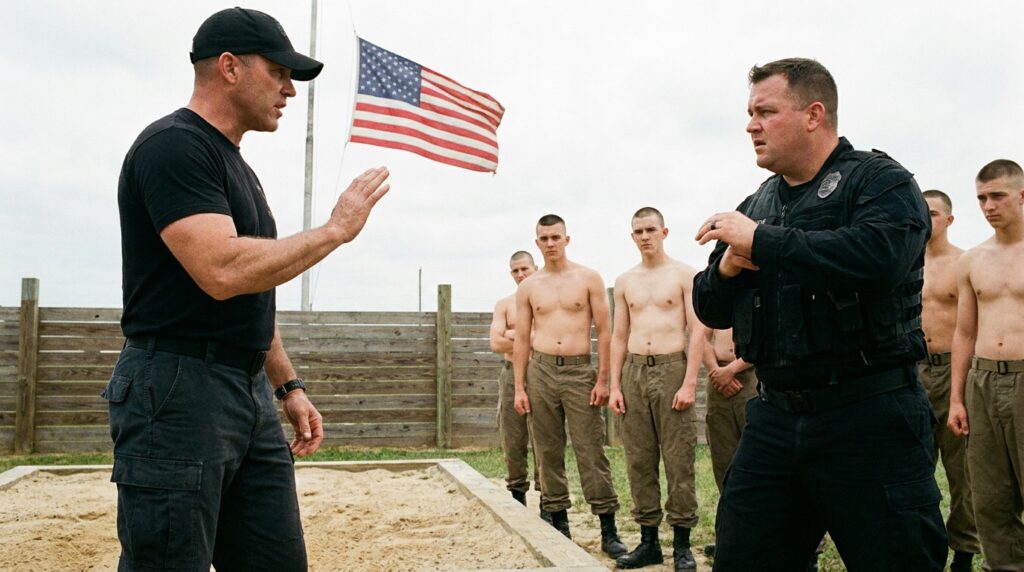
Behind them, the twelve recruits had formed a silent, gray line along the edge of the tool shed. They weren’t wearing their boots anymore. They stood in the dust with their ankles wrapped in standard olive-drab utility tape, their bare shoulders glistening with a grey sheen of sweat and clay residue that had dried hard under the high-pressure sodium lamps. Miller had a cold, twelve-pound concrete rifle held flat across his thighs, his thumbs hooked into the cast-iron sling mounts.
A sharp, metallic hum vibrated through the corrugated siding of the main armory. It wasn’t the regular pulse of the auxiliary generators. It was a high-frequency carrier wave, the kind that used to fry the telephone lines in the valley whenever the deep-subsurface relays were opened for a manual data transfer.
“Colonel Vance didn’t leave the perimeter,” Shane murmured, his eyes tracking the thin, silver conduit line that ran from the base of the flag post down into the concrete foundation of the tool room. “He’s still inside the circuit.”
Shane moved toward the breaker panel at the back of the armory, his shadow stretching across the clay like a long, black needle. The metal box was cold to the touch, its grey enamel paint flaking off in thin, sharp scales that bit into his knuckles. He didn’t check the active switches. He slid his fingers behind the galvanized backing plate, feeling for the small, non-standard toggle switch that hadn’t been listed on any facility blueprint since December of ninety-eight.
The switch was thrown down. The override was live.
“He’s running the shredding program manually,” Shane said, his voice dropping into the gap between the building’s iron sheets. “He’s not clearing the land for storage, Harris. He’s pulling the old operational manifests out of the deep-storage array before the Department’s automated inventory script locks the files for the Friday audit.”
Harris’s tablet suddenly flashed once, a bright, pale blue glare that illuminated the frantic, vertical movement of his chin. “The logistics ledger just went flat, sir. The entire historical index for the SF-EX-09 detachment… it’s being re-classified as administrative waste. The terminal is deleting the line items chronologically.”
“He’s starting with the ninety-eight roster,” Shane said. He pulled his hand back from the breaker box, a thin line of black grease staining the white fragmentation scar across his thumb. He looked at Miller. “Miller. Take Cross and the rear element. Lock the grease-trap doors on the lower bunker. Nobody comes up through the drainage shaft.”
“Understood, sir,” Miller said. He didn’t check with the lieutenant. He swung the concrete rifle into a low-ready position, his taped heels striking the gravel in a synchronized, three-man sprint that disappeared into the darkness behind the latrine block.
The air inside the perimeter grew noticeably colder as the carrier wave died down, leaving nothing but the dry, parched rattle of the canvas flag above their heads. Shane walked toward the center of the sand pit, his feet tracking the exact micro-seconds of Vance’s earlier retreat. The sand was cold now, its heat fully spent, the red granules crunching under his soles with a sound like broken glass.
He knew what Vance was looking for in the dark. It wasn’t a paper manifest or a digital fingerprint. It was the original manual deployment log—the one with the hand-stamped purple serials that listed the twelve names of the men who had stayed on the wrong side of the river line when the political map changed. Vance’s father hadn’t signed an eviction order to save his son’s career; he had signed it to ensure those twelve names remained under four inches of industrial gravel forever.
“Instructor,” Harris called out, his voice shaking as he walked backward toward the command vehicle, his screen flickering with a row of red system-error warnings. “The gate override didn’t come from Vance. The terminal at the eastern checkpoint just logged a primary clearance card. It’s an active-duty command signature from the chief of staff’s office.”
Shane stopped at the very center of the pit. He looked toward the north gate, where the headlights of a heavy black utility vehicle were just clearing the pine line, their long, white beams cutting through the gray dust like twin scalpels, catching the silver edges of the iron posts stacked on the flatbed truck.
The trap hadn’t just sprung on Vance. It had sprung on the entire loop.








