
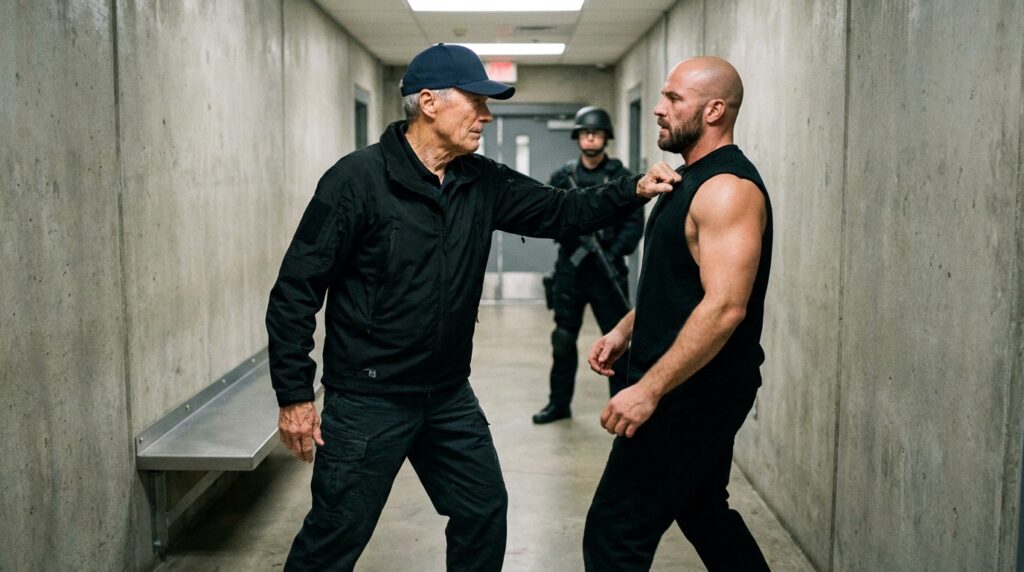
CHAPTER 8: THE LOWER TIER
The subterranean elevator didn’t use cables. It dropped via a heavy hydraulic piston that groaned deep within the bedrock, a slow, shuddering descent that smelled of scorched packing grease and wet sulfur. With every ten feet of depth, the temperature in the shaft plummeted, the dry, filtered air of the processing lanes replaced by a damp, primordial chill that condensed into fine beads of moisture along the iron ribs of the cage.
Commander Vance stood perfectly still in the center of the lift, his polished riding boots planted six inches apart. He hadn’t removed his hands from behind his back since the cage door had rattled shut, his silver signet ring casting a small, dull reflection against the wet iron grating.
“The sub-levels weren’t included in the commercial appraisal,” Vance said. His voice was flat, devoid of the administrative warmth he had used in the corridor above. It bounced off the raw rock walls of the shaft with a heavy, hollow resonance. “The contractors think the grid ends at the storage arrays. They don’t have the clearance to know that the foundation goes down another three tiers.”
The veteran didn’t answer. He stood by the gate, his left hand hooked into the cold iron mesh of the outer screen. His fingers could feel the rhythmic, rhythmic thudding of the hydraulic fluid passing through the lines—a heavy, four-beat pulse that indicated the pump system was running on legacy DC generators from the early cold war era. Beneath the low brim of his navy cap, his eyes tracked the passing strata of the shaft: first the poured concrete of the modern facility, then the rough-cut timbers of the old ordnance depot, and finally the black, unlined shale of the deep archive tier.
The elevator gave a final, massive jolt, its floor settling three inches below the sill of the lower platform with a wet, metallic splash.
The outer gate didn’t slide open automatically. The veteran reached down, his scarred fingers catching the heavy, rusted iron latch handle. It took thirty pounds of levered mass to break the corrosion lock, the metal shrieking in protest before the gate finally swung back against the rock face.
A single corridor stretched ahead, less than six feet wide, carved directly out of the stone. The lighting here didn’t use fluorescent tubes or emergency LED strips; it consisted of old, wire-caged incandescent bulbs spaced twenty feet apart, their filaments glowing a dim, smoky orange that barely reached the floorboards. The air was thick, heavy with the odor of unwashed canvas and decaying paper, a specific institutional stench that only accumulates when records are left to rot in the dark for half a century.
“Vault 3 is at the end of the drift,” Vance murmured, his boots making a sharp, hollow tack-tack on the damp cedar planks that served as a walkway over the drainage trench. “The manual combinations were never updated after the transition. My father kept the logbooks in his private office at the academy until he died.”
The veteran stepped onto the cedar planks, his heels instantly finding the center of the wood to avoid the wet mud oozing from the trench lines. He didn’t look back at the commander. He was calculating the distance—forty yards to the threshold, two separate blind spots where the rock face jutted out to support the ceiling timbers, and no secondary exit if the contractor’s cell above managed to drop a bypass charge down the elevator shaft.
At the midground of the drift, a massive iron wheel-lock was bolted into the face of a heavy steel bulkhead. The surface of the door was pitted with black oxidation, but around the rim of the locking wheel, three faint, white chalk-marks had been scribbled into the iron—an old field confirmation code from the winter of 1985, indicating that the contents had been verified and sealed under an operational blackout order.
The veteran stopped three inches from the wheel. His hand hovered over the iron spokes, his skin instantly registering the intense, penetrating cold radiating from the other side of the bulkhead.
“The combination isn’t a number,” the veteran whispered, his voice sand-dry in the damp air.
Vance stepped up behind his shoulder, the silver signet ring catching the orange glow of the nearest bulb. “No. It’s an internal index name. The name of the team we left behind in the delta.”
Before the veteran’s hand could touch the iron spoke, a low, wet vibration shuddered through the rock ceiling above them—the distinct, high-frequency thud of a commercial linear breaching charge firing on the processing floor three hundred feet up. The contractor’s cell had just bypassed the clerk’s terminal, and they were clearing the elevator shaft by force.








