
CHAPTER 3: THE NARROW LANE
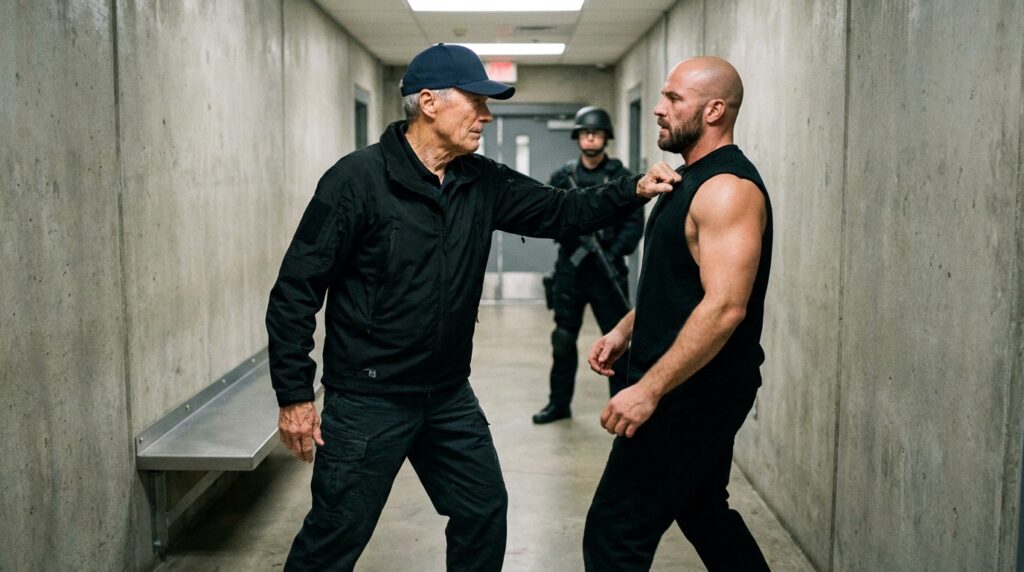
The concrete hallway stretched forty feet between the intake counter and the reinforced inner threshold, a desaturated tube of industrial gray that smelled of curing lime and old iron. The air didn’t circulate well here; it pooled in the corners, leaving a thin film of fine grit on the raw metal fittings.
The contractor didn’t let go immediately. His fingers slid off the veteran’s sleeve with a dry, scraping sound, leaving small, crumpled lines in the heavy cotton fabric. He looked down at his own hand, his knuckles white, his thumb twitching slightly from the microscopic leverage the older man had used to neutralize his stance. The arrogance in his posture hadn’t disappeared, but it had grown rigid—the fluid, sweeping confidence of a massive man replaced by the hard, defensive framing of a brawler who realized he had just stepped onto uneven ice.
“You’re tracking dirt into a clean transit,” the contractor said. His voice was lower now, lacking the performative boom he had used for the clerk’s benefit. He adjusted the strap of his nylon gear bag, the metal carabiners clinking against each other like dull coins. “The old brigade left their trash everywhere. They forgot to clean out the system when they closed the books.”
The veteran didn’t offer a retort. He simply adjusted his cap, pulling the salt-stained brim a fraction lower to shield his eyes from the direct glare of the fluorescent tubes. He turned his back to the intake counter and began a slow, rhythmic walk down the center of the corridor. His boots made no sound on the grit-dusted floor—an old habit of distributing weight through the outer edges of the sole, keeping the knees slightly bent to absorb the natural imperfections of the concrete.
Behind him, the armed guard didn’t move from his station. The young man’s helmeted head swung slowly, tracking the veteran’s progression with a silent, neutral curiosity. In these lower tiers, the private operators were supposed to handle their own friction, but the guard’s hand remained unlatched from his security holster. He had seen the way the old man had rotated his wrist—an motion so compact it didn’t register on the overhead low-resolution cameras, but one that had stopped two hundred and forty pounds of muscle with less than two inches of displacement.
Five paces down the lane, a single iron bench was bolted directly into the wall. It was a crude piece of utility furniture, its surface pitted with rust spots where the gray primer had flaked away over thirty years of institutional use. Beneath the seat, a small, circular ventilation brass grille hummed with the vibration of a localized cooling fan. The sound was wrong; it had a rhythmic, scraping stutter that suggested an unaligned axle—or an aftermarket recording device tapped directly into the facility’s low-voltage power rail.
The veteran stopped at the edge of the bench. He didn’t sit. He stood with his hip three inches from the iron frame, his left hand resting lightly on the cold metal surface. His fingers automatically found a deep gouge in the iron—three small notches carved into the underside of the seat, an old field marker indicating a dead-drop location used during the facility’s construction when it was still under the jurisdiction of the Department of the Army.
“There’s nothing for you down this line,” the contractor’s voice came from fifteen feet behind. The heavy, deliberate thud of his tactical boots began again, closing the distance with a slow, measured momentum. He wasn’t rushing now; he was stalking, his broad shoulders filling the narrow margins of the hallway, casting a long, irregular shadow that crept up the concrete wall toward the veteran’s feet. “The files you’re looking for were shredded before your pension cleared, old man. We own the storage arrays now.”
The veteran looked down at the rusted bench. The fine dust on the iron surface was vibrating in sync with the stuttering cooling fan beneath. He could read the frequency through the skin of his palm—it wasn’t an unaligned axle. It was an encrypted data pulse, a local wireless handoff masking itself as mechanical noise, broadcasting a legacy handshake protocol to any old-model receiver within three meters. His retirement credential, still tucked inside his palm, grew slightly warm against his skin as its internal copper coil picked up the induction field.
“The storage belongs to the structure,” the veteran said to the wall. His reflection in the polished concrete was a dark, narrow line, almost indistinguishable from the shadows between the structural pillars. “The company only rents the power.”
“We bought the structure,” the contractor countered, his boots stopping five feet away. The air between them grew thick again, warm with the smell of the contractor’s synthetic gear and the sharp, acidic tang of his frustration. He didn’t reach out this time. He simply used his bulk to crowd the veteran against the bench, his chest inches from the old man’s shoulder line, blocking the path toward the inner gate. “And we don’t like ghosts hanging around the hardware.”
The veteran remained perfectly still, his eyes tracking the red light of a security sensor mounted above the inner door. The light was green three seconds ago. Now it was a solid, unblinking crimson, indicating that someone in the central control room had manually isolated this specific corridor from the rest of the processing floor. The automated safety systems were offline. Whatever happened in this lane would stay in the lane until the log was manually cleared.
The contractor took another half-step forward, his large, bearded jaw tightening as he prepared to use his physical mass to force the veteran into the rusted metal of the bench.








