
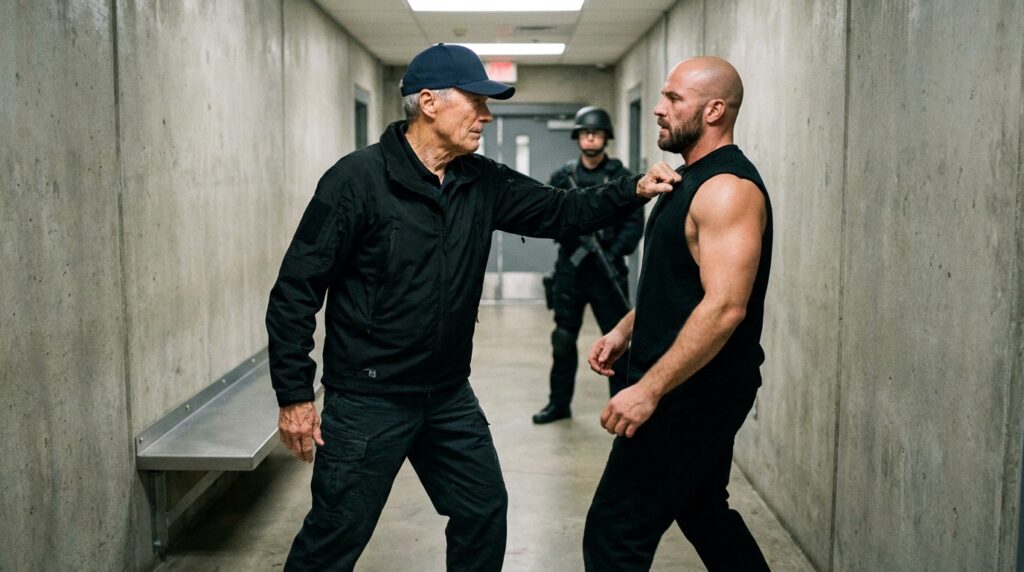
CHAPTER 20: THE SEIZURE ORDER
The heavy iron door frame of the relay station didn’t whistle when the veteran stepped through; the wind had dropped, leaving the high ridge line wrapped in a thick, stagnant blanket of desaturated mountain mist. The sulfur rain had thinned to a cold, vertical drizzle that flattened the gray dust along the brim of his navy service cap, turning the fine concrete sediment on his uniform into a dull, streak-marked glaze.
Behind him in the bunker, the vanguard leader remained perfectly motionless by the dead terminal. He hadn’t raised his carbine again. The mechanical thumping from the lower conduit lines had ceased entirely, but the absolute finality of the circuit lock remained etched into the cold iron housing of the console.
The veteran walked down the concrete pad with his heels low, his boots making a faint, wet crunching sound as he cleared the wild moss lines. Under his left arm, the canvas binder from Vault 3 was frayed, its copper rivets loose and its top edge torn open where the operator’s round had sheared through the wood pulp columns. He didn’t check the pages. The graphite transcription was no longer his custody; it was currently scrolling through a mechanical ticker forty miles east, printing onto hard-copy paper that carried the legal weight of an unalterable federal entry.
From the access road at the base of the ridge, the low, synchronized hum of heavy diesel engines began to climb through the fog. It wasn’t the erratic, high-torque rattle of the contractor’s primer-painted vehicles. This was a flat, metric rumble—the sound of three-ton armored transport beds moving in a tight, three-vehicle convoy, their standard-issue wheels keeping a rigid six-foot distance as they cleared the storage alleys below.
Five paces from the hand-cut iron rungs, the mist broke.
A lone figure stood at the edge of the lower trail shelf, wearing a dark, unbranded wool trench coat that had gone black under the rain. He didn’t carry tactical gear or a visible weapon line, but his right hand held a flat, leather briefing case bound with a heavy brass clasp. Beneath his brimmed hat, his eyes were fixed on the veteran’s athletic, rooted stance.
“The ticker line finished the sequence at twelve-thirty, Miller,” the man said. His voice was thin, clear, and carried the specific, metric delivery of a departmental attorney who had spent his career inside the high-level oversight offices. He didn’t look at the torn binder under the veteran’s sleeve. He reached into his coat and pulled out a single sheet of heavy, green-tinted paper that didn’t wilt in the damp air. “The oversight board just issued an emergency administrative block against the facility’s contract. Sector 4 is under direct federal custody as of five minutes ago.”
The veteran stopped at the top rung, his hand resting on the rusted iron collar driven into the stone. He looked down at the green paper, his eyes isolating the faint, geometric watermark running along the margin—the official seal of the Inspector General’s office, stamped in old-style indelible ink that didn’t run.
“The commander is still down in Vault 3,” the veteran said. His gravelly voice was low, sand-dry, completely unaffected by the transition of the guard above. “The wheel lock is frozen on the spindle. He’ll need a mechanical team to clear the latch.”
“The commander isn’t on our manifest anymore,” the attorney murmured, his fingers snapping the leather case shut with a sharp, dry click that sounded exactly like the security turnstiles at the perimeter line. “The department just reindexed his token to a zero-clearance profile. He doesn’t have an administrative home above the sub-levels.”
The convoy below had reached the concrete pad of the storage units, their white halogen lights turning the mist into a solid, glowing wall that blocked out the dark lines of the perimeter fence. The private operators were already dropping their weapons into the gravel, their hands flat against their tactical vests as the dark-uniformed federal guards cleared the lanes with unhurried, mechanical precision.
The veteran slowly let his hand slide off the iron rung, his fingers cold from the stone. He didn’t look back at the transmitter station or the disabled vanguard vehicle blocking the ditch. He began his descent down the shale path, his boots finding the parallel marks he had carved into the mud during his ascent, a old gatekeeper stepping out of the lane as the structural ledger was closed behind him.








