
CHAPTER 6: THE FRAGILE RETREAT
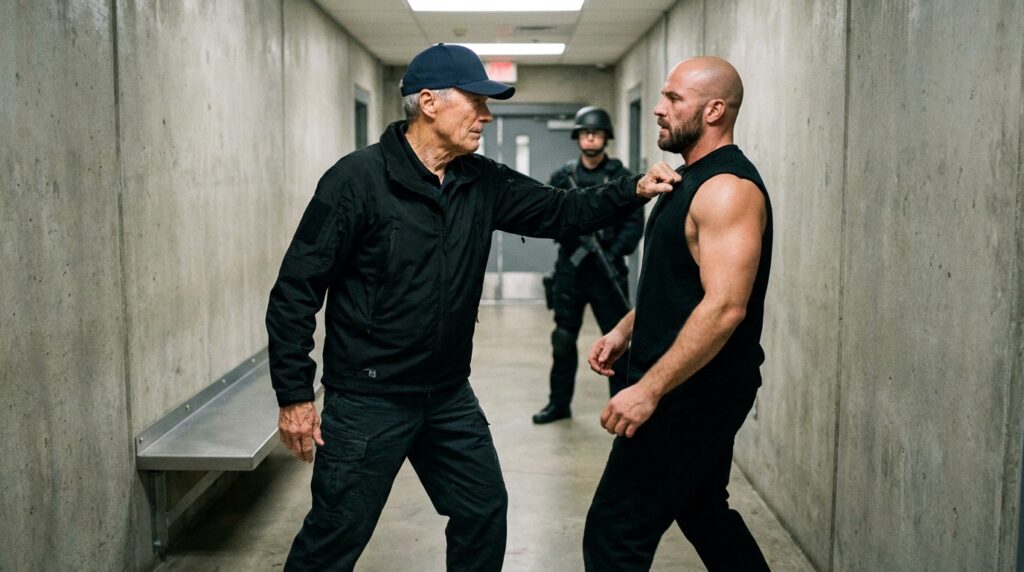
The nylon gear bag hit the floor with a heavy, wet thud, the brass slide fasteners scraping against the fine concrete grit. As the canvas slouched sideways, it exposed a faded stencil on the reinforced waterproof base—a set of inverted chevrons framing an obsolete warehouse code that didn’t belong to any private commercial outfit. It was an old log-mark from the logistics depot at Fort Meade, the exact center that handles deep-archive transfers for defunct shadow operations.
The contractor took three steps backward, his heavy boots making a distinct, dragging scratch across the floor’s expansion joint. He didn’t rise to his full height; his shoulders remained rolled forward, his chin tucked into his collarbone to protect his bruised ribs from a secondary check. The malice in his eyes had taken on a structural coldness, a tactical calculation that replaced his initial brute confidence. He knew the corridor was sealed from the central grid. He knew the log was dark.
“The line is dead, old man,” the contractor spat, his right hand slipping inside the open flap of his vest to adjust the strap of a compact, matte-black pneumatic breaching tool. “Your legacy token just flagged your coordinates to every live terminal in the sector. You thought you were pulling old logs out of the bench grille, but you just signed the inventory release for everything left in the vault.”
The veteran didn’t follow the hand. His gaze remained fixed on the lower lip of the heavy inner security door, where a thin layer of grease had oozed from the hydraulic pistons under the sudden high-pressure lock sequence. Through his soles, the rhythmic stutter of the cooling fan didn’t return, but the structural silence of the building had deepened—the absolute, dead pressure of a concrete tomb wrapped in reinforced steel.
He had calculated the margin of error forty years ago, but he hadn’t accounted for the continuity of the paperwork. The company hadn’t deleted the records; they had simply changed the name on the ledger, keeping the old treason alive beneath three layers of corporate indemnity.
“You’re tracking an expired index,” the veteran said. His voice was low, sand-dry, completely unhurried by the sound of the locking valves. He reached up with his left hand, his thick fingers touching the salt-crusted brim of his navy service cap, tilting it just enough to scan the dark angle where the wall met the ceiling. “The men who wrote that manifest didn’t use network storage. They used ink.”
The guard in the midground took a full pace back, his boots finding the relative safety of the partition glass wall. He looked down at his own wrist-terminal, where the alphanumeric override code had gone completely solid, freezing the screen into a single line of machine code that didn’t respond to his keypad overrides. His visor tracked the contractor’s hand inside the vest, then shifted back to the old man’s immovable shoulders. He wasn’t part of the contract cleanup; he was just a standard base asset who had suddenly realized he was standing inside a live strike window.
“This isn’t over yet,” the contractor said, his teeth showing white through his dark beard as he continued his slow, rhythmic retreat toward the intake turnstile. His weight was distributed evenly on his toes now, his knees loose, ready to sprint or drop the moment the outer perimeter barrier cycled. “You’re an old gatekeeper with an empty ring, grandpa. The commander owns the keys to the archive now.”
“It was over the moment you stepped into my lane,” the veteran whispered.
He didn’t advance on the contractor. Instead, he dropped his center of gravity by a fraction of an inch, his right heel catching the lip of the bolted iron bench. With a single, heavy backward kick that carried the absolute mass of his aligned posture, he struck the base of the bench’s iron support leg. The metal groaned—not from a fracture, but from the sudden shearing force applied to the rusted anchor bolts beneath the concrete surface.
The bench shifted two inches, the iron grille beneath the seat tearing free from its housing with a sharp, electric pop that sent a shower of orange sparks across the grit-dusted floor. The local cooling fan died with a wet whined, its blades striking the bent metal shroud inside the wall casing.
Deep within the floorboards, the counter-vibration of the secondary inductive field broke. The terminal screen behind the partition glass didn’t just flicker; it went completely black, the green legacy code dissolving into a line of static before the auxiliary batteries could kick in. The contractor stopped his retreat, his boots skidding on the concrete as the overhead fluorescent lights died, plunging the narrow detention lane into the absolute, desaturated gray of the emergency backup strips.
Through the dim, crimson light of the safety lamps, the heavy hydraulic arm of the inner security gate began to groan again, its primary fluid pressure failing as the veteran’s physical disruption shorted out the local isolation loop. The door didn’t slam shut; it began to swing outward, very slowly, heavy iron grinding against the raw concrete sill.








