
CHAPTER 5: THE SECTOR ISOLATION
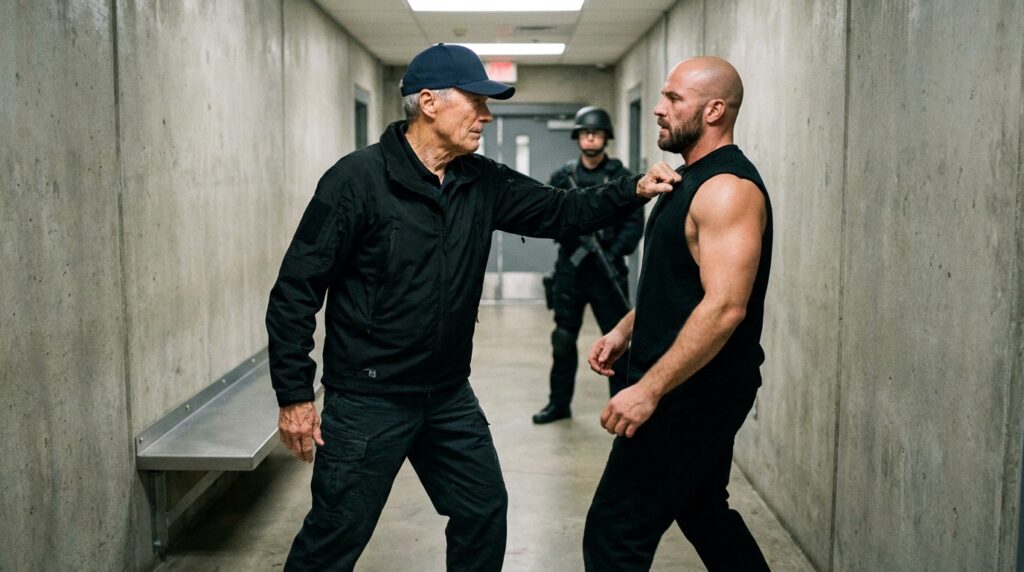
The armed guard did not raise his rifle, but his shadow remained fixed against the salt-scrawled concrete wall like an oily stain. Through the narrow slit of his dark visor, his eyes were wide, their focus locked completely on the veteran’s rooted stance. He had been trained to look for weapon signatures—the tells of a hidden blade, the kinetic twitch of a hand dipping toward a waistband—but there was no policy manual in the modern tier for an old man who weaponized his own skeletal mass without shifting his heels.
The air in the detention lane grew significantly colder as the HVAC system completed its cycle, pushing a dry, sulfurous draft through the ceiling vents that rustled the edges of the contractor’s torn sleeve. The low hum of the local ventilation fan beneath the rusted iron bench altered its rhythm, the steady tap-tap-tap-tap of the data sequence suddenly sharpening into a high-frequency whistle.
On the side of the guard’s helmet, a small operational transceiver blinked into life. A tiny, amber alphanumeric sequence—E-6_MIGRATION_BLOCK—scrolled across his small external ear-display. It was an institutional override command, one that didn’t come from the regional dispatch desk but from an independent terminal embedded deep within the facility’s structural foundation.
“Stand down, 84,” the veteran said. His voice didn’t rise above the mechanical whine of the wall vent, yet it carried an unnatural density that seemed to vibrate the loose iron filings collected in the corners of the bench. He used the guard’s old-tier internal sector index, a numerical designation that had been wiped from the facility’s database during the commercial transition five years ago. “The desk clerk has already isolated the loop. If you break leather now, you’re logging a tactical incident on an unmonitored line.”
The guard’s fingers hovered two inches above his weapon’s retention strap. His boot soles made a tiny, dry crunching sound against the concrete grit as he shifted his weight back toward the partition wall. He wasn’t looking at the veteran as a civilian obstruction anymore; he was reading the posture of a sovereign protector—a man who had held these specific corridors when the concrete was still wet and the names on the walls were stamped in brass rather than printed on vinyl stickers.
“Who initiated the lockout?” the guard asked, his voice muffled by the plastic filter of his respirator. He didn’t look back toward the intake counter, where the clerk was now sitting perfectly motionless, his hands flat against the laminate surface as if he were trying to disconnect his body from the interface. “The grid is showing black from the primary hub.”
“The lock was pulled forty years ago,” the veteran murmured. He slowly closed his right hand, his scarred knuckles locking down over the old retirement credential. “The system is just catching up to the ledger.”
The contractor finally straightened his spine, his breath coming in jagged, wheezing rattles that smelled of copper and dry coffee. His left arm hung slightly loose, the shoulder dropped three inches below its natural line where the force of the forearm check had compressed the subscapular nerve. The arrogance had left his face, replaced by a dark, metallic malice that narrowed his eyes until they were small slits beneath his hairless brow.
“You’re an unregistered asset in a restricted hub,” the contractor spat, his boots dragging slightly as he tried to re-establish a balanced tripod stance against the corridor floor. He reached down with his good hand, his fingers gripping the heavy nylon strap of his gear bag with white-knuckled intensity. “This contract has an indemnity clause for administrative cleanups. The guard doesn’t have the clearance to pull you out once the main gate drops.”
“The main gate isn’t dropping for you,” the veteran said. He turned his face toward the inner doorway, his steady, unblinking gaze tracking a tiny rust line that ran from the upper hinge pin down into the electronic strike plate.
A heavy, metallic thud echoed from the deep archive vaults beyond the threshold—the sound of a multi-ton hydraulic valve seating itself into a dead-lock position. The data transmission through the bench grille ceased instantly, the receiver in the veteran’s palm turning cold as the localized inductive field dissolved into static. The decoy secret had been cleared from the line; the legacy files weren’t in the storage arrays at all. The contractor’s team hadn’t been deleting history—they had been setting a physical trap inside the high-security cells, waiting for the old man to use his legacy token so they could locate the remaining hard-copy journals before the vault was permanently welded shut.
The veteran realized his error not by what he saw, but by the specific failure of the sound. The hydraulic valve hadn’t closed to secure the area; it had closed to trap him in the narrow lane between the turnstile and the iron gate. The agency’s old-model keyways had been completely subverted from within, turned into a mechanical containment cell by the very people who had hired the contractor to crowd him out.
“We knew you’d check the frequency under the bench,” the contractor whispered, a slow, ugly grin breaking through his beard as he let his gear bag slide off his shoulder to the floor with a dull, heavy clatter. “The old man always looks for his old marks.”








