
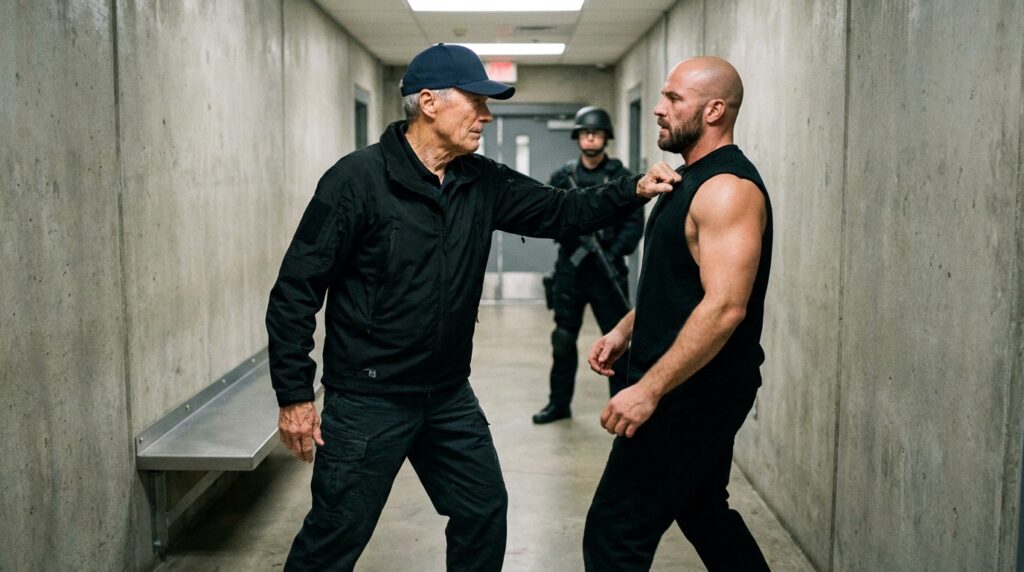
CHAPTER 14: THE SILENT TRANSIT
The linoleum floor of the utility closet gave way to the textured rubber matting of the main exit lane with a short, soft click of the veteran’s heel. The administrative wing of Sector 4 had transitioned back to its baseline metric; the automated overhead lamps hummed at sixty hertz, casting a flat, unblinking glare across the white acoustic ceiling tiles.
The veteran walked with his shoulders square, his arms hanging loosely at his flanks to mask the five-pound block of canvas and copper rivets pressing against his left ribs. Beneath the low brim of his navy service cap, his eyes didn’t swing toward the security monitors. He kept his gaze locked on the lower edge of the glass partition at the primary exit gate, thirty yards out.
The intake clerk who had rejected his legacy card an hour earlier was gone, replaced by a younger woman with the same company patch sewn onto her gray nylon polo shirt. She didn’t look up from her screen as his boots approached the turnstile. Her fingers maintained a swift, unbroken cadence on a touchscreen terminal, clearing the routine transit logs for the mid-tier shifts.
“Credential,” she murmured, her hand reaching out toward the scanner plate without her eyes leaving the data columns.
The veteran didn’t present the laminated retirement card. He reached into his pocket and pulled out a standard, three-dollar private carrier token—a blank piece of blue plastic he had picked up from the terminal kiosk before dawn. He let it drop onto the optical glass with a short, heavy snap.
The scanner gave a flat, mechanical chime. The green LED bar at the base of the turnstile gate flickered twice, its internal database processing the token as an unindexed courier delivery from the local logistics pool. The electronic latch opened with a dull clunk that sounded exactly like the hydraulic gate three hundred feet below, though the sound here carried no structural weight.
“Have a good afternoon, sir,” she said to the glass.
The veteran passed through the stainless steel arms, his black tactical uniform catching a small drift of cool, damp air from the open exterior vestibule ahead. The smell of the facility—the dry ozone, the curing lime, and the grease from the elevator shaft—dissolved within two paces, replaced by the heavy, metallic scent of city rain falling on hot asphalt.
Outside, the gray afternoon had turned into a steady, desaturated downpour that blurred the lines of the perimeter fence lines. The security towers at the outer fence looked like dark concrete needles against the low cloud cover, their searchlight housings locked into a fixed, inward-facing tracking angle. They weren’t looking for a lone operator walking toward the public transit line; their systems were programmed to flag multi-vehicle movements inside the high-value transport lanes.
He didn’t quicken his pace. He maintained the same unhurried, heel-to-toe stride through the slick puddles, his leather boots breaking the surface tension of the water without a splash. Behind him, the glass doors of the intake terminal slid closed, sealing the silence of the corridor behind three inches of reinforced polymer.
At the edge of the access road, a rusty blue steel mailbox stood beneath a dead telephone pole, its surface pitted with orange scale that flaked off in the downpour. The veteran stopped for less than three seconds, his hand sliding beneath his shirt to verify the position of the binder. The copper rivets were cold against his skin, but the canvas had stayed dry.
Through the gray curtain of rain, the rhythmic, high-frequency whistle of a distant facility siren began to crawl down from the upper roofs of Sector 4. The command team had finally processed the dead log on Vault 3, but the lane out to the highway was already open.








