
CHAPTER 4: THE FOREARM CHECK
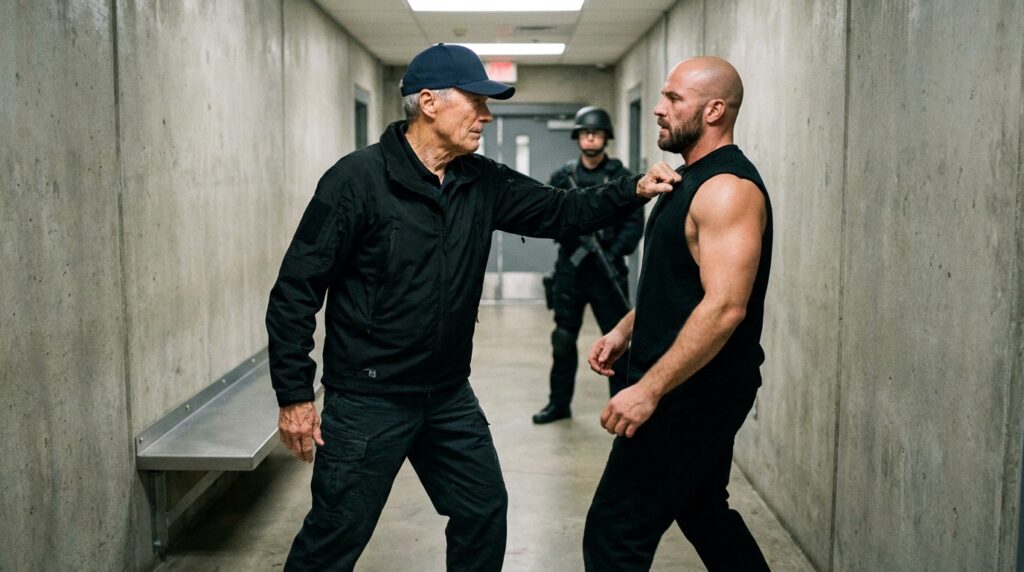
The contractor’s mass rolled forward like a shifted load in an unbraked bed. His left shoulder dropped, his jaw tight beneath his beard, committing his entire centerline to a blunt, crowding push that would pin the older man against the bolted structure of the bench. It was a movement built on thousands of hours of gym-floor metrics and low-tier corridor enforcement—heavy, predictable, and entirely dependent on the assumption that an elderly spine would fold under a direct application of weight.
The veteran didn’t retreat. His left boot didn’t slide an inch across the fine grit of the concrete floor. Instead, he stepped directly into the path of the advance, choosing the exact millisecond before the contractor’s forward foot could plant and lock its leverage.
The movement was an exercise in perfect skeletal mechanics. Raising his right arm in a compact, vertical arc, the veteran kept his elbow tucked tightly against his ribs, aligning the dense, thick radius bone of his forearm with the exact center of his own sternum. He didn’t swing. He didn’t strike. He simply set his mass—rooting his rear heel into the floor’s expansion joint and letting the kinetic energy of the contractor’s two hundred and forty pounds collide with an immovable, perfectly braced pillar of old bone and locked joints.
The impact was loud, a dull, hollow thwack that sounded like a heavy sack of grain dropping onto a timber floor. The air was instantly driven from the contractor’s lungs in a short, wet gasp.
The giant’s forward momentum didn’t just stop; it reversed. Because the veteran had anchored his frame into the structural core of the room, the entire force of the contractor’s rush bounced off the forearm check and traveled backward through his own collarbone. The massive younger man recoiled in pure, unadulterated surprise, his boots scraping wildly against the concrete as his hips tilted backward. He took one heavy, clumsy, controlled step in reverse just to keep his balance, his arms flailing slightly before his heels caught the floor and stabilized his frame.
The narrow corridor became completely silent, save for the scraping sound of tactical rubber soles trying to find purchase on the gritty floor.
The veteran didn’t follow up. He remained exactly where he had planted himself, his forearm still raised in a textbook defensive guard, his lean frame balanced and ready for the next transition. His face beneath the low brim of his navy service cap showed no flush of heat, no tremor of exertion. His pulse, steady and cold, barely registered the collision. Through his boots, the low-frequency vibration of the cooling fan beneath the bench continued its stuttering broadcast, but now a secondary inductive field seemed to click inside the adjacent wall panel, acknowledging the massive kinetic disruption in the corridor.
The contractor stood five feet back, his chest heaving as he forced air back into his bruised lungs. His thick hands were open, the fingers twitching with a mixture of shock and instinctive anger. The skin above his beard had gone a mottled, pale gray where the impact had rattled his breastbone. He looked down at the center of his black sleeveless shirt, where a faint, white line of fine concrete dust from the veteran’s sleeve had been printed directly over his tattoos.
“You…” the contractor started, but his voice broke on the intake, the gravel of his own throat matching the dry air of the facility. He shifted his weight to his rear leg, but this time his posture was hollow—the center of his gravity had been pushed too far back, and his heels were heavy against the floorboards.
The armed guard in the midground hadn’t moved a muscle, but his entire position had changed. His body was leaned back away from the interaction lane, his chin tucked into the collar of his tactical vest as his visor tracked the old man’s steady posture. He had seen riots in the yard and high-value transits go sideways with blades, but he had never seen a human frame stop a charging operator without moving an inch from its marks. His hand, which had been resting on his sidearm’s retention clip, slowly dropped away, his fingers curling into a loose, respectful fist against his thigh.
The veteran slowly lowered his arm, his wrist rotating with that same silent, mechanical precision. He didn’t look at the guard, nor did he look at the clerk behind the partition glass. His eyes remained locked on the contractor’s pupils, tracking the rapid, erratic movement of the giant’s irises as the younger man tried to calculate how an asset with seventy-eight years of wear on his joints had just hit him with the weight of an iron bulkhead.
“The lane,” the veteran said, his low, gravelly voice cutting through the ozone-scented air like a cold blade through grease, “is closed to commercial traffic.”








