
CHAPTER 7: THE RECKONING OF THE LEDGER
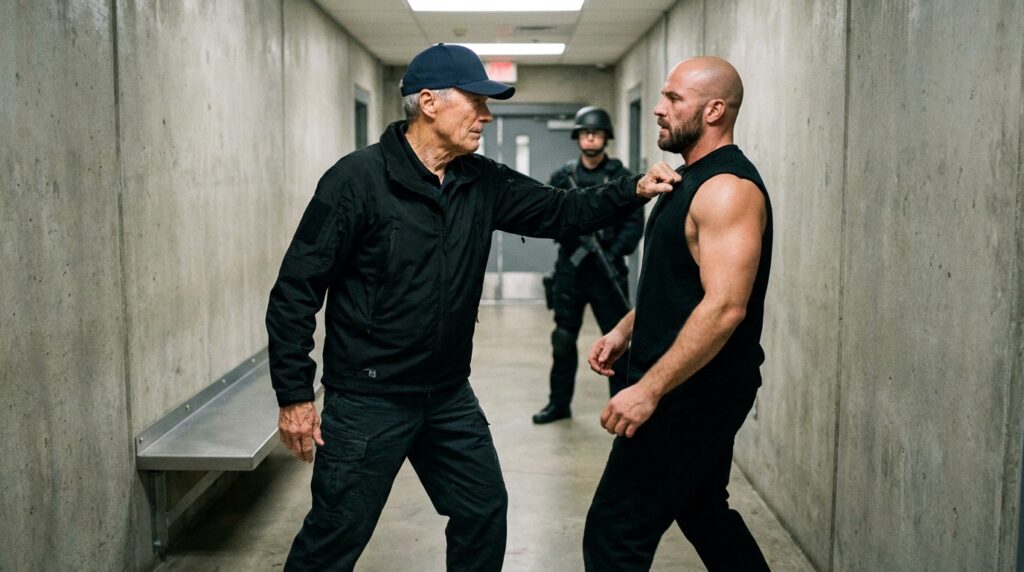
The heavy iron panel of the inner security gate did not swing smoothly. It ground its lower edge against the uneven, grit-streaked concrete floor, tearing a long, raw scoring mark through the gray industrial sealant. The emergency backup lighting cast a desaturated, crimson wash across the lane, turning the smoke from the shorted-out bench grille into drifting ribbons of dark ink.
The contractor froze five feet from the turnstile, his heels skidding slightly before his posture went rigid. His good arm dropped down to his flank, his thick fingers uncurling from the frame of the pneumatic breaching tool. The malice that had sharpened his features during the blackout vanished, replaced by a sudden, hard architectural calculation as a pair of polished leather riding boots stepped over the grinding threshold from the dark archive cells beyond.
The boots were flawless—lacking the fine coating of concrete dust that fouled every other surface in Sector 4. Moving upward, the dark wool trousers carried a sharp, military crease that terminated at the waist of a tailored service coat. It wasn’t the uniform of a private contractor or a standard base tier guard.
The man who entered the lane was sixty years old, his silver hair cropped close to a skull that looked as if it had been carved from the same cold granite as the facility’s foundations. On his right hand, resting loosely against the brass hilt of a ceremonial sidearm, he wore a pristine silver signet ring engraved with a three-pronged star inside a notched family crest—the private standard of General Vance, the operational director who had signed the liquidation orders for the old Seventh Bureau in the autumn of 1986.
The veteran did not adjust his stance. He remained rooted by the sheared base of the iron bench, his left hand still pressed against the rusted metal surface, his thumb over the small carved notches. He looked up, his unblinking gaze passing over the commander’s polished brass buttons until it settled squarely on the signet ring.
The weight of forty years of institutional dust seemed to settle into the narrow hallway. The logic was no longer a matter of barcodes or network tokens; the lineage of the betrayal had a face, and it had inherited the keys to the archive from the man who had written the original cross-clearance logs.
The commander stopped three paces from the veteran. His leather soles made a sharp, clean click on the grit, a sound that carried the absolute weight of a sovereign authority that didn’t need to borrow its power from a commercial manifest. He looked down at the faded navy service cap, tracking the salt-stained lines along the brim with an expression that carried no anger—only a cold, historical recognition.
The armed guard in the midground didn’t wait for a command. The small amber string on his helmet display had vanished, replaced by a universal security lock indicator. His entire body snapped straight, his heels coming together with a sharp, metallic ring against the concrete floorboards as his chin tucked into a rigid, unquestioning posture of absolute deference.
The contractor tried to step forward, his jaw working as he pointed a thick, tattooed finger toward the broken grille beneath the bench. “Commander, the asset sabotaged the local interface loop. He’s carrying an unregistered legacy token. We were moving to isolate—”
The commander did not turn his head. He didn’t lift his eyes from the veteran’s weathered face. He raised his right hand—the one bearing the signet ring—by two inches, a single, compact gesture that cut the contractor’s explanation off in the middle of a syllable. The silence that followed was heavy with the smell of ionized battery fluid and the cold, stagnant draft from the lower vaults.
“Leave the corridor,” the commander said. His voice was smooth, polished by decades of high-level administrative briefing, lacking the gravel or the friction of the men who did the physical labor in the lanes. “Your logistics team has completed its manifest. The remaining arrays are now under direct departmental custody.”
“The array isn’t clear,” the contractor muttered, though his boots were already shifting backward toward the automated turnstiles, his weight leaning away from the desk where the clerk remained perfectly still behind the glass partition. “The file logs are still cycling.”
“The logs are where they belong,” the commander murmured.
He turned fully toward the veteran. Slowly, with a deliberate, rhythmic precision that belonged to an era before the migration to digital tokens, the commander raised his right arm. His elbow tucked against his ribs, his hand flattening into a straight, rigid line even with the temple of his silver brow. He snapped a formal, full-dress salute—a gesture of absolute institutional deference rendered to a man who officially didn’t exist on any live roster in the United States.
The contractor’s mouth dropped slightly, his boots freezing on the turnstile plate as he witnessed the entire hierarchy of the facility reorder itself around the old man’s navy cap. The guard remained frozen in his stance, his visor tracking the signet ring as it held the salute in the crimson glare of the emergency lamps.
The veteran didn’t return the salute. He slowly pulled his hand away from the rusted bench, his fingers cold from the iron. He let his arms hang loosely at his sides, his athletic frame perfectly centered, an old gatekeeper who had finally located the deep-archive line he had spent half a lifetime tracking through the gray.
“The ledger is still open, Vance,” the veteran said softly, his gravelly voice cutting through the mechanical hum of the failing hydraulic gate.
The commander dropped his hand, his silver ring catching the last red pulse of the security sensor. “Then we had better go down into the vault and finish the entries.”








