
CHAPTER 2: THE BREACHING POINT
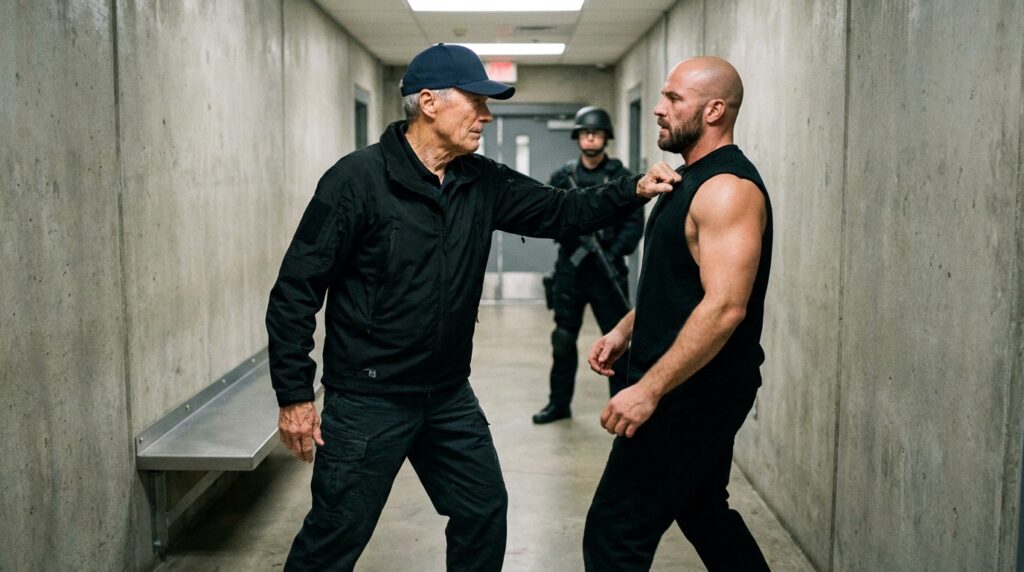
The thumb of the contractor’s glove was rough, the synthetic fabric worn down to a fraying weave that scraped against the veteran’s shoulder. It was a pressure designed to make a lesser man lean away, to create a tilt in the spine that signaled submission before the first ounce of true force was even applied.
The veteran didn’t tilt. He allowed his shoulder to absorb the initial contact, treating the giant’s hand like a mechanical failure in a piece of heavy machinery—something to be calculated, timed, and then cleared from the gears. Beneath his boots, the vibration of the manual override lock inside the wall casing went cold. A single, heavy metallic thud resonated through the concrete flooring, a sound that only someone who had spent decades waiting behind closed bulkheads would isolate from the generic hum of the facility’s air scrubbers.
The override code hadn’t been an automated pulse. It had been typed manually, with a uneven, three-beat pause between the fourth and fifth digits. Tap-tap-tap-tap… tap-tap. The specific cadence belonged to a field manual procedure that had been decommissioned in the late eighties, an operational shorthand used by the old Seventh Bureau to signal an emergency extract under fire.
“The name on the door is private asset logistics,” the contractor muttered, his face lowering until the shadow of his heavy jaw completely eclipsed the light on the veteran’s cap. His fingers tightened, gathering the black fabric of the uniform into a bunch. “That means the rules are whatever we write on the manifest. Now back your heels out of my lane before I show you how we handle surplus property.”
“The card doesn’t have a name,” the veteran said. His chin remained level, his gaze fixed on the small, rusted screw head anchoring the clerk’s computer terminal to the desk. “It has an index number. If you knew how to read a three-digit suffix, you’d be standing three feet further back.”
The clerk behind the glass stopped moving completely. His hand stayed hovering over his mouse, his eyes darting toward the security feed monitor at the edge of his desk. The terminal screen flickered once, a line of legacy code—green text against a dead black background—bleeding through the modern Windows interface for less than half a second before being suppressed by the network’s firewall.
“I don’t read paper,” the contractor growled. He shifted his weight, his rear heel lifting slightly off the concrete as he prepared to drive his shoulder forward to clear the lane by force. “I clear blockages.”
The veteran didn’t wait for the mass to descend. He let his breath out in a short, silent exhalation, dropping his center of gravity by a fraction of an inch as his left boot pivoted inward. The movement was tiny, almost invisible beneath the stiff denim of his trousers, but it locked his skeletal frame directly into the floor’s expansion seam.
Before the contractor’s arm could extend into a full shove, the inner security door at the far end of the processing lane clicked. The latch didn’t open, but the pressure inside the corridor shifted. A small wisp of cold air, smelling faintly of old sulfur and wet iron, escaped from beneath the door frame.
“You’re using an unauthorized keyway,” the veteran said, his voice dropping into that gravelly, immovable register that didn’t require volume to carry.
The contractor didn’t register the words. His forward momentum was already locked in. His massive forearm came up, thick with tattooed vines that twisted around old scar tissue, intending to use his elbow as a wedge to force the older man against the bolted iron bench lining the wall.
The veteran’s right hand moved. It wasn’t a strike; it was a small, circular rotation of the wrist that caught the contractor’s thumb at the joint, utilizing the leverage of the giant’s own grip to twist the alignment of his wrist by five degrees. The friction of the synthetic glove fabric against his skin made a dry, snapping sound.
The contractor’s eyes widened slightly, not from pain, but from the sudden, inexplicable loss of leverage. His balance, which had been calculated to crush an old man’s frame against a hard surface, found nothing but an oiled hinge that absorbed the impact and redirected it downward into the concrete.
“Watch the line,” the guard in the midground called out. His voice was tight, his gloved hand moving down toward the retention strap of his holstered sidearm. He hadn’t stepped forward yet, but his boots shuffled back, trying to clear his own line of sight in the narrow hallway. “Keep your distance from the desk.”
The clerk didn’t answer. He was staring at his terminal, where a small icon—a three-pointed star inside a broken circle, the old seal of the logistics branch—had just begun to spin in the bottom right corner of the taskbar.
The veteran held the contractor’s wrist fixed in space for one heartbeat, his thumb pressed against the small radial bone just above the glove line. He could feel the giant’s pulse—fast, heavy, driven by an adrenaline spike that hadn’t expected an obstruction.
“The three-digit suffix,” the veteran whispered, his eyes finally lifting to meet the contractor’s stare beneath the brim of his navy cap. “It means the man who holds this card doesn’t leave a trail for your company to buy.”
The inner door at the end of the hall gave a second, louder pop, and the heavy iron panel began to swing inward into the dark.








