
CHAPTER 9: THE LEVERAGE CRITICAL
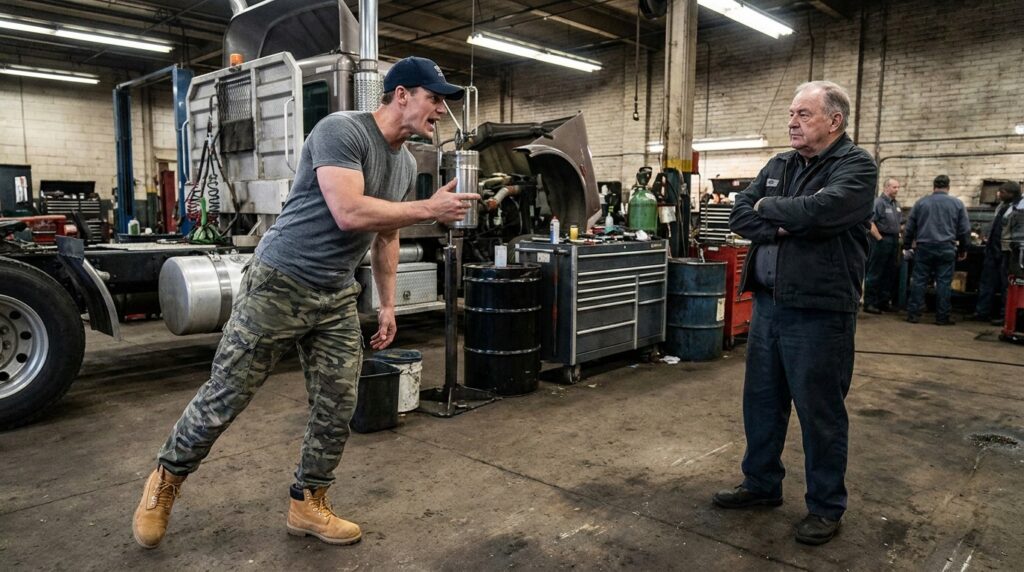
The six-foot beam wrench rattled against the truck’s heavy steel rim as a fresh blast of frozen rain hit the high corrugated siding of bay three. Down in the overhaul trench, Miller’s muscular back was slick with black water and pulverized road salt. His gray T-shirt was torn at the left shoulder blade where he had scraped against a jagged chassis bracket, the fabric stiffening from the freezing draft cutting under the heavy rolling doors.
“Hold the jack saddle steady!” Miller roared, his voice bouncing hoarsely off the unyielding iron underside of the northern transport. He jammed his boot heel into the floor grid, his thigh muscles locking as he wrestled the heavy, sixty-pound mechanical shackle assembly into alignment with the frame rail. “If that hydraulic ram slips before the pin clears the knuckle, the whole hanger is going to shear.”
The two apprentices above him didn’t look up. They were leaning over the fender wells, their hands numb inside their frayed split-leather gloves, pushing their full weight against a manual pry bar to counteract the twisted tilt of the trailer frame. The continuous, ear-splitting drone of the main shop hoist filled the floor—not the usual smooth operation, but a high-pitched, straining scream that signaled the internal pneumatic seals were blowing past their structural tolerance.
The old man stood on the raised steel walkway, his dark civilian coveralls buttoned to the throat, a heavy oil rag tucked into his leather belt. He didn’t pick up a pneumatic impact gun. He kept his hands flat against the cold iron railing, his unblinking stare fixed on the lower manifold of the primary lift where a thick, high-pressure line was beginning to bulge near the main control valve.
“The pump pressure is sitting at four hundred over the line limit, Miller,” Garrett said. His voice didn’t cut through the noise; it seemed to travel beneath it, flat and metric, carrying the unhurried authority of a man who knew the breaking point of every valve in the building. “Vance didn’t just clear the manifest ledger from the office terminal. Before he went up those steps, he over-torqued the safety return line to force the hoists to hold the extra tonnage without cycling the cooling valves.”
Miller didn’t drop the beam wrench. He reached up, his grease-blackened fingers catching the knurled locking collar of the dial scale, his thumb feeling the gritty drag of iron shavings inside the adjustment threads. “The next four trucks are already stacked up outside the chain-link gate, Mr. Garrett. If we pull the air lines to bleed the manifold now, the yard gridlocks. The state transport inspectors will be at the perimeter line in twenty minutes. If they see four trucks sitting on dead jacks with uncertified shackle pins, the facility certificate is done before the sun clears the tree line.”
“The certificate is already done, son,” Garrett said, his boots making a single, crisp click as he moved down the steel steps toward the pit margin. He didn’t look at the office window where Vance’s desk light was still casting a yellow square through the wire-glass. He looked at the mechanical tracking dial on the side of the lift. “The blue drive in the office desk didn’t just carry a second set of invoice codes. It carried the routing tables for every salvage pallet shipped out of the southern hub since last November. The steel you’re trying to bolt into that frame wasn’t rejected by the depot. It was paid for as new premium Ohio stock, and the difference in the ledger went into a private account across the line.”
Miller’s shoulders went rigid beneath the truck’s mass. His clean-shaven face was drawn, his skin gray from tactical exhaustion as he looked from the stripped threads of the shackle bolt up to the old man’s steady profile. The realization didn’t hit him like an administrative notice; it hit him like a cracked iron casting—the understanding that his entire shop, his speed records, and his modern digital telemetry had been used as a screen for an international asset drain.
“They used my turnarounds,” Miller muttered, his throat clicking as he spat a mouthful of grit onto the wet concrete. His fingers slipped twice on the heavy handle of the beam wrench before he could lock his grip. “They ran the numbers through my login because the system flags an old-timer’s code if the timeline moves too fast.”
“They used your pride, Miller,” Garrett said, his voice level and dry as he reached down into the tool chest to retrieve a manual brass pressure gauge whose casing was green with oxidation. “They gave you a digital clock to watch so you’d stop feeling the friction under your feet. Now get out of the pit.”
Before Miller could shift his heels, the bulging pneumatic line near the primary valve split with a sound like a rifle shot. A high-density spray of atomized hydraulic oil and frozen condensation erupted from the manifold, obscuring the service bay in a grey, whistling fog that smelled of scorched rubber and sulfurous gear oil. The heavy semi-truck chassis dropped three inches with a terrifying, metal-on-metal groan as the main lift cylinder lost its holding pressure, the massive iron frame settling directly toward Miller’s pinned shoulder.
Garrett didn’t lunge. He stepped marginally inside the line of the hydraulic control arm, his weight transferring entirely into his heels as his thick, scarred fingers caught the auxiliary manual override lever—a rusted iron bar that Vance had painted over to keep it locked in place. With a single, disciplined balance shift, the old man threw his entire frame against the iron lever, using pure mechanical advantage to drop the secondary safety dogs into the teeth of the hoist rack just as the primary cylinder failed completely.
The steel teeth caught with a deafening, echoing shatter that shook the concrete floor from bay three to the back parts room. The truck stopped an inch from Miller’s chest, its massive frame vibrating against the iron stops while the severed air line continued to whip and hiss against the stone.
Miller scrambled out of the trench, his knees shaking within his heavy camouflage trousers as he reached the safety line. He looked back at the unmoving figure of the old man, who still held the iron override lever down with one hand, his posture completely unyielding against the grey, whistling cloud of the ruptured bay.
From the front gate of the yard, the sharp, rhythmic wail of a dual-tone siren cut through the fog as the first state transit investigator’s unit cleared the outer perimeter.








