
CHAPTER 6: THE RETRACTED ANCHOR
The iron door at the top of the office stairs banged shut, the latch rattling inside its frame with a loose, tinny sound. Down on the floor, the yellow carbon work orders Vance had left behind lay strewn across the corner of the greasy tool cart, their corners fluttering each time the overhead heater kicked its draft into the bay.
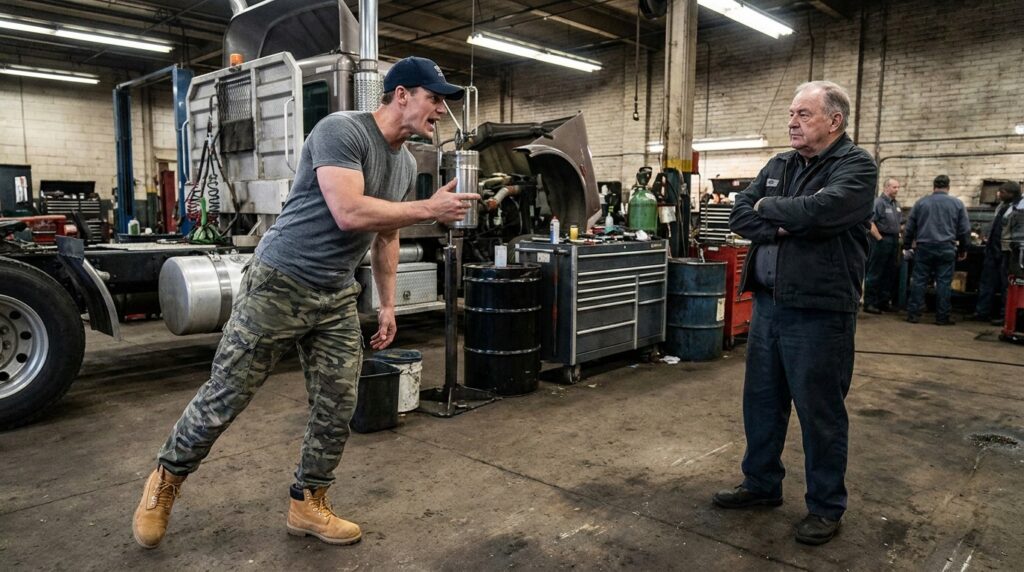
Miller stepped out from the gap between the dual tires. He didn’t look tall anymore; his shoulders were drawn inward, the gray T-shirt damp with sweat that had turned dark from the grease scaling along the semi-truck’s undercarriage. He looked down at his navy cap, still resting in the puddle of water by the front axle, then reached down and picked it up by the brim, wringing the moisture out with a single, brutal twist of his wrist.
“He won’t stop those northern rigs,” Miller said, his voice dropping into a flat, exhausted register that matched the grey masonry of the walls. “They’re already past the state checkpoint. The automated dispatch logs them at forty-mile intervals. If I refuse to sign off on the shackle pins when they hit the hoist, he’ll just pull my credentials from the terminal and run the cycle under his own supervisor code.”
The old man did not move to follow Vance’s path. He reached into his pocket, his thick, scarred fingers closing around the notched steel calibration shim that had skittered against his boot. He picked it up, feeling the crude, fresh file marks along its edge with the ball of his thumb.
“A supervisor’s code doesn’t change the yield point of the metal, son,” the old man said. He laid the shim exactly on top of the blank signature line of the nearest work order. It sat there like a weight, holding down the yellow paper against the cold air. “The holding company doesn’t look at the name on the terminal until the chassis cracks. They look at the stamp on the knuckle.”
“You don’t understand how the contract is built,” Miller said, his fingers tightening around the damp fabric of his navy cap until his knuckles showed white beneath the grease stains. He leaned his hips against the cold iron of the lift frame, his boots sliding an inch through the dry grit. “Vance isn’t shorting the parts because he wants a bonus. He’s shorting them because the depot hasn’t shipped proper spec iron to this district in six months. They’ve been routing the Ohio steel to the urban lines down south to keep the priority transit contract solvent. We get the salvage pallets or we get empty hoists. If the bays go empty for forty-eight hours, the regional board pulls the facility certificate. The whole shop goes into default.”
The old man listened, his head tilted slightly toward the open bay doors. From the outer yard, past the chain-link perimeter fence, the low, multi-toned rumble of a multi-axle commercial transport began to grow, its transmission whining as it dropped gears to make the turn off the county route. The headlights cut through the heavy ground fog, throwing two long, white bars of light across the grease-slicked concrete of bay three.
“The facility doesn’t go into default because the iron is late,” the old man murmured, his voice maintaining that dry, historical clarity that had kept the room silent since the first hour. “The facility goes into default because the men inside it stopped measuring the clearance with their fingers.”
He reached down, his heavy hand closing around the handle of the old manual beam wrench he had left on the locker. He didn’t lift it to use it again; he simply turned the dial back to zero, his thumb feeling the click of each detent as the spring inside settled into its housing.
“The log is already updating,” Miller said, pointing a thumb toward the wall-mounted terminal behind the tool chest. The green indicator light had begun to pulse in a rhythmic, rapid sequence, signaling that the northern transport was being entered into the active bay queue by Vance’s remote terminal upstairs. “He’s clearing the bay three manifest from the desk. According to the board, this rig is already on the highway.”
The old man didn’t look at the screen. He turned his side-profile toward the approaching headlights, his solid frame completely blocking the white beams as the front bumper of the incoming truck cleared the threshold of the outer gate.
“Let him sign it,” the old man said, his unblinking gaze fixed on the driver’s cab as it air-braked to a halt outside the bay line. “The signature only works as long as the ledger stays in the office.”
He stepped off the walkway, his dark leather boots making a final, flat click against the yellow line before he stepped into the shadow of the incoming chassis.








