
CHAPTER 11: THE TERMINAL CLEARANCE
“The uplink is dead, Garrett,” Vance said, his shoe soles dragging heavily down the iron steps until he reached the concrete of the bay floor. His canvas jacket was completely unbuttoned, the company lanyard hanging slack against his shirt like a broken hoist chain. He laid the blue ruggedized tablet flat on the metal top of Miller’s rolling tool chest, right next to the hand-filed calibration shim and the brass pressure gauge. The screen was no longer flashing amber or green; it had settled into a solid, desaturated white—the final system lock code of a remote corporate purge.
The emergency strobes from Kincaid’s utility unit continued to wash across the rusted surfaces of the center bay, throwing a rhythmic red and blue pulse over the massive frame of the third northern transport idling outside.
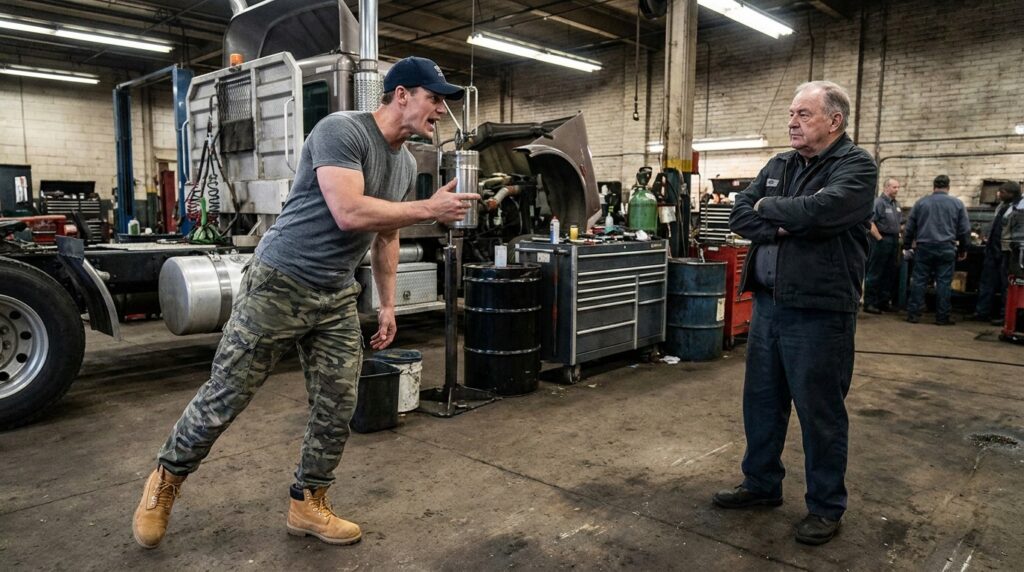
Mr. Garrett did not shift his feet from the yellow pit margin. He kept his hands loose at his sides, his dark leather work boots staying perfectly parallel along the concrete edge. He looked at Vance’s open collar, then down at the white glass of the locked tablet. There was no victory in the old man’s gaze, only the flat, metric observation of a mechanic looking at a stripped gear that could no longer hold its torque.
“The uplink didn’t clear the localized cache, Vance,” the old man said. His voice carried the same programmatic weight that had held the entire shop silent since the first hour. He reached into his dark coveralls and pulled out a heavy leather-bound inspector’s logbook—the thick, hand-ruled ledger that had sat inside his aluminum brief box. He laid it flat across the white screen of the dead tablet, the thick paper fibers striking the plastic casing with a solid thud. “The central database reads the signal from your supervisor fob, but the physical yard manifest doesn’t uncouple from the iron until I sign the release block.”
Kincaid stepped closer, his heavy trench coat rustling as he set his tact case down beside the locker. His fingers remained loose near the latch of his clipboard, his eyes tracking the rows of handwritten serial codes filling the open pages of Garrett’s ledger. Every entry carried a three-state cross-reference stamp—the master logistics seal of the parent holding network, dated five years before Vance had even applied for the supervisor lease.
“The state line run is frozen, Mr. Garrett,” Kincaid said, his voice dropping into a level, transactional rumble that barely carried to the back benches where the apprentices stood. He pointed a finger at the red serial prefix US-441-B ground into the leaf spring beneath the tri-axle chassis. “If these codes match the salvage manifest from the southern hub, the embezzlement case crosses the jurisdiction boundary before noon. The federal transit division takes the ledger.”
“Let them take the ledger,” Garrett said, his unblinking profile catching the sharp glare of the flashing strobes. “The ledger is already duplicated on the central transit terminal in Ohio. The blue drive you were looking for wasn’t a shortcut to save the facility score, investigator. It was the verification loop for the third-party distributor’s accounts. Vance wasn’t working for the competitor. He was working for the board members who signed the lease.”
Miller took a slow step forward out of the shadow of the tire frame, his muscles stiff under his torn gray T-shirt, his face dark with grease and cold rain. He looked at Vance, then at the old man’s heavy frame, his hands tightening around the handle of the six-foot manual beam wrench he still carried like a standard. The bravado that had driven his forward advance three hours ago was entirely gone, replaced by a raw, somatic exhaustion that showed in the line of his shoulders.
“The northern transport lines,” Miller muttered, his throat clicking as he looked out toward the headlights in the yard. “If the parent company owns the salvage pallets, then the fleet was never meant to pass the state safety audit. They were forcing the district into default to clear the maintenance contract for a private sale.”
“They were clearing the liabilities, son,” Garrett said, his voice level and dry as he reached down to pick up the manual wrench from the locker top. He didn’t lift it to threaten; he simply set the jaw width back to the standard spec with a single, practiced click of his thumb against the knurled adjustment screw. “They forgot that the iron remains on the floor after the ledger is burned. When you skip the hand-check because you think the system is too big to feel the friction, you’re the one who ends up underneath the frame.”
He turned his heavy body toward the open bay doors, where the cold dawn light was finally turning the ground fog into a thin, gray mist across the yard asphalt. The third transport engine dropped its idle, its driver waiting for the yellow light on the gate post to shift from hold to clear.
“Put the long-reach mirrors back in the racks, Miller,” the old man commanded, his boots making a clean, parallel sequence of strides as he headed toward the office steps, his hand keeping the leather ledger tucked deep against his side like a tool that had survived thirty winters. “And tell the morning shift to change the pins by hand. We’ve got twenty-four rigs to make honest before the road opens.”
He didn’t look back to see if they followed. He just climbed the iron risers one step at a time, his weight balanced perfectly over his heels, while the sound of his boots echoed through the high corrugated rafters of the bay until the room was completely quiet.








