
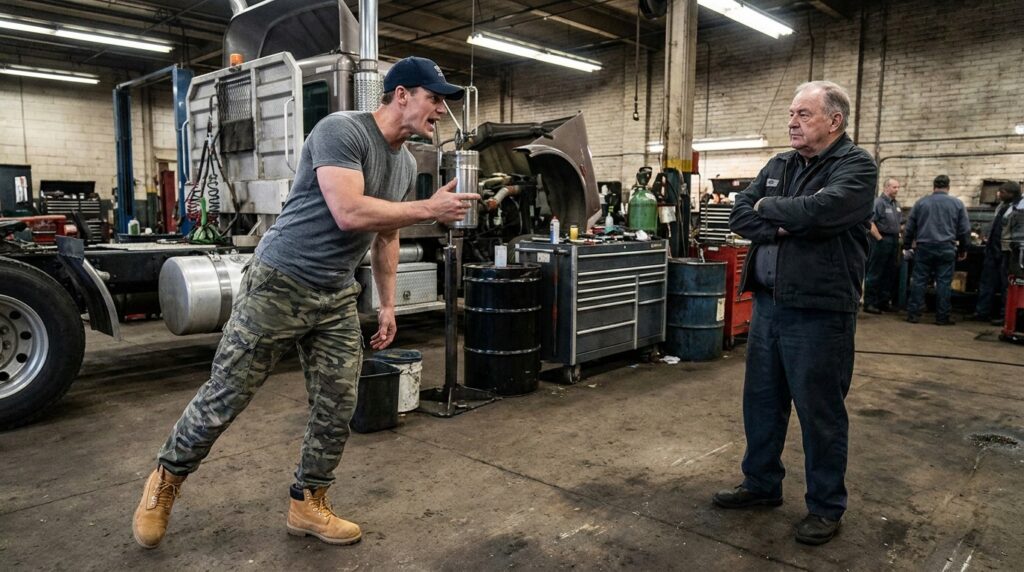
CHAPTER 3: THE FRICTION OF THE BAY
Miller rose slowly, the textured rubber of the semi-truck’s front tire bracing his spine until his knees locked into place. The tall mechanic didn’t dust off his trousers. His jaw muscle twitched, a tight lump forming along the bone as he kept his stare leveled downward, fixed on the grease-filmed metal base of the tool cabinet rather than meeting the old man’s gaze. Across the floor, the low hum of the stationary compressor cycled off, leaving only the dripping rhythm of differential oil hitting a metal drip pan three bays down.
“The replacement springs came out of the regional depot on Tuesday,” Miller muttered, his throat dry, his hand dropping to the heavy steel latch of the drawer beneath his diagnostic array. “They were stamped and logged. If the line is starved, it’s an installation fault from the night shift. Not my build.”
The old man did not offer a contradiction. He turned his heavy frame toward the side tool locker, his dark leather work boots crunching softly on the scattering of iron filings and dry grit near the hoist. He reached down, his scarred fingers selecting a long-reach mechanical inspection mirror and a hand-cracked flashlight whose aluminum casing was pitted with grey oxidation.
“The night shift doesn’t file the calibration shims, Miller,” the elder said. He didn’t drop his voice to hide the words from the apprentices, but he didn’t raise it either. The tone remained level, flat, carrying the cold, programmatic authority of an inspector who had measured clearance tolerances before Miller’s father had entered an apprenticeship. “The night shift handles the grease-packing and the shackle pins. They don’t touch the telemetry boards unless someone leaves a signed work order on the spindle.”
He knelt by the rear tandem axle, his movements unhurried, lacking the fluid spring of youth but possessing a absolute certainty of balance that left his weight perfectly centered over his heels. The floor was cold here, the raw concrete absorbing the northern draft from the open bay doors. He slid the inspection mirror beneath the main frame rail, angling the glass past the heavy brake chambers toward the hidden shoulder where the leaf spring nested into the main hanger.
The flashlight beam cut through the hanging particulate of aerosol degreaser and diesel exhaust. Underneath the fresh black chassis paint, the steel of the spring leaf didn’t show the uniform gray of a new forge. It was pitted. The edges were uneven, showing the heavy, layered scaling of a component that had sat in a salvage yard or a salt-air storage depot for five winters before being ground smooth and coated with quick-drying acrylic.
The old man’s thumb traced the outer face of the spring retainer. His nail caught on a stamped serial number—US-441-B.
He didn’t speak for a full minute. He simply held the light on those five characters, his eyes measuring the depth of the stamp. The regional depot invoice sitting on the clipboard by the supervisor’s desk didn’t carry that prefix. The contract for the county logistics fleet explicitly specified US-500-Heavy Duty spec iron, forged in Ohio, certified for thirty-ton cross-state hauls. The 441 series was retired surplus from an old military supply line—brittle steel, prone to micro-fractures when subject to rapid thermal shifts under heavy loads.
Miller had stepped closer, his boots clicking in a hesitant, irregular pattern on the concrete until he stood just behind the elder’s left shoulder. His muscular frame cast a long shadow over the wheel well, but the aggressive posture from ten minutes ago was entirely gone, replaced by a rigid, guarded vigilance.
“They’re within the weight tolerance,” Miller said, his voice dropping to a whisper that barely cleared the rumble of an idling utility truck outside the main gate. “The hardness test was verified on the depot floor. The digital sheet came down from the main office with the manifest.”
“The sheet came down because you plugged the shim into the reader to pass the safety audit,” the old man said, his voice remaining low, filtered through the dark space beneath the trailer bed. He didn’t rise from his knees yet. He kept the mirror focused on the leaf spring’s throat, where a hair-thin line of orange rust was already beginning to weep through the fresh black paint—a stress fracture under the initial tension of the empty chassis. “The sheet doesn’t hold the frame together when the driver hits the frost heaves on Route 9. You’re running old salvage iron under a high-priority logistics line, son. That isn’t shortcutting. That’s structural fraud.”
“I don’t buy the parts,” Miller hissed, his hand tightening on the rim of the semi-truck’s steel wheel. “I handle the turnarounds. The shop manager says we use what’s on the pallet or we lose the maintenance bonus from the county. If the rigs don’t roll by Monday at six, the whole facility goes into default. You think the holding company cares about a serial prefix? They care about the schedule.”
The old man slowly stood up, his spine making a series of dry, clicking pops that sounded like small sticks snapping under leather. He didn’t look at Miller. He took the inspection mirror and laid it exactly parallel to the blue diagnostic tablet on the metal tool chest. The small, hand-filed calibration shim still sat there between them, a cold sliver of compromised iron reflecting the gray light from the ceiling windows.
“The holding company cares about what’s signed for in the ledger,” the old man said. He pulled a grease-stained cotton rag from his pocket and began wiping the thin film of oil from his fingers, his movements methodical, rhythmic, unchanging. “And they care about who takes the fall when thirty tons of freight crosses the median into oncoming traffic.”
He turned his side-profile toward the main office stairs at the back of the garage, where a shadow had just moved behind the wired-glass window of the supervisor’s deck.








