
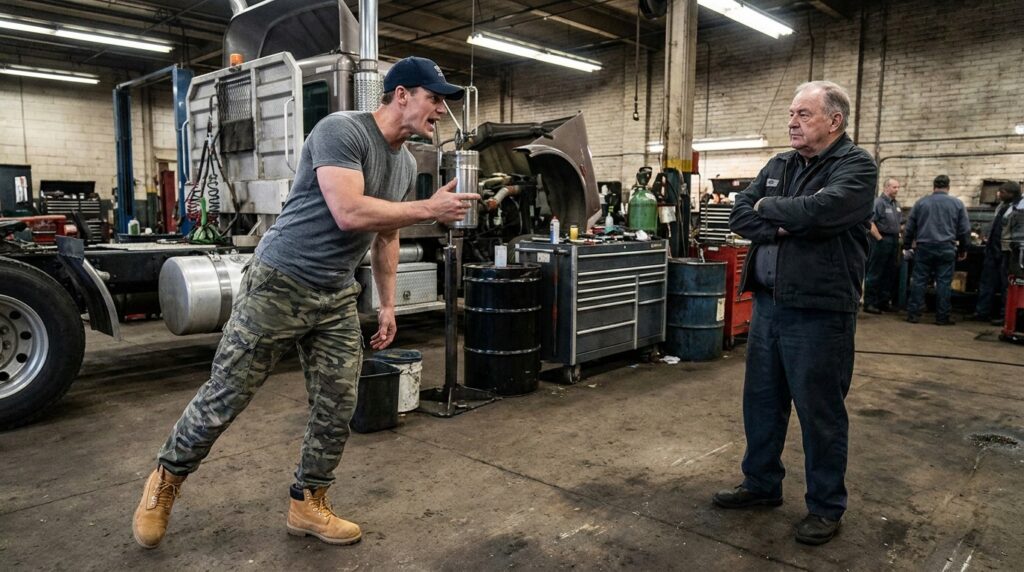
CHAPTER 1: THE FRICTION OF INTENT
“You think strength wins, you’ve never faced real experience,” Miller spat, his shadow completely blotting out the faded gray work shirt of the old man standing by the center hoist.
The industrial air compressor kicked off in the high rafters of the bay, leaving a heavy, vibrating hum in the concrete. Around the perimeter of the service floor, three junior technicians stopped their impact wrenches. The silence spread fast, smelling of diesel oil, sulfur-heavy gear fluid, and the sharp, hot scent of scorched iron plates.
The old man did not shift his feet. His boots, dark leather with heels worn flat by decades of deliberate strides, stayed perfectly parallel along the yellow safety line bordering the truck pit. He looked at Miller’s chin, then up to the tilted brim of the navy cap. There was no sweat on the elder’s face, only the deep-set lines around his mouth that looked less like wrinkles and more like old scoring marks on an engine block. He held a weathered steel wrench in his left hand, his fingers loose around the oily handle.
“The digital readout says the pressure seal on the secondary reservoir is holding,” Miller said, taking another half-step forward. His gray fitted T-shirt was taut across his chest, the camouflage fabric of his trousers rustling against the stiff leather of his new tan work boots. He wanted the room to look. He needed the apprentices at the back benches to see how easily seventy-odd years of old-school stubbornness could be pushed out of a modern shop floor. “We don’t need a hand-check on the line. We don’t need someone listening to the casing with a rod like it’s 1974. The contract changes next month, old man. Clear the lane.”
The old man looked at the semi-truck behind Miller—a massive, tri-axle freight mover with its chrome grille reflecting the cold, desaturated light filtering through the high, unwashed clerestory windows. A single drop of amber oil fell from the oil pan, striking the floor between them with a faint, metallic ping.
“The digital gauge reads the pressure at the sensor,” the old man said. His voice was low, devoid of the gravelly anger Miller had been trying to provoke for three days. It had the dry, rhythmic clarity of an instructional manual read aloud in an unheated room. “The sensor is clean. The line three feet back from the block is restricted. It’s starving the rear actuators.”
Miller laughed, a quick, sharp bark that didn’t reach his eyes. He reached out, his hand open, intending to grab the greasy shoulder of the old man’s coveralls to pivot him toward the exit door. “I said, out of the lane.”
The old man didn’t pull back. He simply lowered his center of gravity by an inch, his shoulders settling as his weight transferred entirely into his rear heel. A small scar, shaped like a notched gear tooth just beneath his left collarbone, twitched beneath the dark cloth.
Miller’s fingers closed on air as the elder moved slightly off the axis of approach. The young mechanic’s own forward lean, built entirely on the assumption of a soft resistance that never came, pulled his balance over the yellow line. His tan boot slipped on a thin film of industrial degreaser, his shoulder tilting toward the concrete as the old man watched him go down.








