
CHAPTER 5: THE CEASEFIRE BOUNDARY
“That’s enough manual checking on bay three,” a sharp voice cut down from the iron steps.
Vance, the shop supervisor, didn’t use the handrail as he descended. His heavy, flat-bottomed work shoes struck each grated riser with a distinct, ringing clack that echoed through the high corrugated ceiling. His canvas jacket was unbuttoned, exposing a company lanyard that swung like a pendulum across his stomach. In his right hand, he held a stack of yellow carbon work orders, their edges curled and grease-smudged from his fingers.
The three apprentices immediately dropped their eyes, their hands moving with sudden, unearned urgency to pick up oil rags or rearrange socket sets on their mobile trays. The dead silence that had held the room since Miller’s fall evaporated into an artificial atmosphere of busy, performative labor.
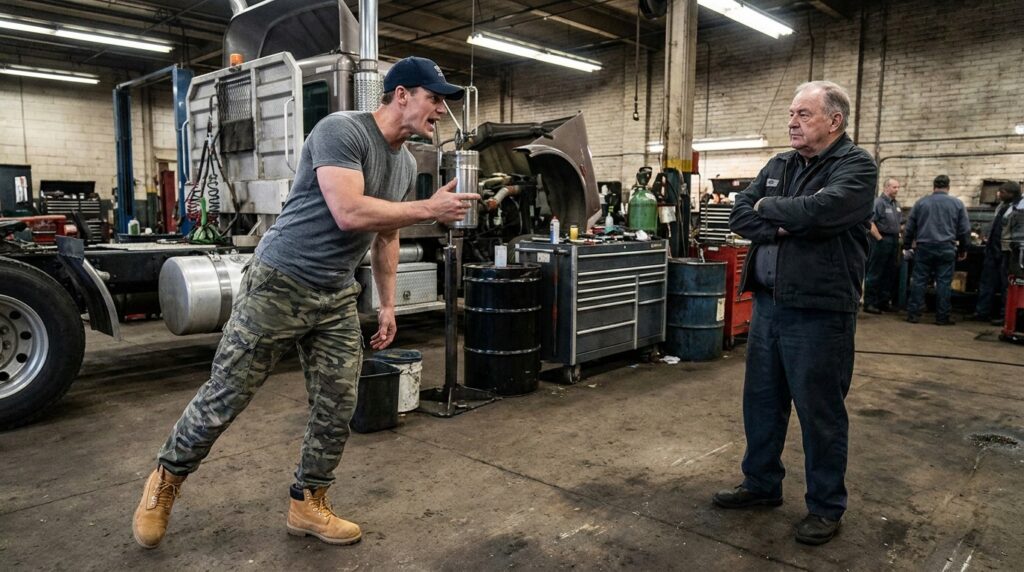
The old man did not spin around to face the approach. He kept his boots planted parallel along the pit margin, his thick shoulder remaining propped against the heavy iron frame of the hoist cylinder. He pulled the oily rag back from his belt loop, slowly clearing a fresh layer of charcoal-colored grease from the beam wrench’s digital scale before setting the tool down on the locker top.
“The shackle bolt on the primary side didn’t hold two hundred pounds, Vance,” the old man said. His voice was low, flat, carrying no more anger than a parts catalog entry. “The internal threads are gone. The hanger is floating on three points instead of four.”
Vance stopped five feet back, his boots crunching on the layer of dry sand scattered over an old transmission fluid spill. He didn’t look at the stripped bolt. He didn’t look at the blue diagnostic interface where the hand-filed calibration shim still gleamed like a coin under the high neon bars. His eyes fixed on the old man’s faded work shirt, his chin lifting just enough to expose the graying bristle along his jaw.
“The unit was cleared by regional logistics at noon, old man,” Vance said, his fingers tightening on the yellow pages until the carbon paper made a dry, rustling hiss. “The automated system doesn’t record thread slippage on a sub-assembly that isn’t due for a full teardown until October. Miller ran the cycle. The board in the main office shows green across the line. If you’re here to do unauthorized inspections on state-contract iron, you can take your book out to the front gate.”
Miller didn’t speak. He had moved three steps back into the dark recess between the dual rear tires, his muscular frame hidden by the massive overhang of the trailer bed. His navy cap remained on the floor, its brim catching a steady drip of water from the air-conditioning condenser above. He looked at Vance, then at the old man’s profile, his jaw locked into a hard, silent line that offered no support to either side.
“The automated system reads the digital signature on the port,” the old man murmured. He didn’t lift his head, but his thumb moved half an inch, pointing toward the blue tablet. “It doesn’t feel the iron give. You’ve got six more tri-axles coming through that gate before the morning shift hits the clock, Vance. If they’re carrying the same surplus leaves out of the depot, you’re putting twenty thousand tons of moving steel on a public road with brittle pins.”
Vance took a rapid step forward, his shadow cutting across the metal tool chest, his hand coming down hard on the clipboard resting near the tablet. The impact made a sharp, plastic snap that caused the nearest apprentice to freeze mid-stride.
“The parts are depot-certified,” Vance hissed, his voice dropping into a low, transactional rumble that barely carried past the hoist line. His eyes narrowed, the skin around his temples tightening as he glanced toward the open bay doors where the night air was turning fog-heavy. “The state contract doesn’t pay for hand-honed tolerances. It pays for volume and it pays for speed. We drop three units behind schedule, and the holding company terminates the maintenance lease before the month is out. You think these boys keep their wrenches if the bay goes dark? You think Miller has a job tomorrow if the yard score goes red?”
He reached past the clipboard, his fingers closing around the blue tablet. As he yanked the device toward himself, his sleeve caught the small, notched calibration shim, sending the silver sliver of iron skittering across the concrete floor until it struck the rim of the old man’s boot with a dry, metallic ping.
The old man looked down at the shim. He didn’t kick it away. He didn’t reach down to retrieve it. He simply kept his weight centered over his flat heels, his unblinking stare moving from the concrete up to Vance’s face.
In the open slot of the blue tablet’s auxiliary diagnostic bay, a small gold security fob remained inserted—the supervisor’s high-level access key, used to bypass the automated safety overrides on the central database. It was scratched, the gold plating worn down to the underlying brass by daily contact with the terminal slots up in the office. It shouldn’t have been down on the shop floor. It shouldn’t have been plugged into a mechanic’s field unit while an active repair log was being updated.
Vance saw where the old man was looking. A sudden, rigid stillness hit his shoulders, his fingers locking around the edges of the plastic ruggedized frame as he pulled the tablet close against his chest, his canvas coat folding over the screen to hide the gold reflection.
“The bay is closed for the night shift,” Vance said, his voice losing its previous edge, replaced by a cold, transactional stiffness that seemed to hollow out his chest. “Put the tools back in the racks, Miller. Clear the pit.”
He turned on his heel, his heavy work shoes scraping hard on the concrete as he headed back toward the metal stairs, his hand keeping the blue tablet tucked deep inside the fold of his jacket like a stolen tool.








