
CHAPTER 7: THE RECOVERY LEDGER
The driver’s side door of the white regional authority transport didn’t swing wide; it popped open with the stiff, synchronized click of industrial latches maintained under high depot funding. The idling engine, a six-cylinder diesel running with a clean, muffled rhythm that completely embarrassed the uncalibrated thrum of the shop’s older compressors, filled the main bay with a high-density purr.
Vance was halfway down the stairs before the tires had stopped rotating against the grit. His canvas coat was bunched under his arms, his face white beneath the slick neon tubes as he scrambled to clear the yellow copies off his desk balcony. He still held the ruggedized tablet pressed flat against his ribs, but the gold security key plugged into its base was no longer catching the light—he had thrown an oily mechanic’s rag over the port to deaden the gleam.
“The gate logs were locked, driver,” Vance shouted, his shoes skittering on the loose sand at the base of the risers. He didn’t look at Miller, who remained planted like a rusted jack stand between the semi-truck’s dual tires. “The shift manifest was transmitted forty minutes ago. We aren’t scheduled for a physical courier hand-off until the morning ledger update.”
The driver didn’t answer him. He was a younger man, his uniform trousers pressed with sharp, military-style creases that showed no traces of the grease or lithium film that coated every surface of bay three. He stepped down onto the concrete floor, his polished black low-quarters making a succession of rapid, disciplined snaps against the gray stone. In his right hand, he carried a heavy, reinforced aluminum brief box stamped with the crimson seal of the state logistics commission.
He bypassed Vance without a side glance, his shoulder checking the supervisor’s unbuttoned jacket out of his line of march as his eyes searched the dim, desaturated interior of the hoist lane.
When his gaze found the old man standing by the center hoist frame, the driver’s heels came together with a sharp, dry crack that sounded like a dry branch snapping under a heavy boot. His spine went perfectly vertical, his chin tucking into his high collar as his right hand rose to the brim of his campaign cap in an absolute, unmoving salute.
“Sir,” the driver said. His voice was loud, disciplined, lacking any of the hesitant blue-collar cadence that defined the garage. “The regional board has completed the verification loop on the holding company assets. The full corporate oversight transition papers are signed. We have the ledger lock keys in the container.”
The three apprentices at the back benches didn’t move. One of them let an iron socket slip from his fingers; it struck the edge of the pit with a ringing clatter that seemed to linger in the rafters for ten seconds before dying out.
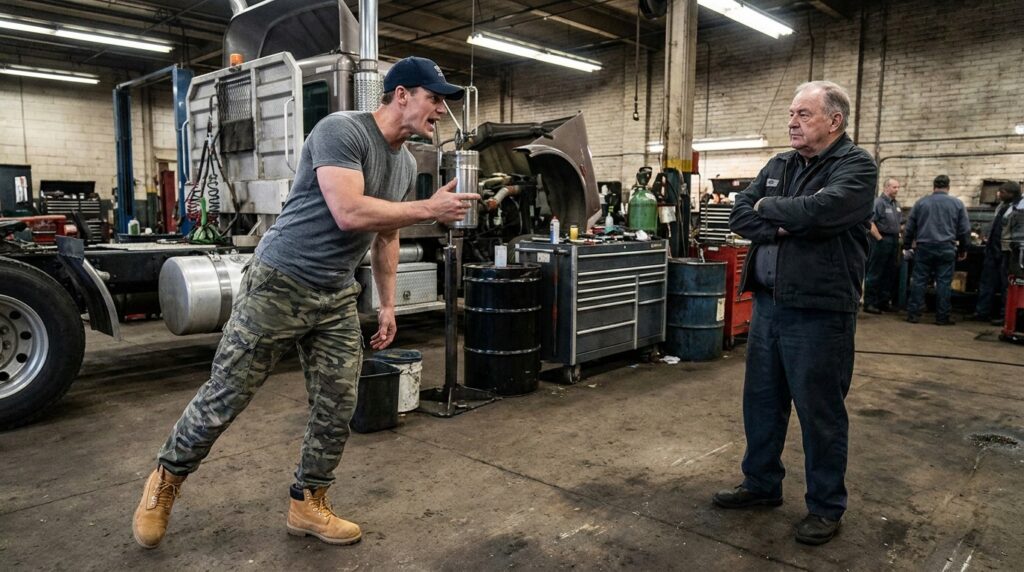
Miller stepped forward out of the shadow of the trailer, his cap still squeezed flat between his massive hands. He looked at the driver’s rigid stance, then at the faded, grease-scored gray shirt of the older man who had just dismantled his pride with an inch of spatial leverage. The lines on the old man’s face didn’t look old anymore; they looked permanent, like the forge marks on an armor plate that had survived the testing block.
“You’re late, corporal,” the old man said. His voice had the dry, programmatic flatness it had carried since he first walked into the lane, but the room seemed to contract around it now. He didn’t return the salute. He simply reached down and took the heavy aluminum brief box by its steel handle, his thick, scarred thumb sliding across the combination tumbler without looking at the numbers. “The northern rigs have already cleared the state line on brittle leaf pins. The supervisor code was updated from the balcony five minutes ago.”
Vance stopped three feet back, his knees shaking slightly within his wide trousers as the tablet in his arms gave a sharp, electronic chirp—the automatic notification that his remote administrative access had just been quarantined by the central holding network.
“Mr. Garrett,” Vance stammered, the name catching in his throat like dry grit. He tried to pull the canvas coat over the blue ruggedized casing, but his fingers were too loose to manage the fabric. “The county turnaround bonus… we were only matching the delivery schedule the main office pushed down through the terminal. If we held the line for the Ohio iron, the district score—”
“The district score belongs to the parent company, Vance,” the old man said, turning his side-profile toward the stairs. He set the aluminum box down on top of the mobile tool locker, right next to the hand-filed calibration shim and the manual beam wrench. “And the parent company doesn’t hire operators who use shims to cheat the iron. Miller.”
The tall mechanic looked up, his jaw tightening as he met the elder’s unblinking stare.
“Get the long-reach mirrors back under the rear tandem,” the old man commanded, his fingers loose around the handle of his old chrome-vanadium adjustable wrench. “We have twenty-four steering knuckles to ream before the morning drivers take the keys. Leverage always beats brute force, son. Remember that next time you look at a machine—or a man.”
He didn’t wait for an answer. He turned his heavy frame toward the open bay doors, where the ground fog was beginning to lift under the cold, early light of the northern dawn, leaving the concrete floor wet, gray, and completely clear of excuses.








