
CHAPTER 2: THE METRIC OF FRICTION
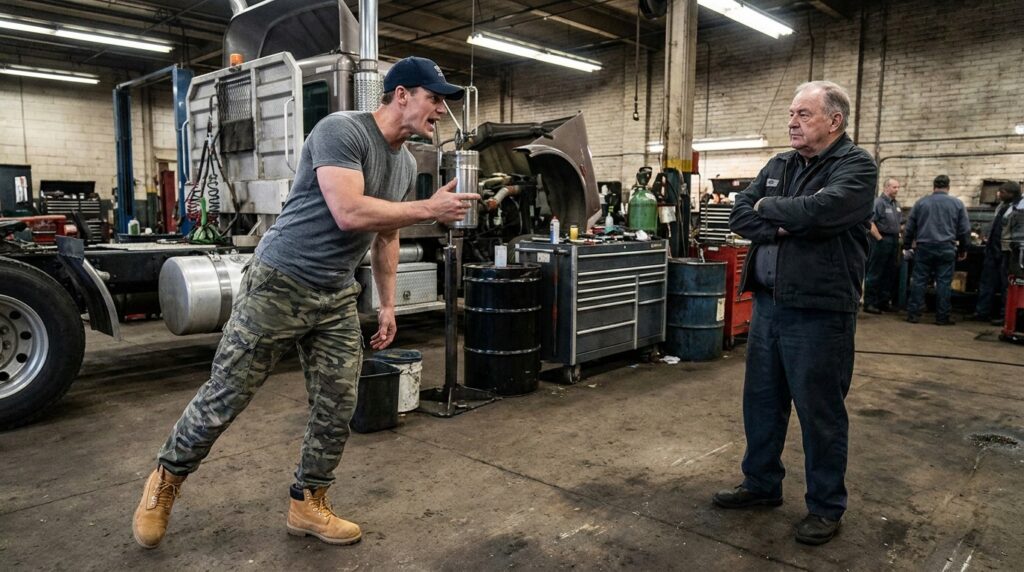
The slap of Miller’s heavy, muscular frame hitting the degreaser-filmed concrete sounded like a wet sandbag dropped from the rafters. It wasn’t a clean sound. It carried the gritty, scraping vibration of a man whose center of gravity had been stolen by his own momentum.
Miller stayed down for two full seconds, his left palm splayed flat against the damp stone, his navy cap skittering three feet away into the dark puddle beneath the semi-truck’s steering axle. His breath came out in a ragged, whistling grunt—the sound of an engine drawing air through a cracked manifold.
The old man didn’t look down at him. He kept his eyes fixed at shoulder-height, his dark leather boots still perfectly parallel along the yellow safety line. His fingers remained loose around the oily handle of the chrome-vanadium adjustable wrench. To the junior technicians watching from the perimeter benches, it looked as though the elder hadn’t even moved; he had simply occupied a different pocket of space a millisecond before the air where he used to be was occupied by a failing fist.
“Get up,” the old man said. The words weren’t loud. They had the dry, metric weight of iron tools hitting a wooden bench. “The differential housing is still dripping. You haven’t cleared the line.”
Miller’s shoulders bunched under his gray T-shirt, the fabric dark with a crescent moon of wet grease where his shoulder check had failed against the truck’s frame. His tan boots kicked once against the floor, seeking purchase on the slick concrete before he managed to lever himself into a seated position. His clean-shaven face was dark with blood, the flush of sudden, public failure crawling up his throat. He looked at his own open palm, then up at the dark civilian clothes of the elder standing over him. There was no mockery in the old man’s face, which made the silence in the garage burn worse.
The three apprentices at the back benches hadn’t breathed. One of them still held an air-impact gun three inches from a wheel nut, his finger frozen on the trigger without pulling it. The continuous, low-frequency hum of the main shop compressor was the only thing filling the void between the bays.
“You slipped,” the old man remarked, his voice flat, completely devoid of the satisfaction a smaller man might have used as leverage. He adjusted his grip on the heavy wrench, his thumb sliding over the rusted knurled screw that set the jaw width. “Your footing was wide. When you throw your weight behind an open palm, you don’t leave your rear heel off the deck. That’s basic leverage. Any boy on a farm learns that before he’s twelve.”
Miller pushed himself further back, his spine coming up against the cold, massive rubber of the semi-truck’s front tire. He didn’t reach for his cap. His fingers found the edge of his steel toolkit, his knuckles whitening against the red painted metal. For a second, the muscles in his jaw locked so hard the bone showed white beneath his tanned skin, but the discipline of the floor—the primal reality of a man who had just been dismantled by an inch of movement—kept his hands down.
“The line isn’t restricted,” Miller growled, though the volume was gone from his throat, replaced by a raw, defensive rasp. He spat a thread of gray grit onto the floor. “The digital diagnostics ran a full cycle before you walked into my bay. I checked the logs myself. The pressure curves are inside the fleet standard.”
The old man stepped forward, his boot sole making a sharp, clean click against the dry stone just outside the grease slick. He didn’t look like a warrior; he looked like a piece of structural timber that had survived three floods. He reached down with his free hand, his thick, scarred fingers closing around the handle of Miller’s modern diagnostic interface—a blue plastic ruggedized tablet resting on top of the rolling tool cabinet.
Miller didn’t move to stop him. He couldn’t. The room was still watching, and every eye in the bay was waiting to see if the old man would smash it or read it.
The old man turned the screen toward the gray light of the clerestory windows. The display showed green bars, rows of precise digital telemetry claiming the hydraulic fluid was moving at forty-four gallons per minute through the rear lines. But the elder’s thumb wasn’t looking at the glass. His nail caught on the seam of the plastic housing near the base sensor connector.
Wedged into the diagnostic port was a small, notched piece of carbon-steel—a hand-ground calibration shim, its surface scratched with the telltale cross-hatch marks of an illegal workshop file. It was a mechanical cheat. By forcing the shim into the sensor housing, the physical pressure on the internal diaphragm was manually locked at a standard value, regardless of what was actually happening inside the steel lines three feet back. The tablet wasn’t reading the truck; it was reading the shim.
The old man’s face didn’t change. He didn’t accuse the younger man. He simply let his thumb press against the shim, feeling the crude burr on its edge—the unmistakable texture of a deliberate, hurried modification.
“The log says what you told it to say,” the old man murmured, his gaze shifting back down to Miller, who was still leaned against the heavy tire. “But the iron doesn’t lie. When the rear actuators go dry on the turnpike under thirty tons of steel, the digital log isn’t the thing that’s going to keep the rig inside the lane.”
Miller’s eyes dropped from the old man’s face to the blue tablet. The defensive anger in his posture vanished, replaced by a sudden, rigid stillness that had nothing to do with physical fear and everything to do with exposure. He didn’t deny it. He didn’t reach for the device. He just sat there, his tall frame suddenly looking hollowed out against the massive backdrop of the logistics fleet.
“Stand up,” the old man said, setting the tablet back down on the grease-filmed metal of the tool chest with a small, deliberate click. “And finish the job right.”








