
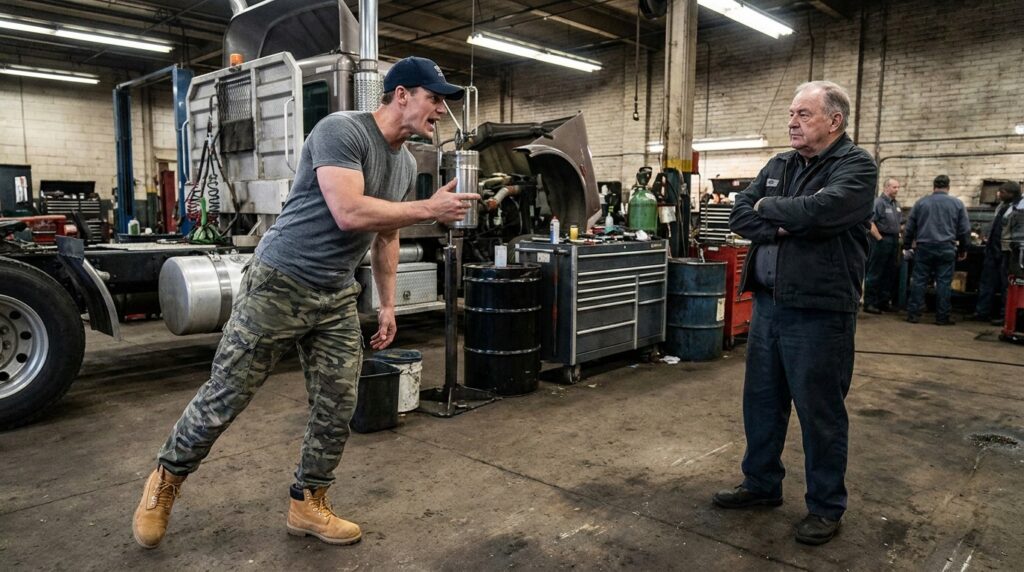
CHAPTER 4: THE CHASSIS LINE LOCK
“You’re tracking more than just the leaf springs,” Miller muttered, his throat clicking as he swallowed. He reached out to steady his balance against the massive tire rim, his muscular forearm trembling slightly under the cold neon glare of the bay lights. “You knew what was on that manifest before the transport driver even dropped the tail-gate.”
The old man did not confirm or deny the guess. He let the grease-stained cotton rag drop into the lower pocket of his dark coveralls, his movements following the same mechanical economy that had kept him upright when Miller had lunged. He stepped closer to the center hoist, his eyes tracing the thick hydraulic cylinder that held thirty tons of iron suspended four feet above the pit.
The silence from the surrounding service bays had turned heavy, dense with the realization that the lead mechanic had lost his room. The three apprentices remained frozen at their benches, their tools heavy in their hands, heads angled toward the floor to avoid meeting Miller’s eyes.
“The kingpin assembly on the driver’s side has a three-millimeter play,” the old man said, his voice level and flat against the background thrum of the building’s main breaker. He tapped the heavy steel spindle with the nose of his aluminum flashlight. The sound was a dull, dead thud instead of the sharp ring of solid casting. “The stamp on the knuckle says it was reamed at the central shop three weeks ago. But the tool marks are circular. Someone used a handheld lathe to clear the lip because the sleeve didn’t sit flush.”
“The service orders came down marked priority one,” Miller said, his boots shifting back an inch into the shadow of the chassis frame. His voice lacked its previous volume, reduced to a dry rattle. “We had forty-eight hours to clear twenty rigs for the state line run. If we pulled the steering knuckles to wait for the certified castings, the bay lines would have backed up into the yard. The manager signed off on the tolerance override.”
“The manager doesn’t sit behind the wheel when the steering column binds on a six-percent grade,” the old man remarked. He reached up, his thick fingers grasping the edge of the tool cabinet to pull himself onto the raised steel walkway that bordered the pit. His joints made a sharp, dry click under the weight, a sound that mirrored the friction of the iron parts beneath the rig. “An override on a ledger doesn’t change the shearing threshold of a cold-rolled steel pin. You know the physics, Miller. You just chose to trust the digital log because the screen didn’t argue back.”
He reached into the cabinet, his hand bypassing the modern plastic-encased torque guns to pull out an old manual click-style beam wrench. The tool was six feet long, its chrome finish scarred by decades of heavy leverage, the numbers on its dial stamped deep into the underlying iron. He laid it across the top of the axle housing with a resounding metallic clatter that made the nearest apprentice flinch.
Miller looked at the heavy wrench, then up at the glass-fronted office box at the top of the metal stairs. The supervisor’s silhouette remained static against the yellowish window, a dark shape holding a telephone receiver to its ear. The door to the balcony hadn’t opened, but the pressure in the room was rising with every minute the old man spent checking the physical steel.
“We have three more transports coming in from the northern depot at midnight,” Miller said, his fingers tightening against the seam of his camouflage trousers. “Same build. Same replacement components from the surplus pallet. If I stop the line now, the automated tracking system registers a structural hold. The regional dispatch drops the facility score before dawn.”
“Let it drop,” the old man said. He didn’t look up from the axle line. He fitted the socket of the beam wrench over the primary shackle bolt, his boots bracing against the concrete floor with absolute parallel symmetry. He didn’t use sudden force; he simply leaned his heavy frame into the long steel handle, using the natural leverage of his weight to test the resistance of the threads.
The wrench didn’t click. The needle on the old mechanical scale swung past the two-hundred-foot-pound marker, then paused. The bolt wasn’t tightening—it was stripping. The threads inside the recycled housing had already been pulled smooth by an over-torqued pneumatic gun during Miller’s rushed afternoon shift. The metal was giving way, a silent, unyielding failure that would have remained invisible until the first heavy bump on the highway tore the hanger completely free from the frame rail.
Miller took a step forward, his hand dropping away from the tire as he saw the needle stall on the rusted face of the gauge. His mouth opened slightly, his clean-shaven jaw dropping into the gray light of the bay. The realization didn’t come from a digital warning or an audit report; it came from the physical behavior of the iron beneath the wrench.
“The log said it was locked,” Miller whispered, his tall build suddenly losing its tension, his shoulders rounding as if the weight of the semi-truck had transferred onto his own back. “The telemetry interface verified the torque limit on the main panel.”
“The panel reads the pressure at the air line,” the old man said, releasing his grip on the long handle and letting the wrench settle against the steel hoist with a dull ring. “It doesn’t feel the iron strip. When you skip the hand-check because you’re running against a digital clock, you aren’t a mechanic anymore. You’re just an operator waiting for the wreck.”
He turned his side-profile toward the younger man, his unblinking gaze catching the reflection of the high clerestory windows. In the corner of the tool chest, the small, hand-ground calibration shim lay exactly where he had left it, its file marks gray and distinct against the blue plastic of Miller’s ruggedized tablet.
From the top of the metal stairs, the office door finally clicked open, the sound of leather soles hitting the iron grating of the balcony cutting through the low vibration of the service bays.








