
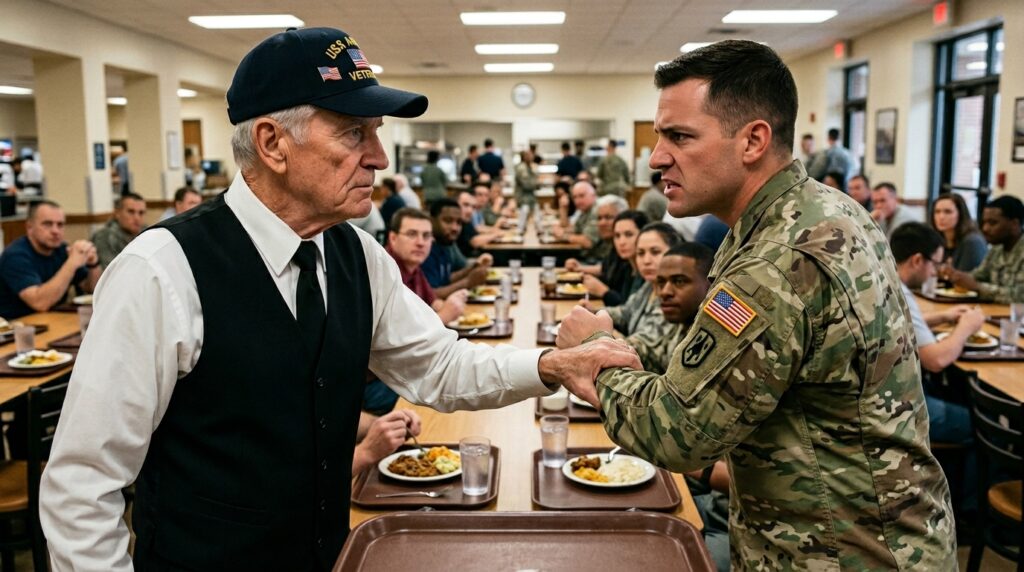
CHAPTER 9: THE COLLISION OF THE FILES
The concrete floor beneath Elias’s boots shuddered as a heavy, mechanical dull thud echoed from the corridor outside—the distinct sound of a structural security door being forced against its hydraulic seals. Inside the interrogation room, the yellowed fluorescent tube gave a loud, agonizing pop, flickering violently before dying completely, plunging the small cell into the harsh, emergency amber glare of the backup bulkhead lights.
Ames didn’t shout. He rose from his metal chair with an economy of movement that betrayed his training, his hand sliding inside his desaturated gray jacket toward the leather holster tucked under his armpit. Beside him, Colonel Harris was already at the heavy iron door, his face a tight knot of bureaucratic panic as his hand gripped the dead-bolt handle.
“Miller doesn’t have the authorization codes for this block,” Harris muttered, his fingers straining against the cold steel of the lock. “The automated routing lines should have bricked his terminal the second he crossed the perimeter fence.”
“He isn’t using a modern network route,” Elias said. He didn’t rise from his seat. He sat with his hands flat on the scratched table, his thumb tracing the rough, charred edge of his veteran cap where the black soot still rubbed off on his skin. His voice remained flat, a low rasp that carried the absolute lack of surprise of a man who had watched entire political structures decay from the inside out. “The motor pool has an analog landline relay that connects straight into the sub-basement cooling shafts. I laid that copper myself in seventy-five. If the boy found the junction box under the grease-pit, your digital lockouts aren’t doing anything but wasting base power.”
A violent screech of tearing metal cut through the intercom speaker, followed by the wet, heavy splash of boots running through the corridor’s drainage gutters. The door didn’t open through the lock; it fractured. The dead-bolt housing sheared off the frame with a sharp explosion of gray iron chips, and the heavy slab of steel swung inward, slamming against the seafoam-green wall with a force that sent a shower of flaking clear-coat across the floor.
Sergeant Miller stood in the threshold. His green utility uniform was torn at the shoulder, soaked through with the foul, oily water of the lower maintenance lines. In his right hand, he carried a heavy, olive-drab field terminal kit—an old magnesium-cased unit from the Oculus era, its faceplates smeared with dark chassis grease and battery acid. A bundle of raw, unshielded jumper wires trailed from the terminal’s side, sparks snapping against the wet concrete as they dragged across the floor.
“Get back from the table, sir,” Miller panted, his eyes wide, bloodshot, fixed entirely on Elias. He didn’t look at Ames’s drawn sidearm or Harris’s silver insignia. The arrogance that had defined his posture in the mess hall was buried under a layer of pure, survival-driven desperation. “The Colonel wasn’t the only one with a backup log. Vance’s desk didn’t just hold the routing coordinates for the ridge. There’s a continuous outbound signal register from thirty different installations across the state line. They’ve been pulling the raw telemetry since the system went red.”
“Drop the kit, Sergeant,” Ames said, his voice dropping into a level, lethal cadence as he pointed his weapon at the young man’s chest. “You are actively executing an act of domestic sabotage inside a Level-One installation. There is no review board that will cover you once the guards clear the hallway.”
“The guards aren’t coming, Ames,” Miller said, a hard, ugly edge cutting through his panic as he slammed the heavy field terminal down onto the steel table between Elias and the bureaucrats. The grease-smeared glass of the screen flickered to life, displaying a cascading column of amber hexadecimal addresses that matched the wax-covered log strip hidden inside Elias’s vest. “The terminal kit just locked the sector gates from the central distribution frame. Every perimeter valve between here and the highway is jammed shut on an emergency isolation loop.”
Elias leaned forward, the brim of his veteran cap casting a long, dark line across the glowing magnesium face of the machine. His eyes scanned the scrolling data. The “Decoy Secret”—the Pentagon’s claim that this was an isolated security review of a rogue officer—died instantly in the reflection of that grease-smeared glass. The addresses weren’t routing to a foreign asset or a rogue command post. They were looping back into the main server farms of the Armed Services Command domestic network. The system wasn’t being audited; it was being synchronized. The systemic rot was alive, and Miller’s intervention had just pulled the veil off the secondary defensive line.
“You shouldn’t have brought this down here, son,” Elias said softly, his fingers shifting to touch the cold metal edge of the magnesium case. “You think you brought a shield, but you only brought them a target.”
“I had to, sir,” Miller whispered, his voice cracking as he looked at the old man’s steady, unyielding face. “Vance’s files… they show the original authorization signature from nineteen-seventy-four. The man who signed the terminal keys into the domestic grid wasn’t a civilian bureaucrat. It was your unit commander. The legend they built the whole citation around.”
Elias felt the internal shock travel down his spine like a cold wire, but his face remained a mask of iron and age. The emotional reality of his own legacy—the sacred weight of the cap he wore—was twisting into something compromised, a tool used to anchor a permanent betrayal before he had ever left the service.
“Harris,” Ames said without breaking his focus from Miller’s chest. “Secure the drive link from the terminal’s rear plate. We take the kit and the sergeant out through the drainage egress.”
Before the colonel could step forward, the field terminal gave a sharp, high-pitched whine that mirrored the sound from the ridge tower vault. The amber columns on the screen froze, snapped into a solid wall of crimson text, and the small mechanical counter on the side of the casing began to spin backward with a rapid, metallic click. The unmapped origin node wasn’t just observing anymore; it had found the field terminal’s unshielded jumper line and was actively reversing the circuit to burn the remaining data banks in the block.








