
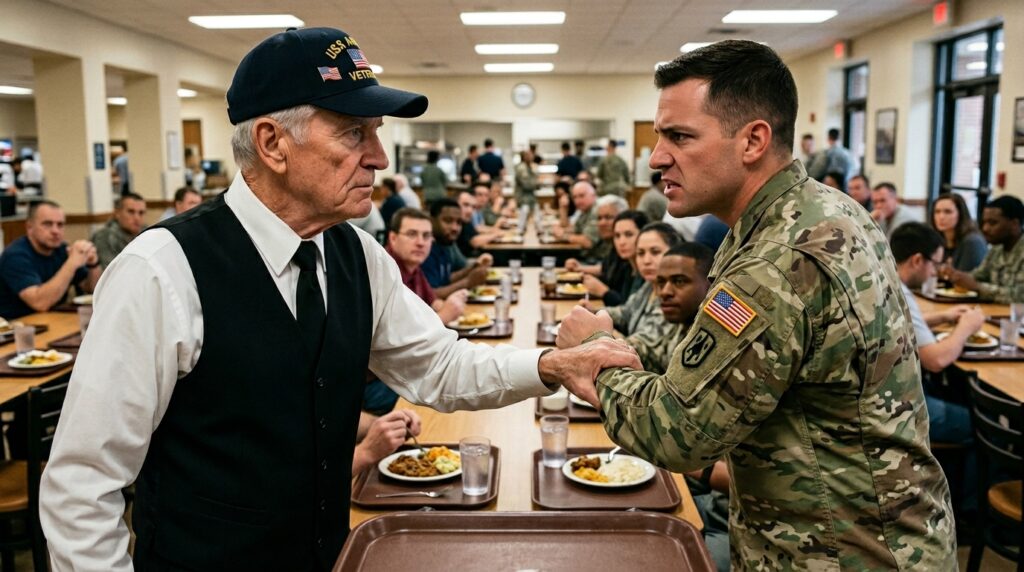
CHAPTER 8: THE RESTRAINT OF THE RECORD
The concrete wall behind Elias had been painted so many times the corners were rounded, buried under thick, glassy layers of government-surplus enamel. The color was a dead, institutional cream that seemed to absorb the light from the humming fluorescent fixture overhead, turning the small room into an artificial twilight. Elias sat with his forearms flat on the bolted-down steel table. He hadn’t taken off his veteran cap; the charred, soot-blackened edge of the wool brim rested low over his brow, a sharp shadow masking his eyes from the two men sitting across from him.
Between them lay no paperwork—only a heavy, silver-plated recorder with an active digital counter that ticked upward in silent, red numbers.
“Let’s establish the ledger again, Master Sergeant,” the man on the left said. He wasn’t dressed in green utilities. He wore a desaturated gray civilian suit that fit his thick shoulders with a tight, tailoring precision that screamed Pentagon bureaucrat. His name tag read Ames, but his eyes had the flat, unblinking stillness of a veteran counter-intelligence handler. “You entered a restricted sub-level facility without an active operational clearance. You discharged a thermal device into a live cryptographic terminal, destroying hardware valued at six figures. And you have an unmapped data strip inside your vest that belongs to a Class-Four archival matrix. Am I reading the perimeter correctly?”
Elias didn’t look at the recorder. He looked at the dead-bolt lock on the heavy isolation door behind Ames. The metal was bright, a modern alloy stamped with a clean, unblemished serial code—MD-Shield-01. The base had updated its locks, but the frame was still the same structural iron Elias had watched the civilian contractors bolt into the bedrock during the Nixon administration.
“You’re reading the text, Mr. Ames,” Elias said, his voice a low, gravelly rasp that cut through the low-frequency hum of the light. “You aren’t reading the wire. The terminal wasn’t destroyed by a thermal device. It was shorted out because your local node was executing a terminal asset pull that the system’s original infrastructure couldn’t support. If I hadn’t jammed that lighter into the relay, the static blow-back would have cleared out every active cryptographic key from here to Langley.”
The second man, a modern infantry colonel named Harris whose uniform was so stiff with starch it didn’t crease when he leaned forward, tapped a manicured finger against the table. “Colonel Vance is currently in a psychiatric holding wing at Walter Reed, Elias. He’s talking about ghosts in the trunk lines. He’s talking about an automated domestic dragnet that’s been running since the end of the Vietnam War. We need to know if that delusion is something you put in his head before you burned the interface.”
Elias allowed himself a brief, cold tightening of his jaw—the closest he would ever get to a smile in this room. His internal monologue remained a cold matrix of risk assessment. They were fishing. They had the ruined terminal, they had Vance’s broken composure, but they didn’t have the analog mechanical tape currently pressed flat against the skin of his ribs under his undershirt.
“Vance is an infantry officer who tried to read a signalman’s map,” Elias said smoothly. “He thought he was dealing with a modern deployment error because his platoon lost six men in the desert to an encryption leak. He didn’t understand that the leak wasn’t a modern vulnerability—it was an intentional back-door designed into the Oculus relays fifty years ago. Your administrative review board isn’t here to find out why the terminal melted, Colonel Harris. You’re here because you realized the domestic intercept loop just triggered its final reporting protocol, and you don’t know who has the outbound registry keys.”
Ames leaned back, his gray suit fabric tightening against his chest with a faint, artificial hiss. He looked at Elias’s charred cap, his eyes narrowing as he evaluated the absolute lack of leverage he held over a seventy-nine-year-old man who had outlived three iterations of the agency’s internal security manuals.
“The Vanguard Citation gives you a lifetime pass to the commissary, Elias,” Ames said, his tone dropping the formal cadence, turning sharp and transactional. “It doesn’t give you sovereign immunity over a domestic intelligence failure. If that paper strip isn’t on this table in thirty seconds, I’ll have the guards transfer you to a civilian federal facility in Alexandria before the sun clears the tree line.”
“You could do that,” Elias said, his hands remaining perfectly still on the steel table, his spine an unbending pole against the plastic chair. “But if I don’t check in with the legacy registry desk at the security perimeter before the zero-nine-hundred shift change, the automated system is going to interpret my absence as a terminal compromise. Do you know what happens when a Delta-Nine-Zero asset asset goes dark without a verification code, Mr. Ames?”
Silence descended on the room, heavy and absolute, broken only by the microscopic click of the digital recorder’s counter hitting 00:04:15.
Ames didn’t blink, but his hand moved—just an inch—closer to the recorder’s stop button. He knew the protocol. He knew that the old guards hadn’t just built networks; they had built human dead-man switches into the architecture to ensure the civilian oversight committees couldn’t bury the operational anomalies.
Before Ames could speak, a sharp, three-tone alert chimed from the internal intercom unit on the wall. The red light above the dead-bolt lock flickered once, turning a dull, mechanical amber as a muffled voice cut through the speaker grille: Review Board Leader, we have a breach at the secondary perimeter fence. It’s Sergeant Miller. He’s bypassed the motor pool guards and is moving toward the isolation wing with a local terminal kit.
Elias didn’t move a muscle, but his eyes locked on the amber light. The sergeant hadn’t stayed in his lane. The consequence loop was widening, and the young soldier was about to bring the rest of Vance’s hidden files directly into the firing line.








