
CHAPTER 2: THE GRAVITY OF SILENCE
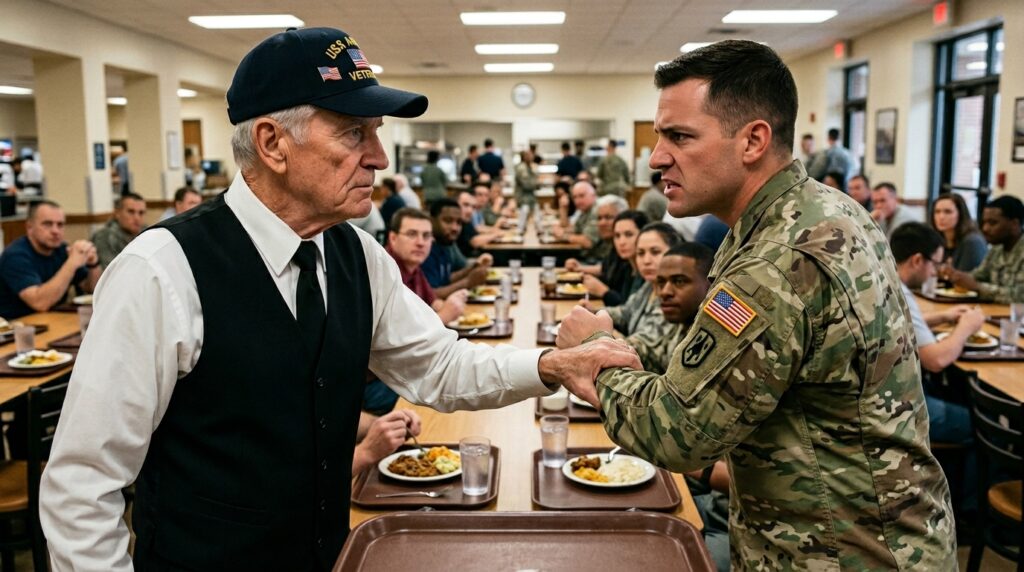
The silence in the dining hall wasn’t empty; it was a physical weight, thick with the smell of scorched coffee and the sudden, sharp ozone of a crisis. Elias didn’t move. He kept his boots planted—heels locked, weight distributed—even as the sergeant on the floor scrambled backward, his boots squeaking in a frantic, undignified rhythm against the linoleum. The amber light on the dropped data drive pulsed like a slow, rhythmic heartbeat against the gray floor tiles, a mechanical eye watching the room.
Elias saw the drive. He knew the serial prefix—XR-Delta. It was a ghost code, something that should have been scrubbed from the institutional memory of Fort Meade forty years ago. To see it here, vibrating slightly against the floor from the hum of the ventilation, felt like a cold needle sliding between his vertebrae.
“Stay down, Sergeant,” a new voice commanded. It wasn’t loud, but it had the density of spent uranium.
From the periphery of the crowded room, a man moved through the frozen ranks of active-duty soldiers. He wasn’t running, but he covered the distance with a predatory efficiency that cleared a path without him having to utter a second word. He wore the oak leaves of a Lieutenant Colonel, his uniform a sharp, desaturated green that seemed to absorb the harsh overhead light rather than reflect it. His face was a map of deep-set lines and a jagged scar that cut through his left eyebrow, ending at the bridge of a nose that had been broken and reset more than once.
The Lieutenant Colonel stopped three feet from Elias. He didn’t look at the sergeant on the floor. He didn’t look at the spilled water or the scattered breakfast trays. His eyes—a hard, flinty gray—were locked on the dark wool of Elias’s veteran cap.
Elias felt the old, rusted gears of protocol grind in his chest. He didn’t offer a civilian smile. He didn’t offer an apology. He simply stood his ground, his hands resting naturally at his sides, fingers inches away from the black vest where his own secrets were tucked.
The officer’s gaze traveled down from the cap to the sharp, white collar of Elias’s shirt, then back up to the unit insignia pinned to the wool—a silver dagger entwined with a lightning bolt, partially obscured by a smudge of old carbon. The officer’s pupils dilated. For a heartbeat, the mask of command flickered, revealing a jagged edge of recognition that bordered on reverence.
The Lieutenant Colonel snapped to a rigid, bone-jarring salute.
The sound of his hand hitting his brow was like a pistol shot in the vaulted room. Behind him, the two soldiers who had been mocking Elias a moment ago recoiled as if they’d been struck. The sergeant on the floor froze, his face draining of color until it matched the salt shaker on the table.
“Sir,” the Lieutenant Colonel said, the word resonating with a depth of respect that seemed to physically push back the surrounding crowd.
Elias didn’t return the salute. He didn’t have the cover or the commission anymore, and they both knew it. Instead, he gave a slow, barely perceptible nod. “Colonel.”
“Sergeant Miller,” the officer said, his voice dropping an octave as he finally looked down at the man on the floor. He didn’t offer a hand to help him up. “You just laid hands on a recipient of the Vanguard Citation. You just assaulted a man who was walking these perimeters when your father was still in grade school. Do you have any idea what you’ve done to your career in the last sixty seconds?”
The sergeant, Miller, looked up, his jaw working but no sound coming out. His eyes darted to the data drive near his knee, then back to the Colonel. His hand hovered near the device, a nervous, twitching motion.
“Leave it,” Elias said.
The command was so sharp it made the Colonel blink. Elias stepped forward, the friction of his boots against the grit of the floor sounding like sandpaper on bone. He reached down, his joints complaining with a dull, rusted ache, and scooped the amber-lit drive off the floor. The plastic was warm, humming with the internal friction of a high-speed processor.
“This doesn’t belong in a dining facility, Colonel,” Elias said, his voice lowering so the words stayed between the two of them. He felt the weight of the drive—it was heavier than it looked, weighted with internal shielding. “And it certainly doesn’t belong in the pocket of a man who can’t keep his feet under him in a simple leverage exchange.”
The Lieutenant Colonel’s eyes fixed on the drive in Elias’s weathered hand. A muscle jumped in his jaw. The “Rusted Truth” of the base’s current state was visible in that look—the desperation of a command structure trying to maintain a high-tech perimeter with low-discipline personnel.
“We are in a heightened state of readiness, sir,” the Colonel said, his voice tight, his eyes flicking toward the silent witnesses in the room. “That hardware is… sensitive.”
“Sensitive is one word for it,” Elias replied, feeling the vibration of the drive against his palm. He knew what a pulsing amber light meant on an XR-Delta unit. It meant it was actively tethered to a local node. It meant it was recording. “Redacted is another.”
Elias tucked the drive into the deep pocket of his black vest, burying it next to his silver Zippo. The metal of the lighter was cold; the drive was hot. The contrast was a reminder of the gap between the military he had left and the one that was currently failing around him.
“I believe we have some paperwork to discuss, Colonel,” Elias said, his gaze shifting to the administrative wing beyond the kitchen. “In a room with a door that locks.”
The Colonel hesitated, then stepped aside, gesturing toward the exit with a stiff, formal motion. “After you, sir.”
As Elias walked past the fallen sergeant, he didn’t look down. He focused on the heavy, reinforced steel doors at the end of the hall. He could feel the eyes of every soldier in the room on his back—some with shame, some with fear, but all of them now seeing the ghost they had tried to ignore. The weight of the cap felt heavier now, not because of age, but because the perimeter he had spent his life defending was clearly starting to crumble from the inside out.








