
CHAPTER 7: THE ARCHIVE OF THE UNBROKEN WIRE
“Clear the portal! Weapons free until identity is established!”
The tactical boots hit the floor of the upper shaft with a series of sharp, metallic cracks that vibrated down the iron ladder rungs. Below, in the dark, red-lit belly of the vault, Elias didn’t change his stance. His joints were stiff, burning with the cold of the flooded floor, and his palm was raw where the charred wool of his veteran cap had scorched against his skin. The air was thick, choked with the chemical stink of vaporized plastic, venting nitrogen, and the unmistakable metallic odor of an electrical fire.
Lieutenant Colonel Vance didn’t move from his position against the cooling rack. His chest rose and fell in ragged, shallow gasps, his eyes staring blankly at the ruined terminal where the melted, chrome carcass of Elias’s Zippo was still welded into the data port. The white display light of the drive had gone stone-black, but the heat coming off the circuit boards was immense, warping the plastic housing into a black bubble.
“They aren’t here for the gear, Elias,” Vance rasped, his voice dropping below the thudding chop of the rotors outside. “They’re here to scrub the grid. If they see you with that insignia… they’ll know the line goes back to the origin.”
Elias didn’t look back at the officer. He focused on the mechanics of the terminal. His active agency drove him forward, his raw fingers clawing at the base of the interface panel. He wasn’t trying to pull his lighter out; he was looking for the hardwired registry log—the analog mechanical wheel that recorded the outbound routing numbers before the electronic encryption took over. In 1974, they didn’t trust the wire; they built mechanical counters into the back plates of every terminal to catch discrepancies.
His fingernails scraped against a cold, grease-coated iron lever behind the melted port. He pulled. With a heavy, metallic click that resisted his strength, a small drawer popped open from the bottom of the casing, dropping a strip of ink-stamped paper tape into the freezing water at his feet.
Elias scooped it up. The paper was dry, preserved inside a wax-coated sleeve. He held it to the dim red glare of the emergency strobe.
The ink had faded to a rusty brown, but the terminal code was clear: ORIGIN NODE: VANGUARD-01. RECIPIENT NODE: ARMED SERVICES COMMAND – REDACTED.
The world slowed down. The systemic tactical failures that had cost Vance his men three years ago weren’t an external hack, nor were they an isolated modern error. The back-door hadn’t been left open by accident. The loop was an intentional institutional design—a continuous domestic surveillance intercept established fifty years ago by the senior base command structure to monitor communication lanes across the eastern seaboard, hidden under the mask of Elias’s own decorated unit. The legends of his past weren’t a shield for the nation; they were the structural architecture for a permanent domestic dragnet that had gone rogue as the modern systems inherited the legacy infrastructure.
“Step away from the console, old man!”
The light hit Elias full in the face—a blinding, six-hundred-lumen tactical beam from a carbine barrel. Two security officers in desaturated black armor dropped from the lower ladder rungs, their boots splashing heavily in the freezing sludge. Their muzzles were locked onto Elias’s chest, their gloved fingers resting rigid on the triggers.
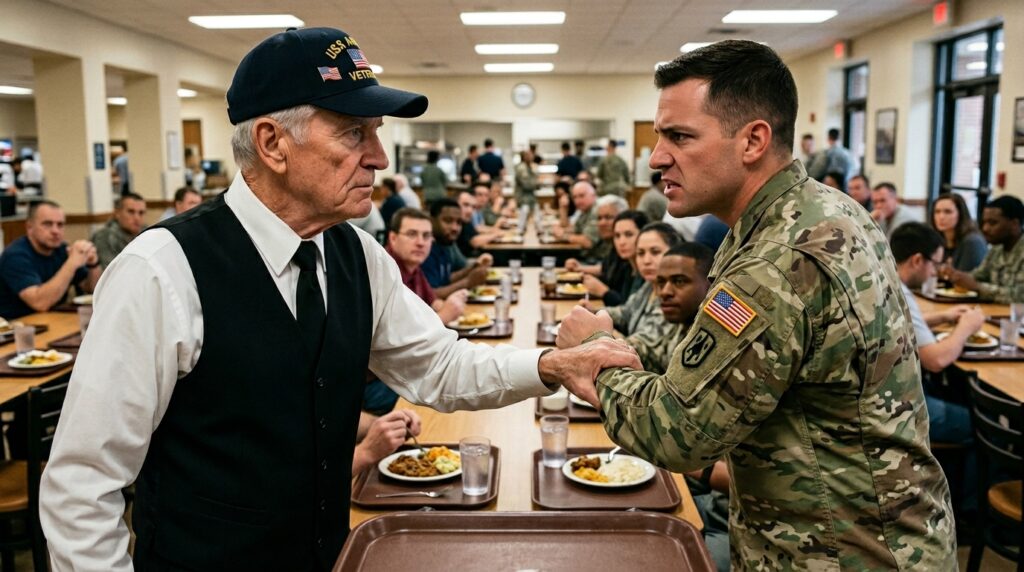
Elias slowly stood up. His spine was an unyielding vertical pole. He didn’t drop his hands, but he didn’t raise them either. In his left hand, he held the wax-covered log tape, tucked flat against his palm. On his head, the charred, soot-stained veteran cap sat perfectly level, its silver dagger insignia catching a sliver of the tactical beam.
“Identify yourself!” the lead guard barked, his voice echoing off the corrugated steel panels of the walls.
“Elias K. Vance, Master Sergeant, United States Army, Retired,” Elias said. The name left his throat not as an explanation, but as a barrier. His voice carried the precise, rhythmic weight of an authority that had commanded these sectors before the black armor on the guards’ chests had been designed. “Serial prefix Delta-Nine-Zero. This terminal is under a legacy quarantine directive. Lower your weapons and bring your commanding officer down here.”
The guards hesitated. The tactical beam flickered slightly, tracking down from Elias’s eyes to the burned wool of his cap and the silver insignia. The name Vance made the lead officer’s head jerk toward the corner where the Lieutenant Colonel still slumped against the rack.
“Colonel Vance?” the guard called out, his posture shifting slightly, losing its aggressive forward tilt. “Sir, is this…”
“He’s right,” Vance said from the dark, his voice hollow, broken by the weight of a generation of silence. “The loop is closed. The transmission he stopped… it wasn’t an external link. It was the internal archive reporting a discrepancy to the oversight committee. We weren’t fixing a breach. We were the breach.”
The lead guard lowered his carbine an inch, his face visible behind his visor—pale, confused, caught between a live security directive and the sudden, overwhelming weight of an institutional legacy that outranked his orders.
Elias stepped past the light. He didn’t run. He walked with the heavy, calculated pace of an old soldier who knew the perimeter was compromised but the ground was still his to defend. He slipped the wax log strip into the inner lining of his vest, right next to the empty space where his Zippo used to live. The metal was gone, the terminal was dead, but the data was locked behind his ribs now.
“Let’s go upstairs, son,” Elias said to the guard, his voice flat, pragmatic, and unyielding. “The air is better up there, and we have an archive to rebuild.”
The guards didn’t reach for his wrists. They fell into a loose formation behind him, their heavy boots splashing in a quiet cadence as Elias led the way up the rusted ladder, leaving the white fog and the melted secrets of the Cold War to cool in the dark below.








