
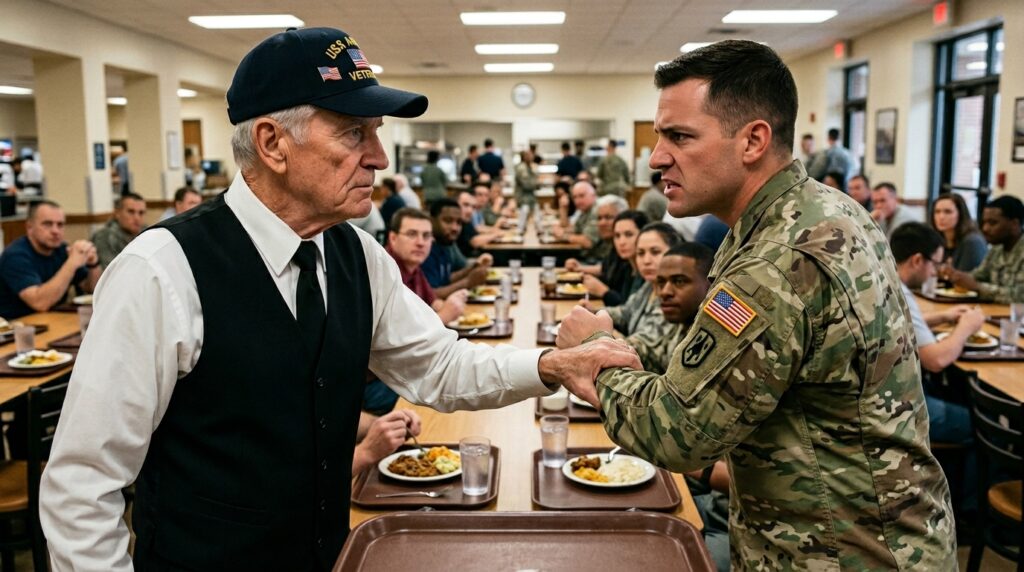
CHAPTER 10: THE CRYPTOGRAPHIC VAULT
The magnesium field terminal erupted into a blinding fountain of brilliant blue arcs. The sharp, toxic stench of burning copper insulation and raw lithium battery acid filled the cramped air of the block instantly, choking off Colonel Harris’s sudden cry of alarm. Miller scrambled backward, his heavy boots skidding through the greasy water as a static pulse threw him hard against the crumbling concrete doorframe. The small mechanical counter on the unit’s flank didn’t just spin; its gears stripped themselves under the massive internal voltage, spitting out microscopic flakes of brass teeth that pinged like shrapnel against the steel table.
Ames didn’t freeze. The gray-suited man threw his entire weight sideways, tackling Harris into the relative protection of the seafoam-green corner just as the terminal’s main cathode tube detonated with a sharp implosion of silvered glass.
Elias was already moving. He didn’t drop his center of gravity to hide. His seventy-nine-year-old framework ignored the structural ache in his spine, his hand lashing out through the smoke to grab the thick, insulated canvas strap of the field terminal’s carrying harness before the magnesium housing could catch fire. The heat was immense, blackening the skin of his knuckles, but his fingers held. With a single, heavy pull that tore the unshielded jumper wires from the basement conduit in a spray of sparks, he dragged the smoking mass off the table and hurled it straight into the flooded corridor outside.
The heavy splash was followed by a dull, crackling hiss as the stagnant trench water killed the short-circuit. The emergency amber lights flickered once, twice, then stabilized into a dim, bloody glow that cast immense shadows across the ruined cell.
“The block is dead,” Ames rasped from the floor, his hand still clutched tightly over his sidearm, though his eyes were wide, staring at the empty doorway where the smoke was slowly clearing. “The secondary perimeter line just executed a hard isolation sweep. If the central frame is bricked, we’re locked in this corridor until the tactical teams cut the main valves from the outside.”
“The central frame isn’t bricked,” Elias said, his voice dropping into a steady, granular rumble that brooked no contradiction. He stood over the desk, his soot-blackened fingers reaching into his vest to adjust the flat, wax-coated paper strip against his ribs. “The transmission didn’t fail. It achieved structural synchronization. The system reversed the circuit because it found what it wanted down here—it found Miller’s legacy codes.”
Miller raised himself from the wet floor, his breathing shallow, his face a smeared mask of grease and red rust from the lower lines. “The vault, sir… the old cryptographic terminal under the administrative wing. The one with the mechanical combination dials. The file logs showed that’s where the original Oculus registry keys are stored. The ones with your commander’s signature.”
Elias turned his eyes toward the hallway. His internal monologue was no longer calculating survival; it was calculating history. The perimeter of his entire life—the honors, the citations, the rigid discipline of the uniform—was crumbling from the within. His commander hadn’t left a legacy of defense; he had left a permanent, domestic parasite hidden in the stone foundations of Fort Meade.
“We go to the vault,” Elias said.
“You don’t have the clearance, Master Sergeant,” Harris shouted, struggling to his feet while dusting flaking paint off his starched uniform. “That sector is under an active Pentagon lockdown. The review board has the keys.”
“The review board has digital cards, Colonel,” Elias said, his gaze shifting to Harris with the cold, unyielding finality of a terminal block. “Digital cards don’t turn an iron tumbler when the main grid is running on analog emergency power. Follow me, or stay in this hole until the air turns stale.”
He didn’t wait for their compliance. Elias stepped out into the dark corridor, his boots grinding into the glass fragments and iron chips that littered the wet concrete. Miller fell into step three paces behind him, his frame hunched under the weight of his torn utilities, but his eyes fixed on the vertical line of the old man’s back. Ames and Harris followed after a short hesitation, their leather shoes slipping in the sludge, their authority stripped down to nothing but a passive reliance on the predecessor they had tried to break.
The path through the subterranean baseline was a geography of rust and shadows. They moved through the narrow utility tunnels where the modern fiber-optic lines had been laid over the ancient, lead-shielded trunks of the original network. The high-frequency scream of the towers above had ceased, replaced by a deep, rhythmic vibration that felt like a pulse inside the stone walls.
At the terminus of the western corridor stood the cryptographic vault. The door was a massive slab of unpolished, corrugated steel, completely devoid of electronic keypads or digital scanners. In its center sat three heavy brass dials, their surfaces dulled by decades of oxidation, grease, and the oil of hands that had been buried in the ground before Miller was born.
Elias stopped before the iron face. He didn’t reach into his pocket for a key. He didn’t look at the paper strip. He looked at the silver insignia on his charred veteran cap, the dagger and the lightning bolt. The mechanical combination wasn’t a random sequence of logistics numbers; it was the original unit designation code of the 1974 Vanguard detachment.
His fingers, raw and soot-stained, gripped the cold brass of the first dial. He turned it left, the internal mechanism responding with a heavy, ungreased click that vibrated up through his arm bones.
Zero.
He turned the second dial right, his thumb feeling the microscopic friction of the iron tumblers catching within the core.
Nine.
He turned the third dial left, locking the final alignment into place with a sound like a hammer hitting an anvil.
Zero.
The heavy iron handle of the vault moved. A deep, mechanical clatter echoed from inside the steel plates as the internal dead-bolts withdrew, their counterweights shifting with a slow, grinding finality. Elias pulled, his shoulders absorbing the immense friction of the unlubricated hinges as the door swung open, revealing the pitch-black space within.
A single, low-voltage amber bulb flickered to life inside the chamber, illuminating a massive, floor-to-ceiling iron cabinet filled with thousands of rows of copper-stamped plates and old analog punch cards. In the center of the room sat the ancient registry terminal, its mechanical printer arm locked over a yellowed roll of paper.
Elias approached the machine, his boots leaving dark, wet prints on the dry dust of the floor. He leaned down, his eyes scanning the final printed line from forty years ago, the ink preserved by the absolute dryness of the vault.
The signature was there—the bold, sweeping ink strokes of General Mitchell, his old commander. But beneath the name, stamped in the unmistakable red dye of a terminal authorization, was a second line that changed the context of the entire narrative arc: PROJECT CO-ORDINATOR: ELIAS K. VANCE, MSG.
Elias stared at his own name, his breath catching in his throat. The emotional reality didn’t hit him like a shock; it arrived like the cold weight of an unexploded shell. He hadn’t been the protector who uncovered a modern betrayal. He had been the original operator who had cleared the lines for the dragnet before his own memory had buried the trauma of the operation under the legend of the Vanguard citation. The ultimate truth was no longer outside him; it was written into the very marrow of his record.
“Elias,” Ames whispered from the threshold, his gun lowered, his face unreadable in the amber twilight. “The transmission from the ridge wasn’t trying to alert Washington. It was verifying your presence on the base. The system didn’t wake up until you walked through the perimeter gate with that cap.”
Elias slowly reached up, his fingers touching the old, charred wool of his headgear. He didn’t take it off. He turned around to face the bureaucrats and the young soldier, his face completely smooth, his posture military-straight, his eyes reflecting the dull, rusted iron of the archive around them.
“Then the perimeter is finally secure,” Elias said, his voice an absolute whisper that held no room for retreat. “Because the line stops right here.”








