
CHAPTER 1: THE FRICTION OF THE LINE
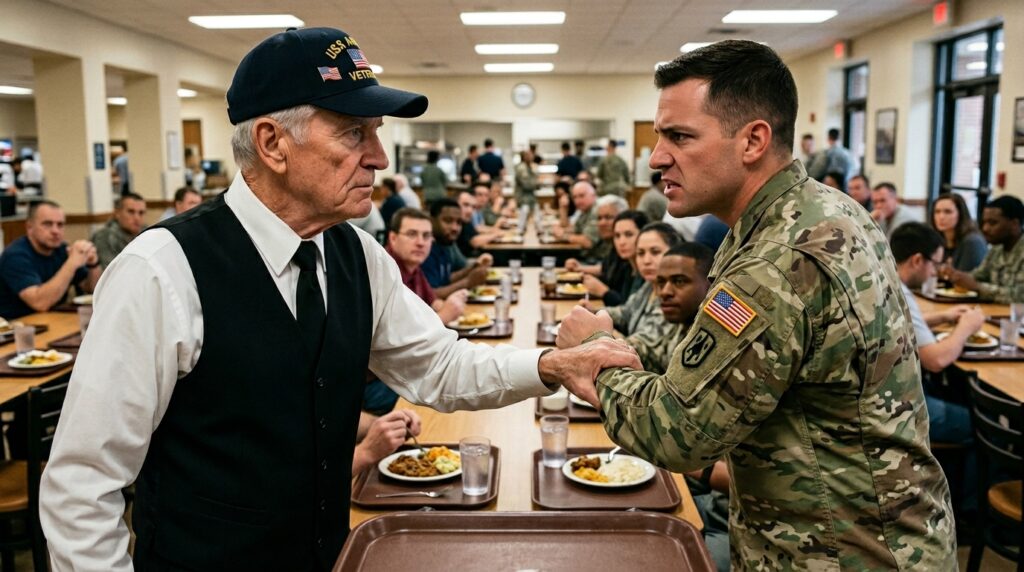
“You’re in the wrong lane, old man,” the voice rasped, thick with the unearned venom of a thirty-year-old sergeant who thought power lived in the thickness of a sleeve. “Pick up your tray and clear out of our space.”
Elias did not look up immediately. He kept his focus on the institutional gray surface of the laminate table, where his standard-issue plastic tray held an unyielding breakfast of cold scrambled eggs and two pieces of dry toast. The dining facility hummed with the industrial vibration of heavy ventilation systems, a low, oppressive drone that failed to drown out the aggressive click of tactical boots behind him. Elias adjusted the dark veteran cap on his head, his fingers catching the stiff, frayed edge of the brim. The wool was old, smelling faintly of dry earth and ancient footlockers, a stark contrast to the sterile, chemical cleaner smell rising from the floor.
The space was tight. The sergeant—athletic, built like a brick mortar shell, with a high-and-tight haircut that looked freshly sheared—crowded Elias’s shoulder. His green utility uniform was stiff with starch, the sleeves rolled up with a geometric perfection that suggested he spent more time in front of barracks mirrors than in the mud. Two other active-duty soldiers stood a few paces back, their arms crossed, their faces twisted into the passive amusement of men watching an old dog get shoved away from the porch.
“I asked you a question, sir,” the sergeant said, the word sir landing with the heavy, sarcastic weight of a stone. He stepped into the narrow gap between the long benches, his shadow completely blotting out the harsh fluorescent light overhead. “This lane is reserved for active personnel clearing out before the zero-eight-hundred transport. You’re dragging down the line. Move.”
Elias picked up his fork. The metal was light, cheap, stamped out by the thousands in some government-contracted factory. His hand shook slightly—not from fear, but from the simple, persistent friction of a seventy-nine-year-old skeleton that had carried thirty extra pounds of gear across three continents. “There are four open tables to your left, young man,” Elias said, his voice flat, devoid of the civilian tremor the sergeant was clearly looking for. “The food tastes the same over there.”
The sergeant’s face darkened, the skin tightening over a jawline that had never known a real ration shortage. “We don’t negotiate for real estate with visitors. Move the tray.”
Before Elias could lower the fork, the sergeant reached down. His thick, calloused fingers clamped directly onto Elias’s left shoulder, the grip tightening to twist him out of the seat. The fabric of Elias’s black vest bunched under the pressure, the small silver Zippo lighter in his pocket shifting with a metallic click against his ribs.
The contact was a border violation. In Elias’s mind, the world narrowed down from the cavernous, green-and-tan dining facility to a grid of three square feet. The muscle memory didn’t arrive like a thought; it arrived like an old machine being kicked into gear by an operator who had forgotten the manual but remembered the noise.
“Don’t ever put your hands on me again, young man,” Elias said. The tone wasn’t loud, but it had the specific, clipped cadence of a command that used to stop deuce-and-a-half trucks in their tracks.
The sergeant smiled, a brief, ugly baring of teeth. He didn’t let go. Instead, he leaned his weight forward, intending to drag Elias upward by the collar.
Elias didn’t fight the pull. He used it.
His right hand came up, not in a fist, but as an open palm that caught the sergeant’s wrist from underneath, his thumb finding the precise gap between the carpal bones. With a swift, economical pivot of his hips that relied entirely on the sergeant’s forward momentum, Elias dropped his own center of gravity. His left elbow drove upward into the crook of the sergeant’s arm, breaking the leverage of the grip, while his right fingers twisted the wrist outward with the cold, unyielding mechanics of an iron vise.
The sergeant’s weight capsized. The physics were brutal and brief. There was no theatrical struggle—only the sudden, heavy sound of an operational utility uniform colliding violently with the hard linoleum floor. A plastic cup of water on the edge of the table rattled, tipped, and spilled its contents in a slow, expanding circle toward the fallen man’s boots.
The entire dining facility stopped.
The clatter of hundreds of metal forks against trays vanished in a fraction of a second. The low murmur of two hundred soldiers froze into a dead, paralyzed silence so absolute that the rhythmic thrum of the industrial exhaust fan sounded like an artillery barrage. Younger personnel half-rose from their benches, their mouths open, their eyes locked on the floor where an infantry sergeant was currently pinning his own shoulder down to stop the pressure on his wrist.
Elias stood up. His spine was straight, a rigid vertical line against the desaturated background of the hall. He didn’t check his vest, and his veteran cap hadn’t shifted an inch. He looked down at the younger man, whose face was now flushed with a mixture of sharp pain and institutional shock.
“Show some respect and step back right now,” Elias commanded, his voice cutting through the silence like a cold chisel through rust.
The sergeant lay still for two long seconds, his chest heaving against the floor, his eyes wide as he looked at the smooth, unreadable face of the old man above him. The aggression had entirely left his frame, replaced by the deep, instinctive realization of who—and what—he had just touched. He slowly pulled his arm back, his posture subduing into a rigid, defensive tuck.
“Understood, sir,” the sergeant whispered.
Elias began to reach for his tray, but his eyes caught a small, dark object that had slipped from the sergeant’s unbuttoned utility pocket during the fall—a heavy, non-standard black encrypted data drive with an active, pulsing amber light, bearing a restricted serial number that Elias hadn’t seen since the winter of 1974.








