
CHAPTER 3: THE LOGISTICS OF DECEIT
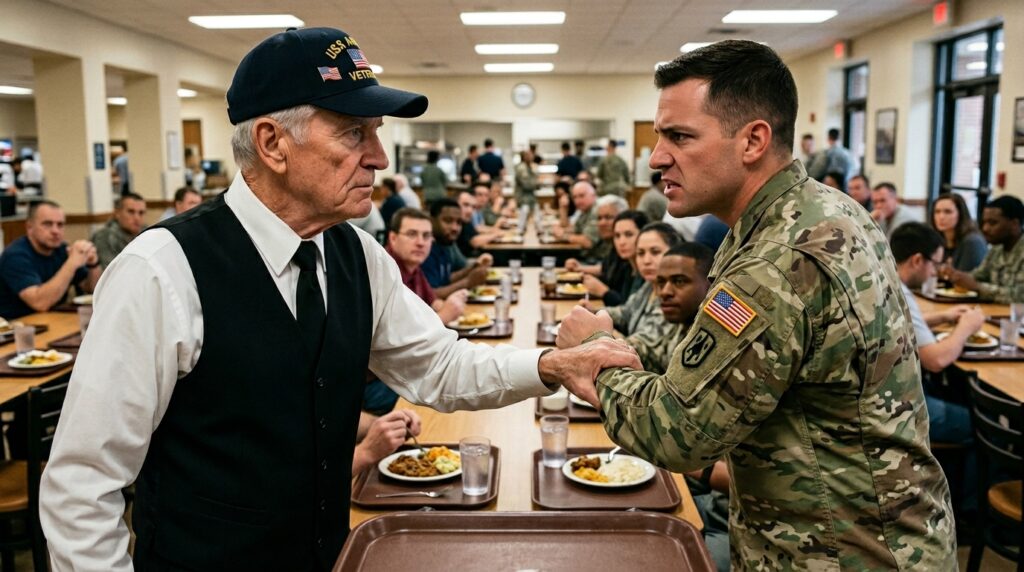
“The unit classification on this sheet doesn’t exist, Colonel,” Elias said, his thumb pressing into the coarse paper of the printout. “Not on this base. Not anymore.”
The administrative holding room was small, cold, and buried in the concrete basement beneath the base headquarters. The walls were painted a dull, peeling seafoam green, a color meant to calm people but one that only seemed to collect the dust of the last thirty years. A single steel desk sat between them, its surface scarred by decades of shifted typewriters and heavy binders. The air was dead, tasting of old grease and the damp rot of underground pipes. Every time the ventilation kicked on, the rusted iron hinges of the heavy security door rattled with a low, hollow vibration.
Lieutenant Colonel Vance didn’t answer immediately. He sat with his hands flat on the scratched metal desk, his gray eyes tracking the slight tremor in Elias’s right hand as the older man slid the logbook across the table. Between them lay the black data drive Elias had stripped from the sergeant upstairs. It sat quiet now, its active amber light casting a greasy yellow glare across the printed text of the deployment logs.
“It’s an updated designation, sir,” Vance said. His voice had lost its sharpness from the dining hall, replaced by a flat, transactional drone. “Modern restructuring. Things change.”
” restructuring doesn’t leave a ghost trail in the logistics line,” Elias countered, his voice steady, his military-straight spine refusing to lean against the hard plastic back of his chair. He reached into his vest pocket, his fingers brushing past the warm casing of the data drive to pull out his old silver Zippo. He placed it on the desk with a heavy, deliberate click. The scratched chrome surface caught the dull fluorescent light. “Look at the transport codes on page four. Delta-Nine-Zero. Those aren’t routing numbers for an active infantry platoon preparing for deployment. Those are terminal asset tags for static deep-surveillance positions. Domestic positions.”
Vance’s posture didn’t change, but his fingers twitched against the metal desk. “You’re reading old maps, Elias. The perimeter has evolved. We aren’t hunting the same shadows you were in seventy-four.”
“The shadows don’t change, Vance. Only the men trying to catch them get sloppier.” Elias leaned forward, the dark wool of his veteran cap casting a sharp shadow over his lined forehead. “Sergeant Miller’s unit isn’t staging for a transport to Europe or the Pacific. These sheets show they’ve been pulling raw equipment out of the old sub-level bunkers near the western ridge. The ones that were welded shut before you went to West Point. Why is a modern active-duty platoon drawing rusted gear out of an unmapped vault?”
The silence stretched between them, heavy and absolute, broken only by the distant, muffled thud of boots on the ceiling above. Vance was calculating. Elias could see the math running behind the officer’s eyes—the evaluation of risk, the measuring of an old man’s institutional memory against the operational security of a live directive.
“Miller is part of a specialized training detachment,” Vance said slowly, his words carefully measured. “They are testing baseline resilience with legacy gear. Electronic warfare defense. If the network goes dark, our people need to know how to operate on iron and grease.”
“A beautiful lie,” Elias said, his voice dropping into a dangerous, quiet rasp. “Except for one detail. The log shows they drew three functional encryption racks from the old Oculus program inventory last Tuesday. Those aren’t legacy trainers. Those are intercept units designed to tap localized landlines and analog relays. Who is the target, Colonel?”
Vance stood up, his heavy chair scraping loudly across the concrete floor. The sound was abrasive, cutting through the damp room like a saw. He walked to the corner of the small office, his back to Elias as he stared at a faded wall map of the installation. His green utility uniform looked stiff, but Elias noticed the microscopic fraying at the collar, the subtle stain of carbon oil on his cuff. This was a man working under a clock, suffocating under a weight he hadn’t planned for.
“You have a recipient’s card and a legacy pass, Elias,” Vance said without turning around. “That gives you the right to eat at our mess and look at our history. It doesn’t give you the right to audit my logistics. You took a piece of restricted gear from a non-commissioned officer. Hand it back over, and I will personally ensure Miller spends his next three months digging ditches in the motor pool instead of filing charges against you.”
“Miller didn’t drop this drive because he was careless, Vance. He dropped it because he was terrified,” Elias said, his active agency driving him out of the chair. He stood up, his knees popping with a dry, sharp crack that felt loud in the small room. He didn’t touch the drive on the table; he kept his hands resting near the pockets of his vest. “He knew what was on it. He knew that if anyone with an old uniform saw him carrying a live XR-Delta node through a public mess hall, the whole perimeter would fall apart.”
Elias picked up his silver Zippo, his thumb sliding over the smooth, rubbed-down unit insignia on its side. He looked at the paper logs one last time, memorizing the alphanumeric sequence under the fuel requisitions. Zone Seven. The old radio tower.
“Keep your paperwork, Colonel,” Elias said, turning toward the heavy steel door. “But the drive stays with me until I verify exactly what node that amber light is talking to.”
Vance turned around, his face completely pale, his eyes wide with a cold, professional anger that mirrored Elias’s own internal resolve. “If you leave this room with that hardware, Elias, you aren’t a veteran anymore. You’re a security breach.”
“I was a security breach before you learned how to salute, young man,” Elias said, his hand clamping onto the rusted iron handle of the door. He pulled it open, the heavy hinge screaming against the frame, stepping out into the dim gray corridor before the officer could call for the guard.
The victory felt clear, but as Elias turned the corner toward the lower exit, his fingers reached into his vest pocket to secure the drive. His pulse hitched. The casing was cold now. The active amber light hadn’t just changed rhythm—it had turned a solid, unblinking crimson, and the small digital display on its spine now read: LINK TERMINATED – UPLOCK LOGGED. They hadn’t just traced the device; they had used his presence in the room to authorize a hard lock on the local network, changing the context of every coordinate he had just memorized.








