
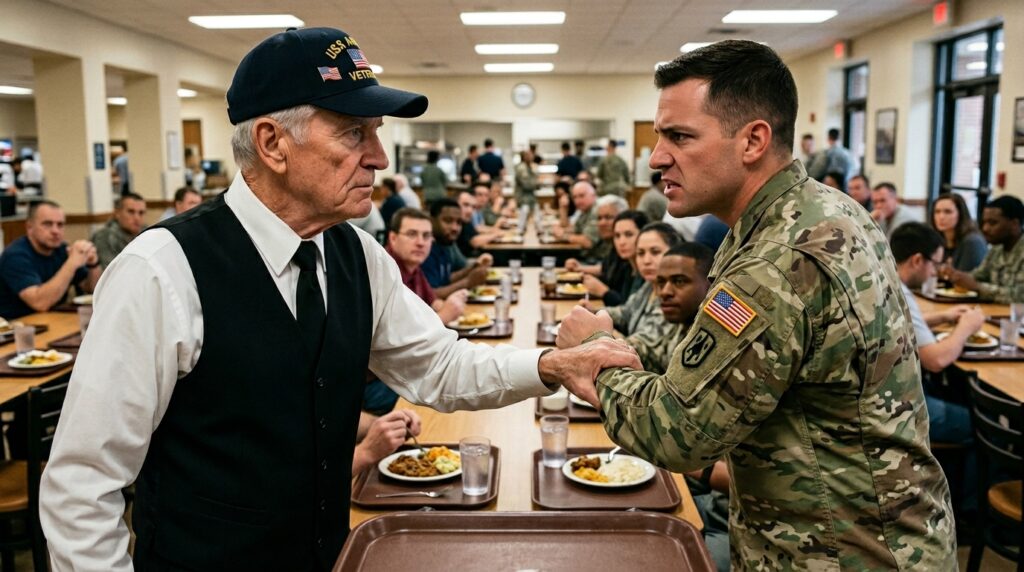
CHAPTER 4: THE WEAR OF THE GEAR
The gravel of the auxiliary parking lot chewed at Elias’s soles with a dry, rhythmic crunch. Outside the concrete shelter of the headquarters, the Maryland air was heavy, smelling of scorched diesel, wet asphalt, and the sharp, metallic tang of unwashed undercarriages. A row of standard tactical trucks sat baking under a low, milk-white sky, their green paint oxidized into a powdery chalk that rubbed off on anything that brushed against them. Elias kept his hands jammed deep into his vest pockets, his left fingers wrapped tightly around the cold, dead chassis of the data drive. The crimson warning light had stopped flashing, fading into a dull, solid eye that felt heavier with every step he took away from the basement.
He wasn’t alone. Fifty yards out, near the tailgate of an unbadged three-quarter-ton pickup, Sergeant Miller was leaning against the rusted steel bed. The young man’s utility uniform was no longer immaculate; the right elbow was dark with grease from the dining hall floor, and his posture had lost the geometric rigidity he had flaunted an hour earlier. He was fumbling with a heavy iron tie-down strap, his movements jerky, driven by the frantic, silent panic of a soldier who knows his perimeter has been breached from within.
Elias adjusted the brim of his veteran cap, letting the low shadow mask his eyes as he changed his vector. He didn’t approach from the blind spot; he walked straight down the line of trucks, his boots clicking hard against the grit to announce his weight.
Miller flinched at the sound, his head snapping up. The arrogance was entirely gone, replaced by a gray, exhausted look that made him look closer to forty than thirty. His eyes tracked Elias’s approach, darting instantly to the pocket where the data drive was concealed.
“You shouldn’t be out here, sir,” Miller said, his voice flat, stripped of its edge. He didn’t reach for his belt, but his arm stayed locked near the truck’s paneling. “The Colonel’s detail is already moving the logistics logs to the main terminal. This whole sector is going to a restricted status within the hour.”
Elias stopped five feet away, his frame catching the damp wind coming off the western ridge. He looked at the truck bed. It was filled with old communication components—heavy, green-painted junction boxes with braided copper ground lines that had greened with age. “These aren’t active inventory, Sergeant. This is salvage from the old subterranean relays. The Oculus lines.”
Miller’s jaw tightened, the skin over his cheekbones turning white. He looked down at his own hand, which was wrapped around a heavy brass key fob attached to a grease-stained lanyard. “We’re clearing out old lines. Legacy maintenance. That’s the order.”
“An order from Vance doesn’t change the physics of a data lock,” Elias said smoothly. He stepped closer, the smell of old iron and wet rust rising from the truck bed between them. He pointed a weathered finger at the brass fob in Miller’s hand. Scratched into the soft metal was a series of notched numbers: Tower-07-Relay. “The drive I took off you didn’t terminate its link because I walked out of the room. It terminated because your unit just initiated a localized sweep from the high ridge. They think they’re hunting a signal leakage, don’t they?”
Miller didn’t answer immediately. He let the tie-down strap drop, the heavy iron hook clanging against the truck’s wheel well with a sharp, hollow ring that echoed across the empty lot. He wiped his greasy palm against his trousers, leaving a dark, irregular smear across the green fabric. “They told us it was a domestic exercise, old man. A structural test of the old cold-site infrastructure. They said the data on that drive was just baseline telemetry from the old automated relays.”
“And you believed them because it was easier than looking at the wire,” Elias said. His internal monologue remained sharp, calculating the distance between Miller’s fear and Vance’s desperation. The sergeant wasn’t the architect; he was the lever. “Look at those junction boxes in your bed, son. Look at the insulation on the lead-ins. That’s double-shielded copper with a pressurized nitrogen core. You don’t use that for baseline telemetry. You use that to shield high-frequency intercepts from ground-floor observation. Your unit isn’t testing the system. They’re trying to hide a massive systemic breach in the old core network before the Department inspectors arrive next month.”
The sergeant looked at the boxes, his breathing turning shallow, the exhaust from a nearby idling humvee washing over them in a warm, foul wave. “The Colonel said if the node went red, it was just a diagnostic disconnect. He said it meant the array was resetting.”
“The array isn’t resetting,” Elias said, his voice dropping into a granular whisper that stayed beneath the rattle of the distant engines. He reached into his pocket and pulled out his silver Zippo, holding it up so the rubbed-smooth unit insignia faced the sergeant. “When the Oculus program was shuttered in seventy-eight, we didn’t just turn off the switches. We buried the terminal keys because the original infrastructure had an inherent structural flaw—a loop in the logic that allowed anyone with a legacy terminal to read the outbound lines without generating a log trail. Vance isn’t running a training exercise, Miller. He’s trying to rebuild that loop to cover a tactical failure from his own past deployment records, and he’s using your platoon as the labor.”
Miller’s eyes widened, his gaze shifting from the smooth chrome of the lighter to the absolute finality in Elias’s face. The realization hit him like a physical blow, his shoulder sinking against the truck’s clear-coat paneling. “The coordinates… the ones we were mapping on the western perimeter. They weren’t base boundaries. They were the junction vaults for the old domestic trunk lines.”
“Exactly,” Elias said, his hand closing over the Zippo with a definitive click. “And now that the drive has logged a hard lock, your people on the ridge are going to realize someone who knows the old language just intercepted their decoy.”
Before Miller could reply, a sharp, mechanical squeal cut through the damp air from the far side of the lot. The base’s automated perimeter gates were swinging shut ahead of schedule, the heavy iron gears grinding against their tracks as a line of dark security vehicles activated their flashing amber strobes near the main checkpoint.








