
CHAPTER 5: THE RADIUS OF THE RUSTED RIDGE
The heavy iron wheel of the vault door didn’t want to turn. It felt fused to the frame by forty years of stagnant humidity and tectonic settling. Elias leaned his weight into it, his shoulder—the one Miller had tried to wrench earlier—protesting with a deep, grinding heat. He could feel the grit-crusted gravel shifting under his heels as he strained against the cold steel. Above him, the Maryland sky was beginning to bruise into a deep, sickly purple, and the high ridge radio tower loomed like a skeletal finger against the gathering dark.
With a sharp, crystalline snap of breaking rust, the wheel moved. A quarter turn. Then a half. A hollow, pressurized hiss of air escaped from the seal, smelling of ozone, copper, and the peculiar, dead scent of an era that had supposedly been buried.
Elias pulled. The door groaned on its hinges, a sound like a dying animal echoing off the surrounding brittle concrete of the ridge bunker. He didn’t use a flashlight. He didn’t want to provide a beacon for the amber-strobed security vehicles currently sweeping the auxiliary parking lots two miles below. Instead, he relied on the faint, rhythmic pulse of the crimson light on the data drive in his pocket. It cast a rhythmic, bloody glare against the damp walls of the descent shaft.
He began to climb down. The ladder rungs were cold, the iron flaking away in jagged scales under his grip. His internal monologue was a series of tactical calculations—Vance’s reaction time, the radius of the localized intercept, the specific frequency of the Oculus relays. Vance thought he was covering a deployment error, a simple smudge on a modern record. But as Elias reached the bottom of the shaft and his boots hit the flooded floor of the relay room, the “Rusted Truth” began to vibrate through the soles of his shoes.
The room was humming.
It wasn’t the low, industrial thrum of the base ventilation. This was a high-frequency, glass-shattering whine that made the fillings in his teeth ache. In the center of the vault, three massive encryption racks—the ones Elias had seen in the logistics logs—were tethered to the original 1970s terminal blocks. Thick, braided copper ground lines, fresh and gleaming against the rusted iron of the floor, snaked toward the western wall.
Elias approached the primary terminal. He pulled out the data drive, the crimson light reflecting in the stagnant water at his feet. Near the nitrogen-sealed lead-in of the relay, he saw it: a small, handwritten tag attached to a patch cable. PROJECT CHIMERA – LEGACY TRUNK 04.
His fingers, weathered and calloused, traced the seal. It wasn’t just a signal intercept. The pressurized nitrogen wasn’t there to protect the cable; it was there to maintain the temperature of a high-speed bypass.
“You were always better at the technicals than the politics, Elias.”
The voice came from the shadows behind the cooling racks. It was dry, exhausted, and held the unmistakable weight of a man who had already accepted his own defeat.
Elias didn’t turn around immediately. He kept his eyes on the nitrogen seal. “The Oculus bypass was supposed to be dead, Vance. I watched the concrete pour into the terminal wells myself in seventy-eight.”
Lieutenant Colonel Vance stepped into the crimson glow of the drive. He wasn’t wearing his service cap. His hair was disheveled, and the starch in his uniform had finally given way to the damp heat of the bunker. He was holding a sidearm, but it was pointed at the floor, his grip loose and trembling.
“The concrete didn’t take everywhere,” Vance said. He gestured vaguely at the humming racks. “There are pockets of the old grid that the modern scanners can’t see. They’re like ghost limbs, Elias. They still twitch. When my unit had the failure in the desert three years ago… when the encryption failed and we lost those six men… it wasn’t a modern hack. It was a legacy leak. A back-door that had been left open since your time.”
Elias turned now. His gaze was sharp, his spine an unyielding vertical line. “So you didn’t come here to hide a modern mistake. You came here to fix an old one.”
“I came here to kill the ghost,” Vance rasped, his eyes glassy in the dark. “But the more I tried to patch the loop, the more the old system woke up. It’s not just Intercepting anymore, Elias. It’s broadcasting. Every coordinate Miller mapped today… it wasn’t for a sweep. The system was feeding those coordinates to an outbound relay. It’s talking to someone.”
Elias felt a coldness that had nothing to do with the flooded floor. The “Decoy Secret”—the idea that Vance was simply a corrupt officer covering his tracks—shattered. This was a failure of the architecture itself, a rot in the very foundation Elias had helped build.
“Who is it talking to, Vance?” Elias asked, his voice a low, dangerous rumble.
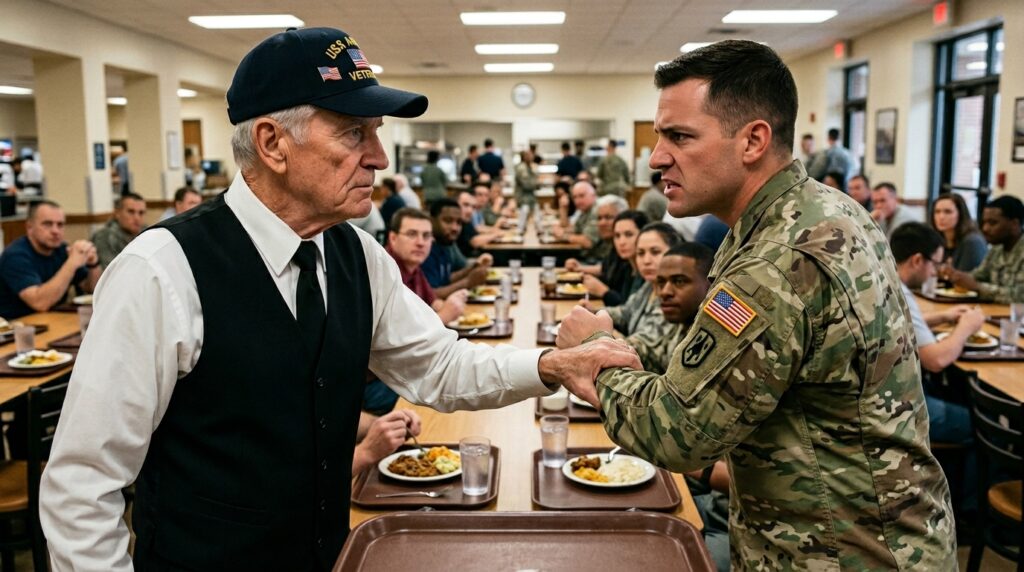
“I don’t know,” Vance whispered. “But the data drive you’re holding? It’s not a receiver. It’s a key. And when you walked into the mess hall with it today, you didn’t just breach my security. You authorized the final transmission.”
A heavy, muffled boom vibrated through the earth above them—not an explosion, but the sound of the high ridge radio tower’s massive emergency relays engaging. The high-frequency hum in the room intensified until it became a physical scream, and the crimson light on the drive in Elias’s hand suddenly turned a blinding, sterile white.
Elias looked at the terminal. The nitrogen seal was venting now, the gas hissing out in a white cloud that obscured the racks. He had forced his way in to find the truth, but he had only succeeded in triggering the very disaster he had come to prevent. The ultimate reality was still locked behind the white fog, but the paradigm had shifted: he wasn’t the protector anymore. He was the catalyst.








