
CHAPTER 4: THE SHIFT ON THE FRONT LINES
The padlock hanging from the secondary chain-link gate of the terminal didn’t have a brass body. It was a massive block of laminated steel, its plates bound together by rusted iron rivets that had turned the color of dried liver under fifty years of salt mist. When the old man dropped his left forearm against the horizontal pipe of the frame, the metal didn’t rattle; it gave a dull, dead thud that belonged to something anchored deep into ten inches of poured dock concrete.
The rain was no longer slanting. It fell straight down now, a heavy, unhurried drumming that flattened the coal-colored surface of the canal and turned the fine limestone dust on the tracking road into a thick, gritty paste. Vance didn’t pull his hands from his coat. He stood under the overhang of an old corrugated-iron pump house, his veteran cap tilted forward just enough to channel the runoff away from his collar.
He wasn’t looking at the lock anymore. He was watching the reflection of the streetlamp in a wide puddle of oil-slicked runoff twenty yards inside the perimeter.
A car was parked down behind the rusted skeleton of the old gantry crane—not the black sedan from Eleventh Street, but a standard city cruiser, its white door panels smeared with a baseline of brown river silt from the unpaved tracking lanes. The engine was dead, the roof-mounted light bar dark and encrusted with salt crust, but the tires weren’t flat. They sat high on the aggregate, their treads clean of the lime mud that coated every other square inch of the yard.
Someone had driven it in from the western approach within the hour.
The old man felt the zinc washer against his left palm, his skin registering the sharp, hand-filed notches along the rim with the cold clarity of an inspector checking a tolerance. The man in the oilcloth coat had known the schedule too well. In the old logistics matrix, a precinct inspection didn’t begin at the desk; it began with a quiet spotter car parked behind an obsolete asset to see if anyone came down with an iron key before the main detail arrived with the torches and the bolt cutters.
A door latch clicked fifty yards down the lane, the sound muffled by the heavy hiss of the river.
It wasn’t a tactical movement. It was the heavy, unhurried step of a man whose boots were broken in for administrative shifts on concrete floors. A middle-aged patrol officer stepped out from the shadow of the gantry supports, his yellow slicker dripping water onto his utility belt with a faint, rhythmic slap. He didn’t have his hand on his holster, but his thumbs were tucked neatly into the top of his load-bearing vest—a natural bit of leverage that kept his shoulders broad against the gray line of the fence.
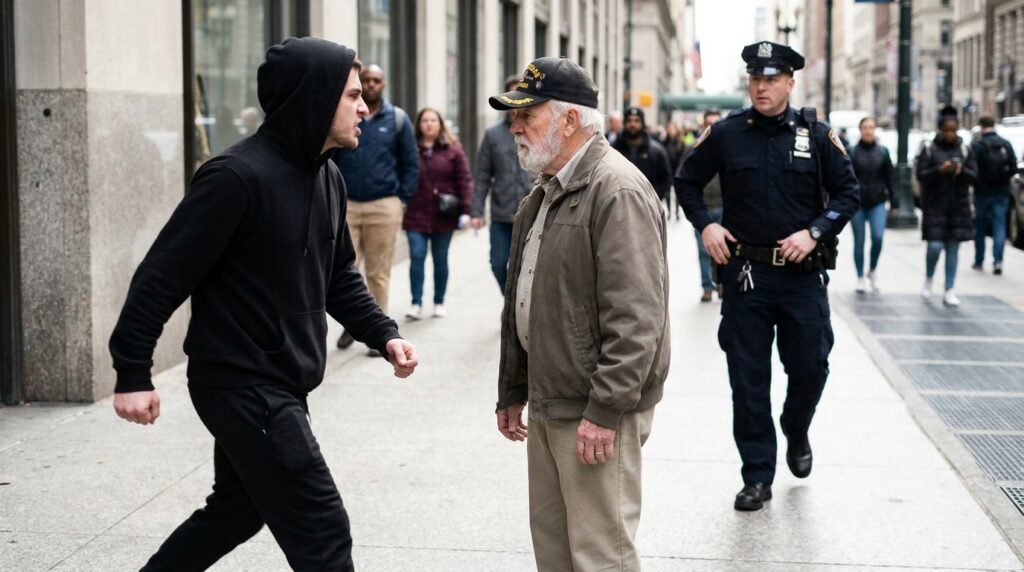
Vance recognized the set of the jaw before the man reached the gate. It was Miller, the officer from the sidewalk confrontation outside the clinic, his clean-cut face looking slightly grey under the yellow wash of the perimeter security light.
“The gate’s locked for a reason, sir,” Miller said. He didn’t use his professional command tone; his voice was flat, carrying the dry, unhurried rasp of an investigator who has already spent four hours writing up a custody report on a kid with a black hoodie. “The city port authority pulled the access permits for this sector three hours ago.”
The old man didn’t take his weight off his heels. He kept his spine straight, his beard catching the moisture from the fog rolling off the shipping channel.
“The port authority didn’t lay the concrete under these posts,” Vance said, his voice dropping into that low, gravelly rasp. “The company paid for the lime and the aggregate in sixty-nine. I signed the delivery logs.”
Miller stopped five feet from the inside face of the wire mesh. He looked at the old man’s cap—at the gold lettering that spelled out the name of the destroyer that no longer existed in any navy registry. Then he reached inside his slicker and pulled out a small, flat manila envelope, the paper dark and swollen with the humidity of the harbor. Through the translucent oil-cloth pocket of his vest, the old man could see the shape of the iron key—the three square teeth showing through the paper like old teeth in a skull.
“The kid had this in his sock when we processed him at the precinct,” Miller said softly, his eyes tracking a line of grease on the fence pipe. “He didn’t give a statement, but the desk sergeant didn’t even log it into the property locker. He put it straight into a blue folder that belongs to the city development board.”
The veteran didn’t reach through the wire. He knew the rule of the line: once an item enters an administrative folder, it doesn’t come back out across a fence unless the price is paid in blood or state scrip.
“The desk sergeant has a brother who works the logistics desk at the regional rail yard,” the old man said. It wasn’t a question.
“He’s got a cousin on the zoning commission too,” Miller replied, his mouth tightening until the skin across his cheekbones looked like dry parchment. “They’re not looking for old tools, Vance. They’re looking for the tracking logs for the limestone vaults under the machine shop. The state EPA wants to clear the site for a deep-water container terminal, but the developers won’t sign the insurance waivers until they know exactly what’s down in the third tier.”
The old man turned his head toward the dark mass of the machine shop three hundred yards inside the fence. The corrugated iron roof had mostly collapsed under the winter snows of ninety-eight, but the concrete foundations were twelve feet thick—built to hold the weight of turbine casings and heavy naval ordnance during the long years before the contracts dried up.
“There are no logs,” Vance said, his voice steady as a plumb line. “The logs were in the annex when the furnace leaked.”
“The blue folder has a duplicate manifest from seventy-three,” Miller said, his hand tightening on the envelope until the paper crinkled. “It has your name on the clearance stamps, sir. Every tank car that came through the Fort Meade siding had a cross-hatch filed into the primary valve washer. They’re matching the stamps on the old zinc washers to find out which unit ran the chemical transport before the records were closed.”
The old man’s left hand grew perfectly cold against the washer in his pocket. The trap wasn’t a street mugging; the kid in the black hoodie had just been a cheap probe deployed to see if the last living supervisor of the third transport detachment still carried the physical proof of the tracking system on his body.
“You should go back to the clinic, sir,” Miller said, his voice dropping into a quiet, transactional whisper that barely cleared the mesh of the gate. “The state inspectors will be here at dawn with the heavy tools. If you’re still within the port boundaries when the warrants are unsealed, the precinct won’t be checking service caps.”
He turned before the old man could answer, his yellow slicker disappearing back into the shadow of the gantry crane like a piece of old canvas caught in a draft. The old man stood alone at the gate, the rain running off the brim of his cap in a steady, unbroken stream that tasted of old iron and the salt of a completely different era.








