
CHAPTER 3: THE ANCHOR INCIDENT ON THE CONCRETE
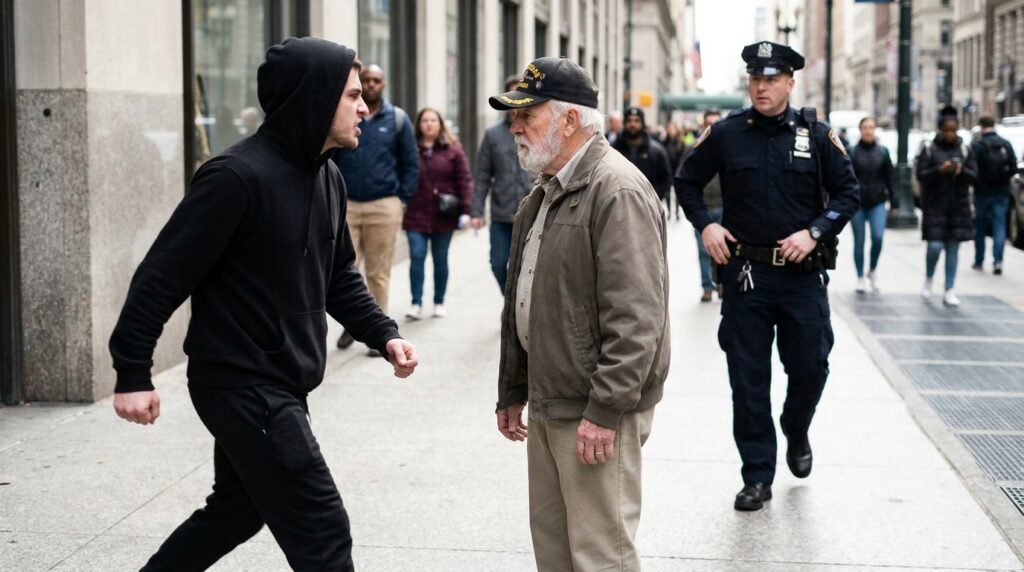
The blue-and-white transport unit left an oily plume of unburnt diesel hovering three inches above the wet aggregate. It settled into the wool of the old man’s collar, heavy and sour, mixing with the scent of dried river salt that never really washed out of the charcoal jacket. He stood exactly where his heels had notched into the concrete trench, his right hand remaining flat against the empty flannel lining of his pocket.
The weight was gone. The hand-filed iron key with its three square teeth had left an imprint against his thigh that still throbbed with a faint, phantom pressure, but the pocket itself was a hollow draft.
He turned his head six degrees to the east. The city commuters were already reclaiming the sidewalk corridor, their shoes scuffing through the grease-stained gutter water with the frantic, short-stroked efficiency of an engine with a loose flywheel. They didn’t look at the old man. They didn’t look at the brickwork where the hooded kid’s shoulders had scraped away the dried mortar. They simply narrowed their eyes against the first thin needles of rain that were beginning to slant down from the harbor, the water turning the grey concrete into a dark, reflective mirror that smelled of zinc and sulfur.
A man who survives thirty winters on a drydock doesn’t chase a shadow through an unmapped crowd. He calculates the leverage. The kid hadn’t been working alone; a three-tooth shipyard key was useless to a street-level shakedown artist unless someone had paid him to find the specific notch it made in the world.
He walked. His stride remained low and unhurried, his worn leather soles striking the pavement with the deliberate, heavy thud of an old piston. He cleared the intersection at Eleventh, his eyes tracking the baseline of the storefronts rather than the faces. At the corner of the commercial block, where the old iron-front buildings began to give way to the chain-link perimeters of the industrial canal, a black sedan sat idling beside a rusted fire hydrant. Its wipers were off, the glass coated in a greasy film of river mist that obscured the driver’s silhouette, but the exhaust pipe was clear—emitting a steady, clean hiss of white vapor that didn’t match the ragged rumble of the city buses.
The veteran stopped before the curb, his fingers tightening around the zinc washer in his left pocket. He let his thumb feel the rough stamp on the metal—the small, non-regulation cross-hatch that someone had filed into the rim fifty years ago when the shipments from the chemical depot were still arriving by rail.
A figure stepped out from the shadow of the brick partition behind the sedan. It wasn’t the kid. This man was broader, his shoulders stiff under a heavy tan oilcloth coat that had the stiff, greasy look of old warehouse stock. He didn’t have a hood, but his cap was pulled low, a flat wool brim that cast a grey wedge of shadow across a jawline that looked like it had been broken and set wrong in a county clinic. He didn’t approach the old man. He simply stood by the rear fender of the car, his hands buried deep in his pockets, his eyes fixed on the gold lettering of the veteran’s cap with the flat, unblinking assessment of an inspector measuring a rusted cable for rot.
“You’re a long way from the slipways, Vance,” the man said. The voice didn’t carry across the street; it dropped straight into the concrete between them, low and heavy with the dry, transactional rattle of a foreman closing a logbook.
The old man didn’t change his stance. He kept his feet planted twenty inches apart, his knees slightly bent to take the weight of his frame off his lower back—the old command-post posture that keeps a man steady when the deck begins to roll under an incoming sea.
“The slipways closed when the ground went sour,” the veteran said, his rasp cutting through the hiss of the sedan’s exhaust. “The iron’s still there. It just doesn’t belong to the company anymore.”
The man in the oilcloth coat didn’t flinch. He reached into his pocket and pulled his right hand out, his fingers holding a small, dull square of tarnished metal by a thin loop of copper wire. It wasn’t the shipyard key. It was a stamped transit token from nineteen-seventy-two, the surface scratched down to the dull orange copper beneath the chrome plating. He let it dangle for a fraction of a second, the metal clicking against the heavy brass button of his cuff with a sound that was too bright, too clean for the street.
“Your old logistics manifest had a gap in the third quarter,” the man said, his eyes shifting down to the veteran’s empty right pocket. “The kid didn’t know what he was pulling. He just knew it was old. But the people who own the property down by the canal—they remember the tracking tags. They remember who signed the bills of lading when the drums went into the limestone vaults.”
The veteran’s left hand grew perfectly still against the zinc washer. The token wasn’t a standard transit piece; the scratch across the face was a deliberate cancellation mark used by the third transport detachment out of Fort Meade—the ones who ran the unmarked tank cars into the siding behind the old shipyard before the state EPA even had an office in the county.
“The vaults were sealed with six feet of grout,” the old man said softly. “The records were burned in the fire at the administrative annex.”
“Some records don’t burn,” the man in the oilcloth coat replied, his mouth flattening into a hard, humorless line as he dropped the token back into his pocket. “They just get misplaced in old toolboxes. The precinct’s got three different warrants for administrative inspection on the riverfront lockers starting tomorrow morning. If the iron doesn’t match the lock, they break the hinge.”
He didn’t wait for a reply. He pivoted with a heavy, deliberate swing of his hip and stepped back into the passenger side of the sedan. The door shut with a solid, well-greased thud that spoke of reinforced panels and heavy latching mechanisms. The car didn’t screech its tires; it pulled away from the curb with a smooth, silent surge of power that left the old man standing alone at the margin of the canal, the rain finally beginning to pool in the deep white fractures of the concrete sidewalk.
The veteran looked down at his left hand. He pulled it from his pocket, exposing the zinc washer to the grey light. The cross-hatch was still there, but under the wet sheen of the rain, he could see what his thumb had missed in the dark—the faint, stamped letters U.S.A.T.C. beneath the grime. The decoy secret of the shipyard locker was already peeling away, and the cold iron beneath it was starting to taste like salt and old bone.








