
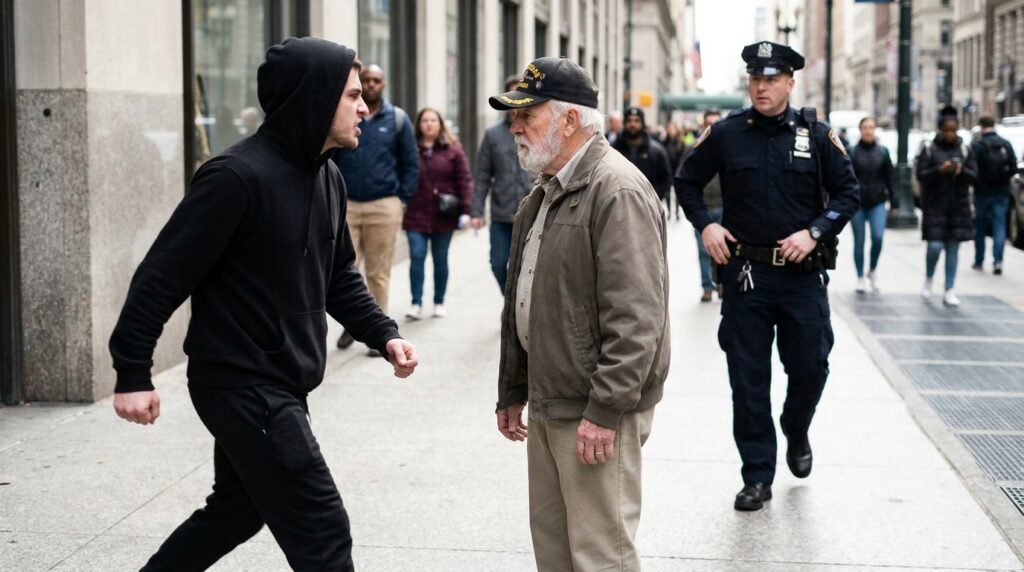
CHAPTER 2: THE ANATOMY OF AN ARREST
“Don’t stiffen up on me,” the officer grunted, his voice flat and thin under the weight of his duty gear.
The sound of the arrest was mostly leather—the heavy, oiled creak of a utility belt shifting mass as the cop pivoted his weight. The hooded challenger didn’t fight the grip, but his body didn’t go loose either; he stayed knotted up like a cold length of wire rope, his shoulder blades grinding hard against the salt-pitted brick face of the clinic wall. A small shower of red dust and dried mortar flaked off the joints, settling into the black synthetic weave of his hood.
The veteran didn’t look at the kid’s face anymore. He was looking at the officer’s right hand, where the skin across the knuckles was white from the force of the leverage. It was an old hold—the kind they taught at the academy back when the cars still had carburetors and the radios used crystals. The cop’s thumb was pressed deep into the nerve cluster behind the collarbone, a pragmatic bit of leverage that kept the kid’s heels off the pavement without requiring a single blow.
“Watch the feet, Miller,” the cop said into his shoulder mic, his breath coming in short, rhythmic puffs that smelled of cold chicory coffee and winter mints. He didn’t look at the old man yet. His focus remained entirely on the three square inches of space between the kid’s shoulder blades where his fingers had gathered a fistful of loose black polyester.
The crowd didn’t stop to cheer. If anything, the circle widened further, the grey current of the sidewalk moving faster now that the danger had been codified into an official state action. People adjusted their bags, tucked their chins into their wool scarves, and slipped past the interaction lane with their eyes fixed on the greasy reflection of the cross-town bus idling twenty feet away. In a city built on thirty-year mortgage cycles and six-minute transit delays, an arrest was just an obstruction—a temporary narrowing of the pipe.
The old man reached down to adjust the hem of his casual jacket, his fingers brushing against the stiff, charcoal wool. His hand felt cold, the skin across his knuckles looking like dry river bed mud under the yellow glare of the streetlamp. He took a single, short breath through his nose, tasting the diesel exhaust and the sharp, sour tang of the kid’s sweat that still hung in the air between them.
That was when his thumb found the void.
The right pocket of his jacket was supposed to have a weight in it. Not the zinc washer—that was in the left, heavy and flat against his thigh—but the small, notched iron key that belonged to the old tool chest at the shipyard. The key wasn’t brass; it was hand-filed iron, four inches long, with three distinct square teeth that had been worn smooth by thirty years of grease and saltwater. It wasn’t there. The bottom of the pocket was just loose flannel lining, the fabric turned inside out like a dead tongue.
His heart didn’t jump. A heart that has spent eleven months in the mud near Da Nang doesn’t change its rhythm for a missing piece of metal, but his eyes narrowed until the white beard along his jawline went rigid. He looked back down at the concrete between his boots. Nothing. Just an empty potato chip bag and three squashed cigarette filters turning grey in the gutter water.
“You alright, sir?” the officer asked. He had the kid’s wrists locked in the steel teeth of the cuffs now, the double-click of the locking mechanism sounding sharp and metallic against the dull rumble of the midday traffic.
The veteran looked up, his face remaining a flat, slate shingle under the brim of his service cap. He didn’t mention the pocket. He didn’t mention the iron. In the dusty gray of the city, you don’t tell a man with a badge what you’re missing until you know exactly who took it and why they wanted the weight of it in their hand.
“The wind’s coming around from the east,” the old man said, his voice dropping into that low, gravelly rasp that sounded like iron filings being shifted with a spade. “It’s going to rain before the shift changes.”
The cop paused, his hand pausing on the kid’s elbow as he began the turn toward the curb where a white-and-blue transport unit was already nosing through the gridlock. He looked at the old man’s cap—at the faded gold thread that spelled out the name of a destroyer that had been broken up for scrap in a Taiwanese shipyard before the kid in the cuffs was even a thought in his father’s mind. The cop’s eyes stayed on the lettering for two seconds, his posture shifting just enough for his shoulders to drop out of their defensive hunch.
“My old man was on the Oriskany,” the officer said, his voice losing its administrative edge for the space of three words. “Seventy-two. He had the same look in his eyes when the boilers went out.”
The kid in the cuffs spat onto the concrete, a thick, dark blob that landed an inch from the cop’s polished leather boot. He didn’t say anything, but his wet eyes were fixed entirely on the veteran’s empty right pocket, his thin mouth curling into a dry, split smile that showed the gray edge of a dead tooth. He knew.
The old man didn’t move. He kept his left hand on the zinc washer in his remaining pocket, feeling the cold circle of the metal against his palm while the transport unit’s brakes squealed against the curb, the air line blowing a dry hiss of moisture across the wet aggregate pavement. The street was narrowing. The fault lines were opening, and the key was already moving three blocks west toward the river.








