CHAPTER 9: THE GRID ISOLATION
“Don’t touch the secondary bus bars until the inductive load drops below ten milliamps,” Jesse said into his dead handset, his voice hoarse against the rising scream of the state drainage pumps. He tossed the useless brick of his tablet into the wet canvas tool sack at his hip and reached for a pair of linesman’s pliers, their insulated handles scarred with gray electrical tape. The cold downpour was turning the interior of the decorative juniper bush into a muddy trap, the slick evergreen needles slapping against his face, leaving a greasy film of soot and water across his eyes.
Beside him, the younger deputy held a heavy fiberglass hot-stick extended toward the transformer hatch, his leather gloves trembling slightly as the low-frequency hum from the earth grew high-pitched, vibrating through the wet soil like an industrial bone-saw.
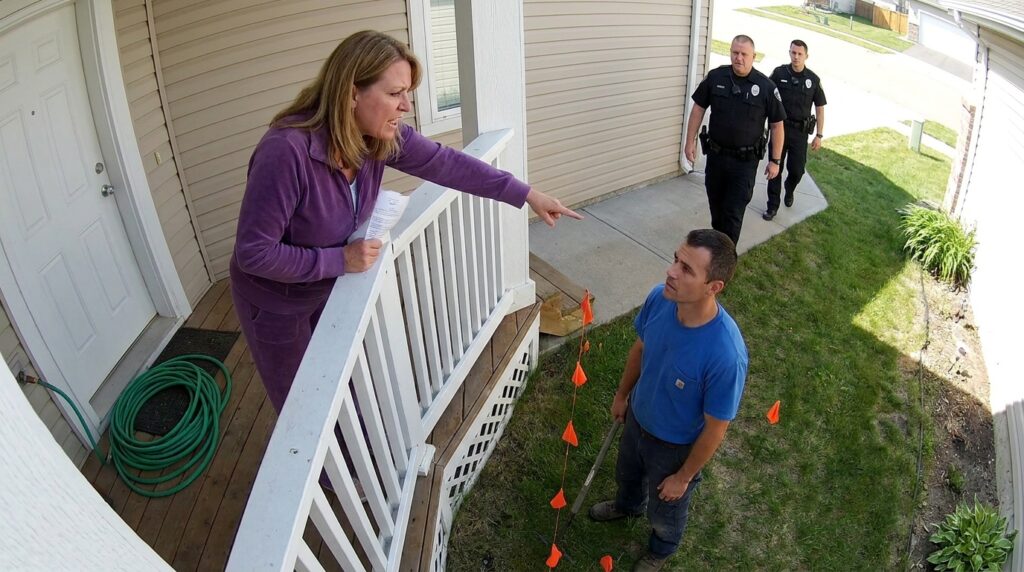
“The master breaker at the county substation won’t isolate this loop, Jesse,” Officer Miller called out from the edge of the curb. He stood just under the dripping line of the neighbor’s garage gutter, his arms crossed tight over his heavy nylon duty vest, his eyes fixed on the house’s dark bay window. “The regional engineer just logged the feed. This junction box has an unmetered three-phase trunk line running down from the old industrial substation on the ridge. If we drop the city main, the parallel line stays live. It’s back-feeding through the ground.”
Jesse knelt deeper into the wet mulch, his work pants soaking through with a cold, sulfurous sludge that leaked from the base of the transformer housing. He used the nose of his pliers to clear a nest of rotten leaves and rusted wire from the primary latch. The steel hatch didn’t swing open cleanly; the hinges were locked solid with a thick crust of orange iron oxide that flaked off under his fingers like old bark. Inside the dark casing, the layout was a total mess. The standard utility terminals had been cut away with an oxy-acetylene torch decades ago, replaced by a row of oversized, oil-cooled ceramic insulators that bore the distinct, ground-down serial stamps of an industrial foundry.
“They didn’t just steal power to keep the anode system running, Miller,” Jesse muttered, his fingers tracing a heavy, lead-shielded cable that plunged straight through the bottom concrete pad into the subsoil. The grease on the wire was thick, foul-smelling, leaving a dark green stain on his wet leather gloves. “They used the transformer box as a hidden switching yard. Every time the city came out to audit the residential grid, they were reading a false loop. The actual current was being diverted through the vinyl fence line to power the deep extraction pumps under Lot 42.”
The deputy grunted, the tip of his fiberglass stick catching the primary disconnect ring. “The state warden says the pressure inside that iron conduit is hitting four hundred pounds per square inch, Miller. If we cut the current to the anode before they get the structural drill rigs set up, the internal acid is going to eat through the remaining iron casing in less than twenty minutes.”
“Then we don’t cut it yet,” Miller said, taking two deliberate steps toward the fence line, his boots sinking into the chemical-softened sod. He looked up at the raised porch. The screen door was still locked, the deadbolt turned tight, but the shadow behind the wire mesh had moved back down into the lower hallway. A faint, greenish glow was coming from the basement utility windows, a flickering, erratic light that timed perfectly with the rhythmic, underground thudding beneath their feet. “She’s down there running the manual override. She’s trying to purge the core before the state teams break the seal.”
Jesse didn’t wait for the officer’s command. He jammed the nose of his insulated pliers into the central bypass terminal, the metal teeth gripping a thick braid of green, oxidized copper wire that had been wrapped around the main transformer lug. The air inside the juniper bush instantly turned ionized, smelling of ozone and fried plastic. A sharp, brilliant blue arc popped across the terminal, throwing a shower of white-hot sparks into the wet grass and melting the tips of his linesman’s pliers into a dead lump of gray slag.
The mechanical hum from the earth didn’t drop; it changed key, shifting from a rhythmic drone to a long, hollow rattle that shook the white vinyl fence panels until the top rails popped out of their sockets. The small puddle of iridescent fluid in the trench lane began to hiss, the surface bubbling with a thick, frothy scum that turned the yellow clay into a grey, smoking sludge.
“The line’s still live,” Jesse called out, dropping the ruined pliers into the mud. He reached down and scooped up a heavy fragment of the broken ceramic insulator from the base of the box. The underside of the porcelain was clean, unoxidized, stamped with the same sharp, three-letter emblem he’d found on the brass surplus cap near the trench lane: C-O-U.
He held the shard up into the rain, the cold water washing the grease away from the blue ink of the mark. It wasn’t an unauthorized private installation. The components were county property, logged under a specialized municipal utility project number that dated back to the original 1988 incorporation. The gatekeeping wasn’t a personal secret; it was an institutional boundary line, maintained by the township itself to keep the old industrial core shallowly covered and out of the state registries.
“Miller,” Jesse said, his voice dropping into the flat, heavy cadence of a man who had finally read the bottom of the map. “The county supervisor didn’t find the old charter in the vault today. He knew it was here. Your office has been verifying the false loop for thirty-eight years.”
Officer Miller didn’t move. He stood under the gray downpour, his hands remaining tucked into his utility belt, his face completely shadowed by the brim of his wet cap. He didn’t look at the ceramic shard Jesse was holding out. He looked toward the driveway, where the heavy, yellow silhouette of the state core-drill rig was just clearing the corner line, its steel stabilizers rattling against the asphalt as it prepared to drop its teeth into the center of Lot 42.