CHAPTER 6: THE PERMIT REVIEW
“The packet was stamped by the regional registrar three years ago, Miller,” Jesse said. He held out the clear, grease-smeared plastic folder, his thumb stabilizing the corner where the heavy paper had split from constant exposure to cab heat and field sweat. The corporate logo of the subcontractor was faded to a gray shadow, but the blue ink of the municipal permit seal was still clear enough to catch the blinding white light reflecting off the cruiser’s hood.
Officer Miller took the folder without shifting his weight off his duty boots. His thick leather gloves gave a dry, rhythmic squeak as he turned the three pages over, his eyes scanning the coordinate grid maps while the younger deputy remained near the white vinyl fence, his heavy flashlight beam pointed into the narrow gap where the iron conduit was weeping its dark grease.
“This is an unrestricted utility right-of-way,” Miller muttered, his thumb tracing the blue border of Lot 42 on the paper schematic. He didn’t look up at the porch screen door, but his head tilted just enough to watch the reflection of the blinds inside his amber lenses. “The county didn’t grant a residential offset here. According to this layout, the main fiber line is supposed to drop straight down this lane. The concrete cap isn’t on the county plat.”
“It’s an unmapped variance,” Jesse said, pulling his gloves off with a sharp snap that shook dry yellow clay loose from his wrists. The sulfurous smell from the ditch was thick now, overriding the sweet scent of the neighborhood’s trimmed hedges. It was the heavy, oily stench of a manufacturing pit, a fluid that had no business sitting five feet from a kitchen window. “Someone went through a lot of trouble to cover that iron pipe with aggregate before the developer laid the sod. And those copper leads aren’t running appliances. They’re supplying a high-voltage primary link down into the seam.”
The deputy straightened up, his boot kicking a flaky crust of orange rust off the exposed conduit saddle. “The line’s drawing more than power, Miller,” he called out, his voice dropping into a tight, quiet register that didn’t travel past the white vinyl post. He tapped his flashlight casing against the ground-down lead patch. “The vibration isn’t coming from the grid transformer. It’s hydraulic. You can feel the fluid pulse inside the iron casing every ninety seconds. It feels like a high-pressure line running back toward the old creek bed behind the ridge.”
Jesse unclipped the digital sensor from his belt again. The screen was still scrambling, the pixels pixelating into green and grey lines every time the subsoil thumping rattled his boots. “The map says the old factory line closed in eighty-eight,” he said, squinting through the glare at the faint vector lines on the tablet. “But the telemetry anomaly goes all the way down the fence line. It doesn’t connect to the house’s service panel. It plunges under the foundation wall.”
Behind the dark mesh of the screen door, a shadow moved. The brass latch gave a brief, dry click as it was held down from the inside, but the deadbolt stayed locked in place. Her voice came through the wire screen, flat and stripped of its previous administrative authority, leaving only the cold, unyielding gravel of a property protector who had run out of rules to quote.
“The permits from eighty-eight are grandfathered under the district development charter,” she said. The sound was muffled by the thick oak frame, but her words were slow, calculated to reach the officer’s ear without crossing the threshold of the porch. “The county has no jurisdiction over private distribution systems laid before the incorporation of the township. You’re violating an enclosed estate.”
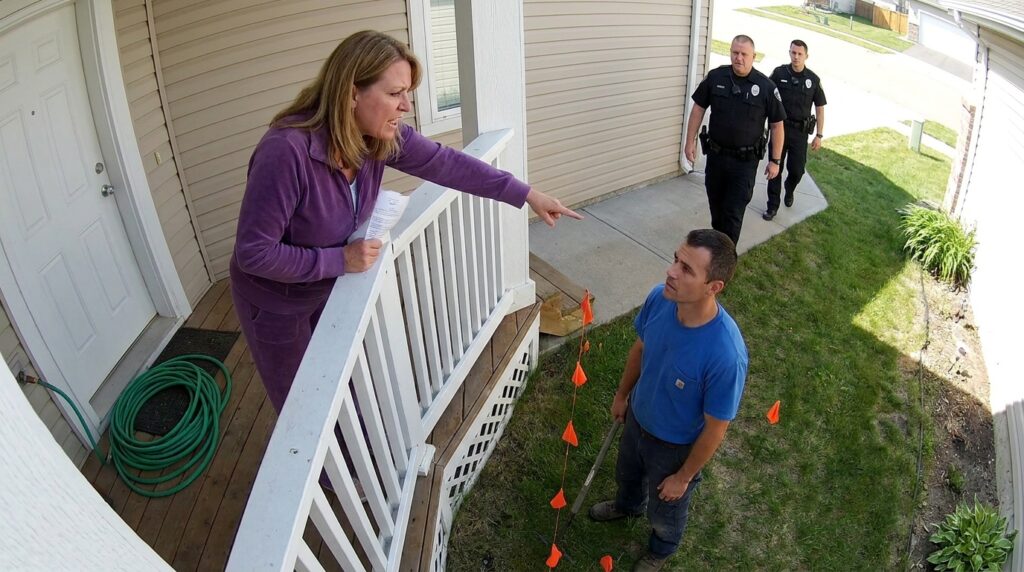
Miller didn’t answer her. He folded the contractor’s map back into its plastic sleeve, his leather glove smoothing the crinkled edges with a heavy, deliberate stroke. He walked across the narrow strip of dead turf, his boots stopping an inch from the white vinyl post where the green copper leads vanished into the plastic. He reached down and took the paper sheet she had left on the steps—the uncreased warning notice she had brandished like a weapon. He didn’t read it. He turned it over, looking at the blank back, then dropped it onto the oil-slicked fescue near Jesse’s spade.
“Ma’am,” Miller said, his voice rising just enough to cut through the subterranean thrum. “The city main goes in tomorrow morning. If you don’t open this door and provide the engineering log for this conduit by five o’clock, I’m calling the state environmental warden to set a perimeter on this yard. This fluid isn’t water, and this pipe isn’t certified under the residential code.”
The silence from behind the screen door was total. The tapping of her nail didn’t return. Through the dark mesh, Jesse saw the faint silhouette of her purple sleeve turn away from the frame, moving back into the dark interior of the split-level until the shadow disappeared completely into the hallway.
Jesse looked down at the lead patch on the pipe. The third letter—the N—was flanked by a small, stamped emblem of a closed valve. The metal around it was hot to the touch, the heat radiating out through the clay grit like a dying furnace. The decoy of the utility theft was already falling apart in his hands; the copper wires weren’t stealing current to lower her electric bill. They were supplying a constant, low-voltage charge to the pipe’s casing to prevent the rusted iron from collapsing under the weight of whatever was packed inside it.
The younger deputy stepped back onto the walkway, his fingers resting near his holster as another low, heavy thud shuddered through the dry soil under their feet. “We need to clear the block, Miller,” he whispered. “If that trenching machine hits this thing tomorrow, the blade’s going to crack the cast iron wide open.”
Jesse looked at his spade, then at the orange flags that were still shaking in the yellow dust. The primary conflict at the property line was over, but the ground beneath Lot 42 was shifting, and the absolute final truth of the line was still locked deep under the foundation.