CHAPTER 5: THE STEP BACK
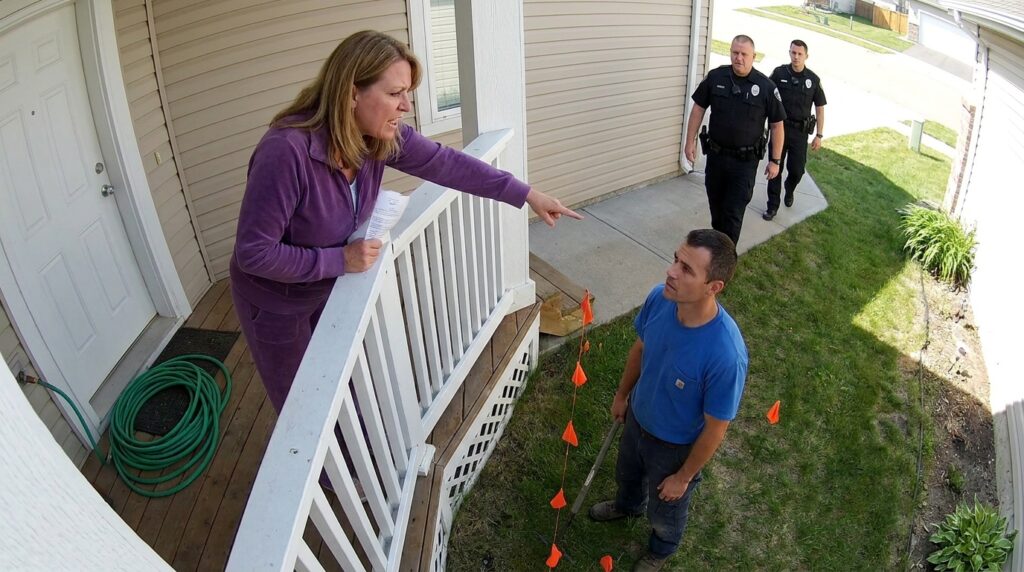
The vinyl railing groaned as she pulled her weight off the top rail. For a split second, the heavy, amber-tinted sunglasses remained tilted downward, fixed on the lead officer’s broad, sweat-shined face, before her heels clipped the lip of the top concrete step. She didn’t drop the uncreased sheet of bond paper, but her fingers crumpled the margin into a sharp, tight fold that gave a loud pop in the stagnant July air.
“The association will hear about the tone of this interaction, Officer,” she said. Her voice lacked the sharp, metric cadence from two minutes ago; it was thinner now, standard-issue suburban panic layered over something ancient and brittle. She took two steps backward toward the heavy oak door frame, her sneakers leaving shallow, gray indentations in the bleached fescue of the upper porch landing. “I have a legal right to expect a certified boundary verification before my private improvements are compromised.”
The lead officer didn’t follow her up the porch. He stayed down on the concrete walkway, his thick-soled duty boots planted precisely at the edge of the orange marking flags. His thumbs remained hooked inside his nylon belt, right beside the matte-black casing of his radio. “Ma’am, I’m not here to debate the deed restrictions,” he said, his voice flat as a gravel bed. “The contractor has an active municipal voucher. If you have an injunction, you present it to the district supervisor at the county line. Until then, you don’t cross the easement strip while the men are working.”
Jesse watched the shadow of her purple tracksuit disappear behind the heavy aluminum frame of the screen door. The lock didn’t turn yet; the dark mesh of the screen stayed grey and opaque, hiding her face, but the soft, rhythmic tapping of her acrylic nail against the interior brass latch continued. She was still standing right behind the wire, watching the dirt.
“Jesse,” the officer said, turning his head just enough to catch the reflection of the trenched yard in his sunglasses. “Show me what you dug up.”
Jesse dropped back to his knees, his denim trousers absorbing the greasy moisture from the clay strip. The sour, chemical odor of zinc primer and old kerosene was stronger now, coming up from the narrow fissure he had carved along the base of the white vinyl fence post. The silver-dollar-sized puddle of iridescent fluid had expanded into a thick, dark film that didn’t sink into the dirt; it clung to the roots of the fescue like old machine oil.
“Right here,” Jesse said, pointing the tip of his brass calipers toward the blackened concrete cap. “The municipal map shows a clear loop, but someone poured this aggregate right over the conduit saddle. These two copper leads are running straight through the bottom rail of her fence. They tapped into the primary line before it hits the pad-mounted transformer at the corner.”
The second officer, the younger deputy, took a step closer, his leather duty belt creaking as he leaned over the white fence line. He reached down with a heavy flashlight, using the aluminum rim to nudge a clump of weed-choked sod away from the exposed post hole. “That’s three-quarter-inch wire,” the deputy muttered, his eyes narrowing as he tracked the green, oxidized corrosion on the copper core. “That isn’t residential grade, Miller. Look at the insulation thickness. That’s old commercial twin-lead.”
The lead officer didn’t answer right away. He walked three paces north, his eyes tracking the straight, unnatural line of the vinyl fence. Every twenty feet, the grass along the bottom rail had the same yellow, chemical-burned tint, a uniform strip of dead turf that followed the exact trajectory of the buried conduit. He stopped near a small green transformer box that sat half-hidden inside a decorative juniper bush three lots down. The lock on the transformer’s steel hatch was gone; a rusted length of baling wire was twisted through the latch instead.
“You’ve got a four-hundred-amp draw on your screen?” Officer Miller asked, looking back at Jesse’s tablet.
“Four-twenty and spiking every time the main sector pump hits its cycle,” Jesse said, holding up the webbed screen. The green vector lines were still jagged, the telemetry anomaly flashing an erratic error code that didn’t fit the standard pattern of a house-flipper’s rogue junction. “If this was just a garage workshop or an unmetered pool heater, the residential breaker would have tripped the primary breaker forty minutes ago. This lead is drawing raw industrial current straight off the three-phase trunk.”
From inside the dark mesh of the screen door, the rhythmic tapping of the nail stopped. A sharp, heavy click echoed through the porch as the interior deadbolt was finally turned, the brass cylinder sliding into the strike plate with a hollow, permanent sound.
Jesse didn’t look at the door. He cleared a second wedge of clay from the iron conduit, his spade scraping against a smooth, unrusted plate of lead that had been cold-soldered over a section of the cast iron casing. The lead patch was thick, stamped with a small, circular logo that had been mostly ground away with a hand file. He could only make out three letters before the oxidation blurred the metal: M-A-N.
“This isn’t a city conduit,” Jesse said, his voice dropping as he rubbed the gritty clay off the lead plate. The fluid weeping from the seam wasn’t coming from a broken water main; it was leaking out from inside the iron pipe itself, a dark, heavy grease that left a faint, blue-green stain on his split-leather gloves. “The old municipal line is three feet lower. This pipe was laid private, Miller. And it’s not carrying power.”
The lead officer walked back to the trench, his boots crunching on the loose gravel Jesse had cleared from the concrete lip. He looked down at the lead patch, then at the iridescent ring widening near the vinyl post. His broad forehead creaked into three deep lines. “If that isn’t a power line, Jesse,” Miller asked quietly, “then what the hell are those copper leads tapping into?”
Jesse didn’t answer. He turned the digital camera toward the lead stamp, but the tablet’s sensor suddenly went grey, the diagnostic screen cycling through three erratic restarts as the low-frequency inductive hum from the fence line grew loud enough to hear without the sensor. The orange flags along the easement began to tremble, not from the wind, but from a deep, rhythmic thumping that had started up again beneath the yellow clay of Lot 42.