CHAPTER 10: THE UNEARTHING OF LOT 42
The concrete slab of the driveway didn’t just split; it collapsed into the subsoil with the hollow, deafening roar of a localized cave-in. The four heavy hydraulic outriggers of the state core-drill rig hissed, their polished steel shafts extending under immense pressure to stabilize the yellow frame as the forty-ton chassis tilted backward. Rain fell in dense, gray sheets now, slamming against the hot diesel engine block and turning the exhaust steam into an acrid, sulfurous fog that choked the cul-de-sac.
Jesse didn’t seek cover under the neighbor’s eaves. He stood right at the edge of the collapsing rim, his boots buried to the shins in water-logged yellow mud that churned with thick ribbons of blue-black slime. His hands, raw and freezing inside his split-leather work gloves, held the heavy fiberglass measuring tape tight against the subsiding lip of the pit.
The heavy core bit, an eight-inch diamond-toothed cylinder of blackened industrial steel, plunged down into the gap. It tore through the superficial layers of residential landscaping—the crushed gravel drainage sheets, the layers of weed-barrier plastic, the rich sod she had spent thousands of dollars to maintain—with a high-pitched, tooth-jarring shriek that vibrated through the foundation walls of the entire block.
“The bit isn’t hitting bedrock,” Jesse shouted through the static of the rain, his voice flat and dried out by the rising fumes of trichloroethylene. He didn’t use the dead tablet at his hip; he pointed his flashlight down into the churning cavity. “It’s through the upper structural cap. Look at the return wash. That’s old factory brick and industrial masonry.”
Officer Miller didn’t move away from the edge. The stocky cop stood with his boots planted on the remaining lip of the concrete driveway, his face dark beneath the dripping rim of his cap. He watched the drill rig’s mud-pump expel a thick, frothy slurry into the drainage ditch—a slag-heavy discharge that carried the unmistakable, metallic tang of spent zinc and old manufacturing scale. The red paraffin wax from the county’s historical cap was floating on top of the water like a grease skim.
“She didn’t run,” Miller said quietly. He wasn’t looking at the pit; his eyes were fixed on the lower level of the split-level where the small, rectangular basement windows sat right at the level of the rising mud. The greenish, erratic flicker from the utility room had stopped, replaced by a dull, constant yellow glow that smelled of wet electrical copper and burning transformer oil. “She stayed at the terminal box. The wardens tried the back threshold, but the entire interior stairwell has been blocked from the inside with poured grout.”
The drill rig’s engine gave a sudden, catastrophic growl, its primary hydraulic line bulging until the braided steel casing began to weep clear fluid. The spinning diamond bit had struck something that wasn’t brick. It gave a long, metallic screech—the unmistakable sound of hardened steel grinding against thick, cold-poured lead shielding.
Jesse leaned over the iron safety rail of the pit, his flashlight beam cutting through the steam. The drill had broken through the top layer of the basement wall from the outside. Beneath the three feet of standard residential foundation lay a vast, vaulted subterranean structure that didn’t follow the contours of the house. It was an industrial processing basin, fifty feet wide, tracking the exact line of the old 1988 easement. Inside the chamber, visible through the shattered casing of the iron line, the true scale of the line lay exposed.
The pipe wasn’t a conduit for cables. It was a pressurized relief flue for a massive, unmonitored storage cell that sat directly beneath the living room floor. The thousands of gallons of industrial trichloroethylene weren’t an old spill; the tank was still active, fed by a network of abandoned regional drainage channels that the county had deliberately sealed within the subdivision’s private covenant to save the township from a federal remediation liability that would have bankrupted the district three decades ago.
The screen door on the porch gave a long, splitting crack as the frame buckled under the weight of the settling ground.
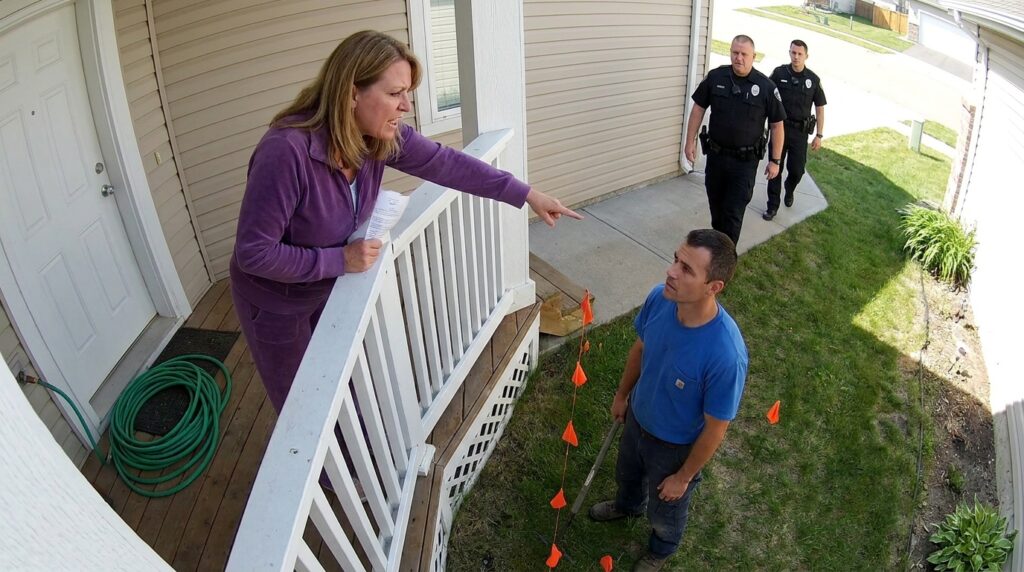
She didn’t come down the steps. The resident stood on the upper landing, her purple tracksuit soaked through and clinging to her gaunt shoulders, her hands gripping the white vinyl railing as it pulled away from the house’s siding. Without her glasses, her eyes were wide, hollow, and completely reflectionless under the gray light of the storm. She looked down at the yellow drill rig, then at Jesse, her mouth opening slightly but no words crossing her lips. The performance of the neighborhood gatekeeper had evaporated, leaving only the cold, unyielding reality of a woman who had spent her entire life living on top of a tomb she had been paid to protect.
“The vouchers were signed by my father-in-law,” she whispered into the rain, her voice small and rattling against the roar of the diesel exhaust. “Every resident on this side of the creek received an association credit. We all signed the non-disclosure addendum on the original deeds. Every single house.”
Jesse didn’t answer. He watched the state environmental wardens move past her porch, their gray slickers glistening as they began to affix heavy, serialized seals to her front door frame. He looked down into his palm, where the broken piece of the county insulator still sat, its blue ink stamp—C-O-U—slowly washing clean under the relentless downpour, revealing the true boundary lines of the subdivision. The task was finished. The line had been cut, the earth had been unburied, and the long, rusted truth of the easement was finally laid bare in the mud.