CHAPTER 4: THE ANCHOR LINE
“You can screen all the calls you want, ma’am, but the router isn’t going to change the property line,” Jesse said. He didn’t look up from the tablet’s glare. His thumb remained hovering over the red-line transmission interface, the data packets struggling against the weak cellular signal bouncing off the neighborhood’s aluminum gutters. The orange flag between his boots flapped once, a crisp, plastic snap that cut through the low, mechanical drone vibrating from the end of the street.
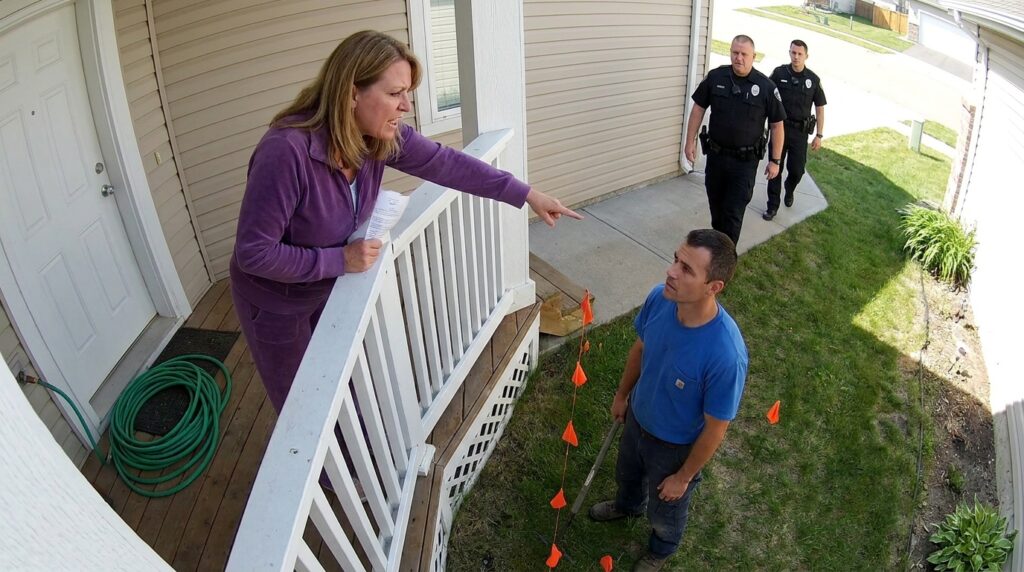
The porch resident didn’t answer with words. She leaned her weight completely onto the white vinyl top rail, the plastic creaking under the sudden leverage of her forearms. The movement was sharp, aggressive, an intentional physical crowding that brought her face within four feet of Jesse’s grease-stained cap. Her thumb was white against the side button of her phone, her knuckles locked.
“You think a plastic badge makes you an inspector, boy?” Her voice was down to a hiss now, dry and hot as the engine room of a scrap-metal baler. She tilted her head, and the amber glare of the afternoon sun slid off her lenses, revealing a spider-web of deep, frantic lines around her eyes that had nothing to do with age. “You don’t touch that line. My husband built this entire block before the county even named this road. You have no idea whose dirt you’re standing in.”
Jesse didn’t give her the reaction she was fishing for. He knelt lower, his fingers sinking into the gritty yellow clay right at the seam where the concrete cap met the rotten vinyl post. The chemical smell was changing, shifting from the sour rot of stale grease to something sharper, like zinc primer and burned wire insulation. The small pool of iridescent fluid had found a narrow fissure in the hard aggregate, bubbling up in tiny, rhythmic bursts every time the distant trenching machine completed a cycle on its drive sprocket.
“I know it’s city dirt, ma’am,” Jesse muttered, his voice dropping into the flat, hollow tone he used for stubborn site bosses. He slipped a small brass calipers from his tool bag, its jaws pitted with gray oxidation, and slid the tips down into the filled silicone hole in the fence post. He didn’t need to look at the scale; his fingers felt the hard, uniform serrations of an unshielded copper core. “And your husband didn’t permit a four-hundred-amp bypass hookup. This isn’t an equalization link. You’ve got an illegal parallel line tapped straight into the primary grid before the residential step-down transformer. That’s why your fence is humming, and that’s why the telemetry map is pulling a dead-zone code.”
“The covenant is closed, Jesse,” she said, her arm jabbing down toward his face, the crumpled sheet of bond paper scraping against the brim of his cap. “The records are private. If your machine cuts that trench, you’re hitting six thousand volts of live lead. You won’t just drop the grid for the cul-de-sac. You’ll burn out your own rig and every circuit on this side of the creek.”
The engine noise from the corner didn’t escalate; it stopped. The sudden absence of the diesel thrum left a heavy, ringing silence over the side yard, broken only by the distant, dry tick-tick-tick of an overhead lawn sprinkler.
Then came the crunch of gravel.
It wasn’t the wide, rubbery slap of a utility truck’s mud flaps. It was the slow, measured roll of high-ply tires moving down the asphalt, followed by the short, authoritative chirp of a standard-issue electronic siren. A clean, black-and-white Ford cruiser drifted into the lane, its roof lights dark but its front bumper angled sharply toward the curb, right where Jesse’s orange marker flags began their line.
Jesse stood up slowly, his knees grinding through the dry fescue. The ash handle of his spade felt heavy against his palm, the iron blade coated in a thick, dark crust of chemical-soaked clay.
The cruiser’s doors didn’t slam; they clicked shut with a heavy, double-latch thud that belonged to official steel. Two men stepped into the heat. The first officer was broad, his black uniform uniform pressed stiff despite the eighty-five-degree humidity, his cropped gray hair glistening with a thin film of sweat under the sun. He didn’t have his hand on his holster, but his thumbs were tucked into his utility belt right beside the heavy plastic casing of his taser. Behind him, a younger deputy followed, his eyes fixed on the white vinyl fence line, his posture loose but watchful.
The porch resident didn’t back away from the railing. She used the height of the steps to keep her chin above the lead officer’s line of sight, her fingers smoothing out the crumpled paper against her purple tracksuit with a frantic, scraping rhythm.
“Officer,” she called out, her voice regaining its sharp, civic cadence before the boots even hit the concrete walkway. “Thank goodness. This sub-contractor is refusing to honor a certified district injunction. He’s actively excavating a private historical plot without a county surveyor present.”
The lead officer stopped right at the boundary line, his boots planting themselves directly on the gray sod between the street and the orange vinyl flags. He didn’t look up at her. His gaze went straight down to the spade in Jesse’s hand, then to the three-inch iron conduit exposed beneath the peeled aggregate. He sniffed the air once, his nostrils flaring as the sour, zinc-and-kerosene odor reached the walkway.
“You Jesse?” the officer asked. His voice was a low, rumbling bass that didn’t carry any anger, just the tired authority of a man who spent his afternoons separating neighbors over six inches of dead hedge.
“Yes, sir,” Jesse said, holding up the cracked tablet. “City sub-contract line forty-two. Running the trunk upgrade. We’ve got an unmapped structural encroachment and a suspected unmetered utility tap inside the easement strip.”
“He’s lying,” the woman snapped from the porch, her arm extended over the rail, her finger pointing straight at the green, bubbling fluid weeping from the post hole. “That’s an old drainage line from the original ninety-two site plan. They’re trying to fabricate a violation so they can clear-cut my privacy hedge.”
The lead officer turned his head slowly, his amber sunglasses catching the reflection of her white vinyl railings. He didn’t look at the paper she was holding out. He looked at the filled post hole, then at the small copper leads wrapped in brittle black tape.
“Ma’am,” the officer said, his voice dropping into a tone that was completely dead of empathy. “Step back from the railing and let us handle this.”