CHAPTER 2: THE SHADOW ON THE SOD
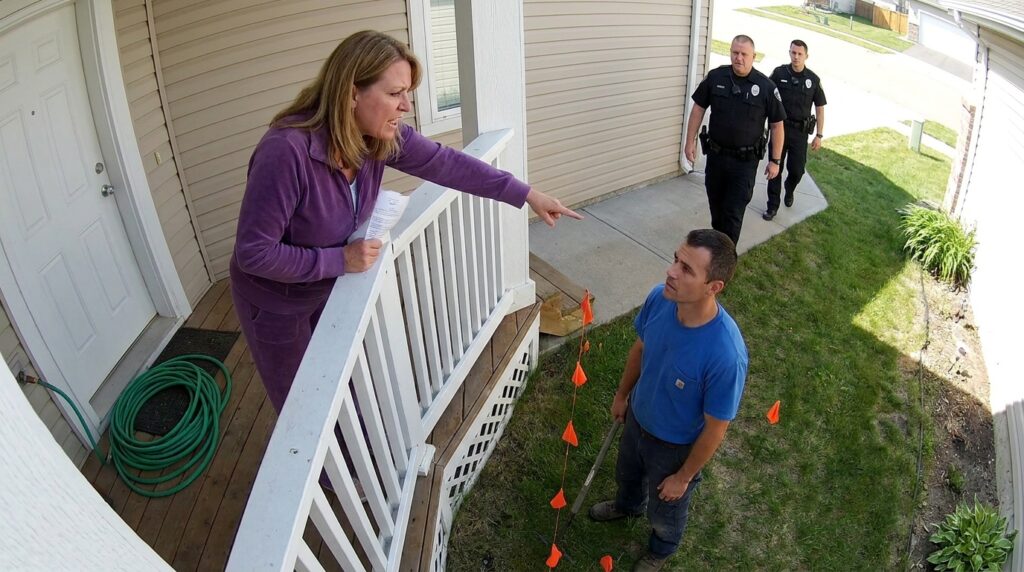
“Section Fourteen, Paragraph B of the county code doesn’t apply to municipal service mains, ma’am,” Jesse said. He didn’t lift his fingers from the fiberglass shaft of the second stake. The orange vinyl ribbon hissed as a hot breeze swept off the asphalt of the cul-de-sac. “You’re reading the residential setback. This is a Class-Three utility corridor. The city owns forty-eight inches from the curb inward, regardless of who paid for the sod.”
The woman behind the white vinyl railing didn’t blink. Through the dark, amber-tinted distortion of her oversized lenses, Jesse could only see the reflection of his own dust-streaked blue T-shirt and the bright, unnatural glare of the marking flags. The copy paper in her hand didn’t tremble. It was heavy bond paper, the kind small-town lawyers used for cease-and-desist notices that had more bluster than black letter law.
“This subdivision has a private maintenance covenant, young man,” she said, her voice dropping into a rhythmic, practiced chill. She tapped her polished acrylic nail against the vinyl top rail, right above the post with the silicone-filled puncture. “The county ceded governance of the greenways to the association in ninety-two. Your ‘Class-Three corridor’ was vacated before you were old enough to hold that shovel.”
Jesse adjusted his grip on the handle. The heat from the iron underground was a myth, but his palms felt slick inside his gloves. He looked past her tracksuit, toward the clean foundation line of the split-level. The concrete was poured thick, coated in gray waterproofing sealant that had begun to flake off near the dirt line like old skin. There was no exterior meter box on this side of the building. In fact, the main service conduit entered the structure forty feet to the west, near the garage.
Yet, the digital transit map on his cracked tablet showed a four-hundred-amp draw pulsing right under the patch of parched fescue where his boot was planted.
“The county doesn’t vacate fiber loops,” Jesse muttered, more to the map than to her. He reached down and unhooked the brass-tipped probing rod from his belt. The metal was pitted, rusted near the collar where the sweat from his hip had eaten through the chrome. “If I don’t drop the flags, the trenching crew brings the ditch-witch through here at six a.m. tomorrow. If they hit a line because I didn’t mark the variance, the sub-contractor pays the fine. Not the county. Not your association.”
“Then I suggest you call your supervisor,” she replied. She took one slow step down the porch stairs, her white sneakers sinking half an inch into the perfectly manicured, chemical-burned grass. The paper notice was lowered now, held flat against her thigh like a weapon kept out of sight until the distance closed. “Because if that machine touches this curb, I have an emergency injunction locked in a file at the municipal district office. I know exactly who signs your checks, Jesse.”
He caught his name on her tongue and felt a hard knot tighten beneath his ribs. He hadn’t introduced himself. His name tag was a faded strip of plastic velcro pinned to his vest, half-covered by the strap of his canvas tool bag. She hadn’t just looked at his badge; she had been waiting for the blue truck to turn into the lane.
Jesse knelt on one knee, the dry clay cracking under the weight of his work pants. He drove the probing rod into the sod, three inches to the left of the filled silicone hole in the fence post. The steel slid through the soft top-dress, then struck the same dull, metallic shelf he’d hit with the stake. It wasn’t stone. It had the slight, ringing resonance of hollow cast iron buried deep under the roots.
“You have a gray-water line out here?” Jesse asked, keeping his eyes on the turf.
The silence from the steps lasted two seconds too long. The rhythmic tapping of her nail against the vinyl rail stopped. When he looked up, she hadn’t moved, but her head had tilted slightly, the amber lenses catching the full, blinding reflection of the mid-day sun, obscuring her eyes completely.
“The utility maps are old, Jesse,” she said, her tone stripping away the bureaucratic formality, leaving something sharper, like the edge of a rusty trowel. “Sometimes it’s better to leave the old lines in the dark.”
Jesse didn’t answer. He turned the probing rod ninety degrees, scraping the tip against the buried iron structure beneath the sod. The digital display on his tool belt hummed, the low-frequency inductive sensor picking up a strange, irregular magnetic field that didn’t match the clean, alternating current of a city main. It was jagged. Erratic. It felt like something heavy was turning over down there, deep beneath the dry roots of Lot 42, entirely independent of the grid.
From three blocks away, the low, metallic rattle of a heavy diesel engine started up, the sound traveling through the heat-thinned air of the subdivision. The excavation crew was testing the hydraulics on the trenching rig.
Jesse stood up, pulling the rusted rod from the earth with a wet suck of clay. “The city doesn’t leave lines in the dark when they’re running three thousand volts of commercial trunk line through the ditch, ma’am. If you’ve got an unmapped structure behind this fence, you need to show me the variance papers now.”
She didn’t retreat. She reached into the pocket of her tracksuit, her fingers wrapping around a small, matte-black cellular phone. “I don’t show papers to the help,” she said quietly. “I call the marshal.”
Jesse looked down at the hole he’d made. A tiny bead of dark, iridescent moisture was bubbling up through the puncture in the clay, smelling faintly of old kerosene and vinegar. It didn’t look like city water. He reached for his tablet to log the fluid variance, but before his thumb could clear the screen, the shadow of her arm fell across his display as she pointed the phone toward the street.