Chapter 1: The Person Holding the Bucket
“You stood there watching me do this, and now you want to blame me?”
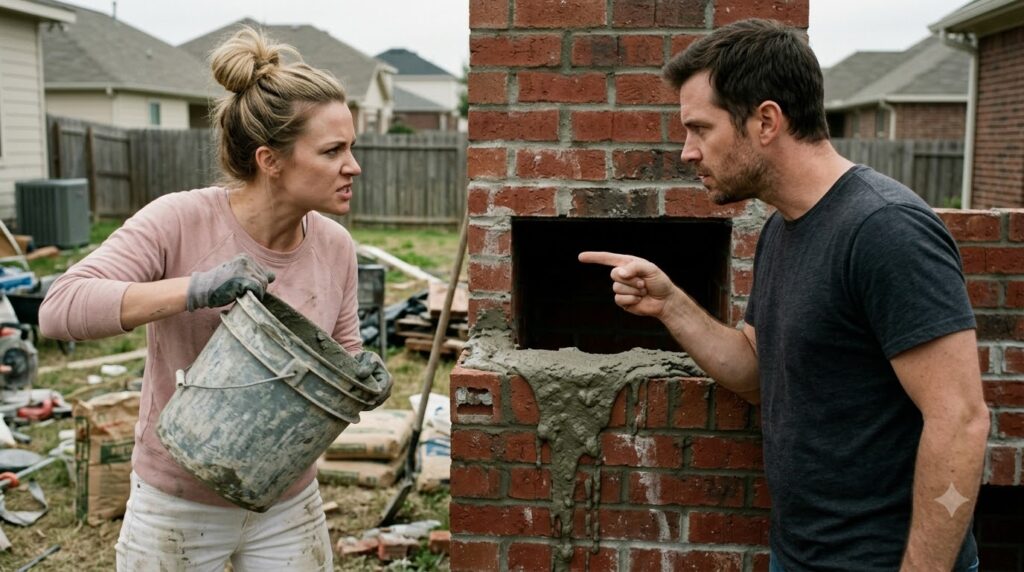
Emily Carter jerked the gray bucket backward as thick, wet cement slopped over the edge of the unfinished brick cavity and streamed down the red bricks. She stared at the spill, then turned toward Mark, who had just stepped into view with a disapproving look on his face.
“Look at the mess!” he said, pointing at the brickwork. “You’re the one holding the bucket!”
Emily tightened her gloved hands around the handle. For a moment, she looked as though she might answer with something sharper than either of them could take back. Instead, she glanced down at the cement dripping toward the ground and drew a measured breath.
“Funny how everyone blames the worker, never the person who just watches!”
Mark’s pointing hand slowly lowered.
The backyard fell quiet except for the ordinary sounds of the neighborhood and the faint scrape of the bucket as Emily set it beside the unfinished structure. The cement continued to creep down the brick face, making the mistake impossible to ignore.
Emily did not deny what had happened. She had been pouring the cement, and some of it had spilled. The bucket had been heavy, the opening awkward to reach, and the flow had become difficult to control. Whatever the precise cause, she had not managed to stop the overflow.
But Mark’s accusation bothered her for a reason that had very little to do with the cement.
He had arrived at the moment of failure, pointed at the result, and treated the person doing the work as though that settled every question about responsibility.
He had not asked what happened. He had not asked whether she needed help. He had simply decided that the person holding the bucket was the person at fault.
Emily had spent much of the day working on the unfinished brick structure in their backyard. The project was supposed to be a practical improvement to the property, something that would eventually provide a useful outdoor workspace. They had discussed the materials and the work involved, and Emily had taken on the physical tasks that needed doing.
Mark, meanwhile, had developed a habit of commenting on the project from the sidelines.
He had opinions about the work. He could point out what looked uneven, question the way materials were being used, and explain how he thought a particular task ought to be done. Sometimes his suggestions were worth considering. Other times, they came after Emily had already begun a task and had no practical value beyond making her feel as though she were being examined.
She had tried not to make too much of it.
A shared project did not require both people to perform every task equally. One person might have more time for physical work, while the other handled planning or supplies. Emily had been willing to accept different contributions.
What she found increasingly difficult to accept was the difference between offering help and offering criticism.
Now she was standing beside a visible mistake, and Mark appeared more interested in identifying the person responsible than in dealing with the problem.
“If you want to know what happened,” she said, “ask me. If you want to fix it, get something we can use to clean it up.”
Mark glanced at the cement. “I’m just saying somebody has to be responsible.”
“Yes,” Emily replied. “Somebody does.”
She waited.
He looked at the wall, then toward the house. His expression remained defensive, but the certainty in his voice had begun to fade.
Emily picked up the bucket handle without lifting it. The remaining cement was still usable, at least potentially, and the spill needed attention before it hardened. She knew that. She also knew that standing there arguing would not improve the wall.
She could clean the bricks herself and continue working. That would be the fastest way to get the immediate task under control.
But it would also allow the afternoon to proceed exactly as it had so many times before: she would do the work, absorb the frustration, and finish the job while Mark retained the freedom to criticize whatever had gone wrong.
For the first time that day, Emily recognized that the decision in front of her was not simply whether to continue pouring cement.
It was whether she would keep accepting responsibility for every part of a shared project while Mark reserved the right to judge the outcome from a safe distance.
She released the bucket handle.
“I’m not asking you to pretend the spill didn’t happen,” she said. “I’m asking you to stop acting like you know why it happened before you’ve even asked.”
Mark folded his arms.
“I saw what happened.”
“No,” Emily said. “You saw the result.”
He opened his mouth, then stopped.
She turned back to the bricks. There was no reason to make the damage worse merely to prove a point. But before she picked up another tool, she wanted an answer to one practical question.
“Are you going to help me clean this up, or are you going to stand there and tell me what I did wrong?”
Mark looked down at the cement.
For the first time, the question left him with a choice that could not be answered by pointing at someone else.