Chapter 1: The Chain Around Their Medicine
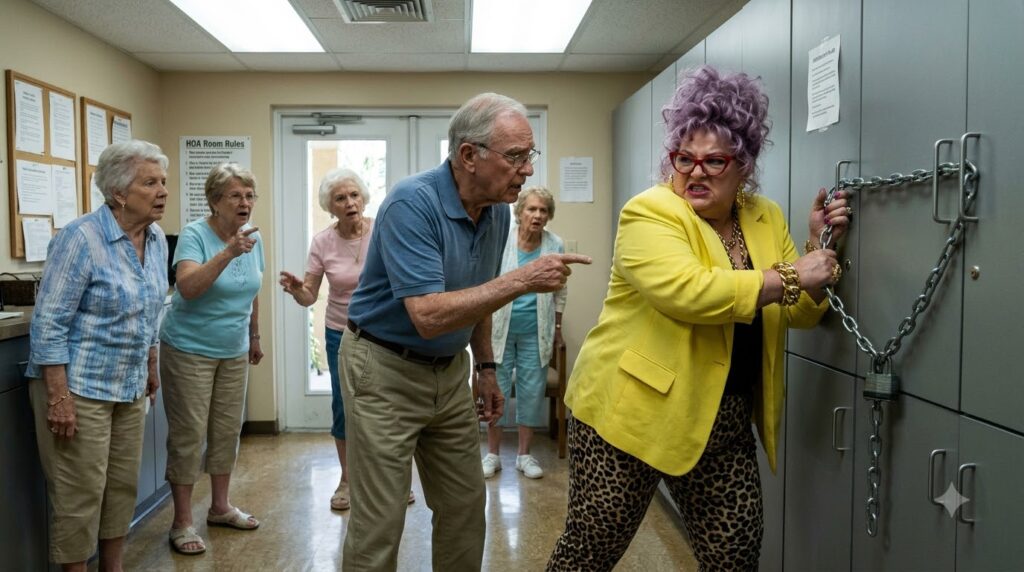
The steel chain scraped across six medication cabinets with a noise that made everyone in the room turn.
Margaret Whitcomb pulled it tighter.
At sixty-two, Margaret was the most feared woman in the Seabreeze Palms condominium community in Clearwater, Florida. She was also its homeowners association president, a position she had held for nearly seven years.
She was impossible to overlook. Her enormous frame filled the narrow aisle between the cabinets and the storage counter. Towering purple curls rose above oversized red glasses, while a lemon-yellow blazer and leopard-print pants made her look like a walking warning sign. Thick gold bracelets rattled against her wrists as she worked.
But nothing about her appearance was as intimidating as the authority she believed she possessed.
With one final jerk, she threaded the chain through the last cabinet handle.
Then she snapped a heavy padlock shut.
CLANG.
“Nobody gets medicine until they pay!”
Her shrill voice bounced off the beige walls.
For a moment, nobody moved.
Then seventy-six-year-old Walter Bennett stepped forward.
Walter was a retired postal supervisor who had lived at Seabreeze Palms for eleven years. His faded blue polo shirt hung loosely over his shoulders, and his hands trembled slightly as he reached toward Cabinet Four.
Inside were his prescribed heart medications, carefully organized in a labeled container. His doctor had recently adjusted his treatment, and Walter had been instructed not to miss his scheduled doses.
He pulled the cabinet handle.
The chain rattled.
The door didn’t move.
“You can’t hold our medicine hostage!”
Margaret swung toward him.
“Watch me!”
Three elderly residents stood near the doorway, horrified.
Evelyn Parker, eighty-one, pressed a hand against her chest. Harold Jenkins, a retired electrician, stared at the padlock. Beside him, seventy-three-year-old Rose Delgado gripped her walker.
All three had medications inside the cabinets.
The room had originally been established as a convenience for residents whose apartments became excessively warm during Florida summers. Each cabinet was individually rented, and the storage room was temperature-controlled.
For years, residents had accessed their cabinets using personal keys.
Until Margaret decided the room could become another weapon in her campaign to collect disputed HOA fees.
Walter tried the handle again.
Margaret stepped closer.
“You’re behind on your special assessment, Bennett. You don’t get privileges until you pay what you owe.”
Walter looked at her in disbelief.
The assessment was $1,850 per condominium.
Margaret claimed the money was needed for urgent building improvements, but residents had been requesting supporting invoices for months.
Walter had paid his regular association dues. He had withheld the special assessment while requesting documentation, along with several other homeowners.
Now Margaret was punishing them.
She seized the chain to demonstrate how securely she had locked the cabinets.
Her oversized gold bracelet slipped into a loose section near the padlock.
Margaret didn’t notice.
She yanked the chain backward.
The loose section tightened around the bracelet, pinning her wrist against a cabinet handle.
She tried stepping away.
Her arm remained trapped.
For the first time that morning, Margaret’s expression changed from triumph to alarm.
She pulled harder.
The cabinets shook.
“Get this chain off me!”
Her scream was so loud that Rose flinched.
Walter stared at the trapped bracelet.
Then he looked at the padlock.
“Where’s the key?”
Margaret’s face reddened.
“That’s none of your business!”
Walter glanced at the other residents.
“Then I suppose we’re all staying right here.”
Margaret twisted her wrist, but the bracelet remained caught. The more she struggled, the more painfully it pressed against her skin.
Harold moved toward the door.
“I’m calling the property manager.”
Margaret immediately stopped pulling.
“Don’t you dare!”
But Harold had already taken out his phone.
Within minutes, the hallway outside the storage room began filling with concerned neighbors.
Walter remained beside his locked cabinet, watching Margaret struggle against the very chain she had installed.
He didn’t laugh.
There was nothing funny about a seventy-six-year-old man being denied access to his heart medication.
Instead, he checked his watch.
His next dose was due soon.
And Margaret still refused to surrender the key.
What Walter didn’t know was that the chain was only the first visible piece of a much larger scheme.